
Although the Trump provocations are a unique situation for the Royal Canadian Air Force to find itself dealing with, the long-delayed decision on what the replacement for our current CF-18 fleet can’t be realistically put off for much longer. The government has committed to paying for the first 16 aircraft of an 88-plane order, but many pundits are crying out for the government to cancel the remaining portion of the order and instead purchase different aircraft … the leading contender being the Swedish Gripen. This might be the worst of all worlds for the RCAF, in needing to support two different airframes with zero parts compatibility. This two-fleet “solution” would make life much more difficult for RCAF training and logistics, but it’d be a performative eLbOwS uP to Trump, so there’s a strong chance it’ll happen despite military and economic reality. Bryan Moir makes the argument for the Gripen on his Substack:
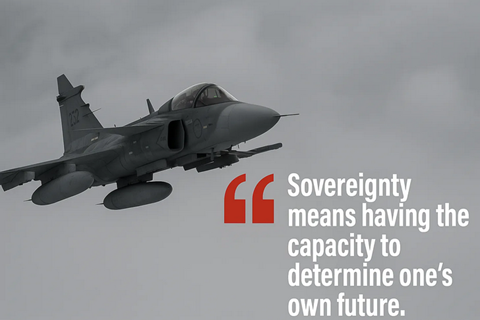
Mark Carney loves the big phrases. “Build Canada strong.” “Rewire the economy.” “Generational investments.”
It’s good branding. But slogans don’t build nations — decisions do. And right now, one decision matters more than the rest:
Will Canada assemble the Saab Gripen fighter on Canadian soil — or will we lock ourselves into permanent military dependence through the F-35?
Let’s start with the truth no one in Ottawa wants to say out loud.
The F-35 is a 56% aircraft in a 100% environment.
The F-35 fleet’s mission-capable rate sits at 55–56%. That means a country buying 16 aircraft can expect maybe eight airborne on a good day. Eight jets to defend the Northwest Passage, the Arctic archipelago, and a coastline longer than Russia’s.
This isn’t speculation; it’s physics, logistics, and accounting.
Meanwhile, the United States fields 54 F-35s at Eielson AFB in Alaska — backed by billions in supporting infrastructure: software hubs, spares depots, rapid part cycling, and multiple layers of maintenance and training.
They can sustain the F-35 in the Arctic.
Canada cannot.
And pretending that we can — or worse, pretending that it doesn’t matter — is not national defence. It’s denial.
Gripen was designed for the world Canada actually lives in.
Gripen’s core design features are the ones Canada pretends the F-35 also has:
- Cold-weather resilience
- Short runway and road-base operations
- Minimal crew requirements
- Quick turnarounds
- Low maintenance footprint
- Sovereign sustainment
Gripen isn’t just compatible with Canada.
It was built for countries whose geography forces them to be independent.



I served in the Forces for a bunch of years, mostly Air Force. What most people don’t realize is that we are down in manpower to a point where we can do one multi-role aircraft. (We were at that point when I retired 10 years ago, and it hasn’t gotten any better) The people who evaluated the different aircraft were the experts, and the choice had more to do with capability than price. This USA hate is deranged. I just don’t get it, but then my politics don’t define me, so I don’t hate people based on politics or politicians. I also don’t make short sighted decisions based on politicians. At any rate I found the info below a rational argument why Canada needs to just continue with its purchase of the F-35.
This is pulled from The Pilot Project Podcast on Facebook:
There has been a lot of public debate in Canada on the F-35 vs the Gripen, and what is right for us. We reached out to a retired RCAF fighter pilot who was one of the original CF-188 Hornet pilots and is familiar with bringing on board a new generation of fighter technology, the challenges it brings, and what the job demands of us. Here is his ‘2 cents’:
Hi Bryan. Thanks for reaching out. I generally shy away from public discussions about this because most people are not reasonable, and there is a lot of divisive information out there. First principle: just like when you buy a car or a house, the most important criteria include whether or not the big-ticket item is suitable for your needs. Figuring out who builds the car, etc, is a secondary consideration – but in the case of a car or a house, it is true that most manufacturers can make an acceptable product that will meet one’s needs. In those cases, Buy Canadian or other considerations can be the deciding factor. That’s why most Canadians who do not understand fighter operations are on the ‘buy the Gripen and screw the USA’ bandwagon. The problem is that fighter jets are not that simple, and in today’s threat environment, there is truly only ONE suitable machine – the F-35. Gripen E is a tiny upgrade over the CF-18, and if you asked me to fight one with a current Hornet, I’d go into battle quite confident that I could beat a Gripen. It’s just not a contender in the near future, where the threat will be far more difficult to counter. For NORAD, if cost were not an object, probably the best jet is the F-22 (not an option of course), with the F-35 and F-15EX close behind. Interoperability within NORAD is even more crucial than NATO, since we have a common command structure and jets from either country can seamlessly take over from each other. Having common datalinks and secure comms is essential. Would the USA allow Gripen to be equipped with sensitive CANUS eyes-only equipment like Mode 4 and secure datalinks? Unlikely. NATO is full of F-35s. Gripens are the exception, and in small numbers. From a pure interoperability standpoint, the F-35 is king. Parts availability, for example. When we deployed to Aviano to bomb Kosovo, and when we were in the Gulf, parts were always a concern. In Doha, we relied on some USN/USMC parts, which thankfully were available from Bahrain where the USMC had 98 Hornets. In Aviano, we were the only fleet operating the Hornet, while others had F-16s and could share parts when needed. Just a small example of why you don’t want to be the organisation that operates a unique fleet. Our own supply is woefully inadequate when it comes to stocking and distributing parts (how many hangar queens have you seen?).
Next consideration: combat effectiveness. The F-35 can sneak in, detect, target, shoot, and disappear, all without being seen. Adversaries are sitting ducks, like prize fighters blindfolded who are being shot with arrows in the dark by NVG-equipped archers. It is not a fair fight when going up against a stealthy adversary. Beyond that, there is the data and sensor fusion aspect. You’ve seen how important it is in the back of an Aurora to have information from multiple sources available and expertly interpreted. The ‘fog of war’ is accentuated when you’re by yourself in a cockpit (or even a crew of two) and you have to rely on radios and/or datalink. The way in which the F-35 shares and uses information securely and jam-resistant is a total game-changer. Flying in a 2 or 4-plane combat formation with Hornets, visual mutual support is key, since comms and datalink are not enough to detect and defend against threats. By using superior sensor fusion and datalinks, F-35s are able to operate autonomously, or use uninhabited wingmen, to cover more airspace and be more effective than pairs or quads of 4th-gen fighters. Having flown many NORAD night air defence exercises with jamming of comms and radar, I can tell you that it’s nearly impossible to counter a sophisticated threat. Having the ‘answer key’ available on your ownship displays makes separating spoofing, friendly, and hostile contacts a piece of cake.
Final consideration, Canadian industry. During the early days of the JSF, I recall attending trade shows and seeing Lockheed Martin conduct information sessions for potential suppliers. I saw many Canadian aerospace companies attending these, and as a founding member of the JSF program, we were able to snag many contracts. Canadian companies like Heroux-Devtek, L-3 MAS, etc, have already been making parts or supporting maintenance for years, and would do so for 30 or 40 years to come. An acquisition of Gripens would involve a small bubble of workers to build factories and jets, then some maintenance work for a small fleet for some decades until Canada realized that the Gripen was not a front-line capable aircraft and retired it in favour of a 6th-gen aircraft. Meanwhile, the scale of implication in F-35 global supply chains by Canadian companies would be reduced due to our tiny F-35 fleet size. The idea of buying Gripens is a non-starter to me. Inferior jet. The only reason it was considered is because the government biased the selection criteria to boost the percentage of scoring for industrial offsets, and used a narrow definition of those to allow Gripen to score better than F-35 – but Gripen lost out big-time in operational effectiveness to the far-superior F-35. Let’s not allow economics to dictate the kit our airmen need to defend Canada and win future wars. My two cents, anyway. I’ve worked in the CF-18 software business as a group leader, and saw first-hand the complexity involved in making small improvements to it. The global effort to update and improve F-35s is massive, and a small Gripen fleet would be very limited as to what it could do to remain partially relevant, compared to a huge workforce deploying complex software across a fleet of thousands of NATO allies.
Comment by Dwayne — November 26, 2025 @ 23:36