
On the social media site formerly known as Twitter, Fortissax responds to a recent article published in the National Post, where Geoff Russ describes Liberal nationalism as “a cringey failure” and calls for young members of the “new right” to work toward a new idea of Canada:
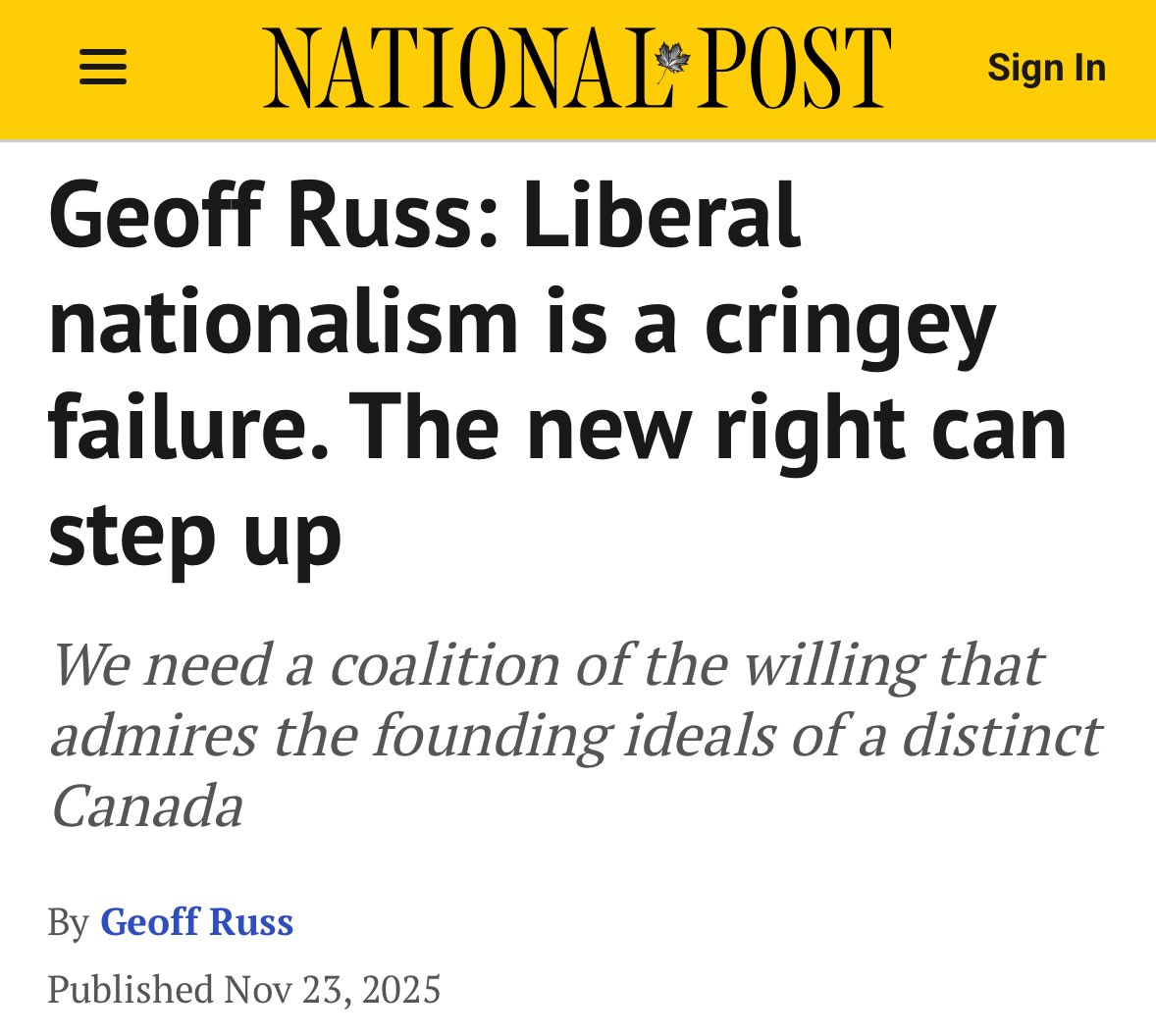
Geoff Russ’ specific claim that “millions of old stock Canadians cheered for it” is wrong. He takes a decades-long elite project, driven over the heads of the public, and pins it on the very people it was done to.
There was never a clear democratic moment when ethnic Canadians calmly voted to abolish old Canada and embrace a postnational, multicultural order. What happened was a long campaign run from the top.
After 1945, cabinet ministers, mandarins and policy people rebuilt Canadian identity around liberal internationalism and continental integration. The older understanding of Canada as a British and French country with its own civilisation was treated as something shameful to be buried. Schools, television, churches, courts, universities and the federal bureaucracy repeated the same script: “progress” meant loosening ties to the founding peoples and aligning with UN norms and North American liberal opinion.
This was not some anonymous drift. C.D. Howe and the postwar planners normalised a centralised, technocratic state tied to American capital. Mackenzie King and Louis St Laurent locked in continental and institutional commitments that weakened any independent British and French national idea. Jack Pickersgill used immigration as a tool of social engineering and admitted that public opinion was hostile, so policy had to move quietly from above.
Lester Pearson chaired the Biculturalism Commission while preparing the shift from “two founding races” to a vague multicultural formula, and his government set up the flag change that deliberately severed visual continuity with the old country.
Pierre Trudeau went further, announcing in 1971 that Canada would have no official culture and that no ethnic group would take precedence, which was a polite way of saying the historic British and French peoples would be stripped of formal primacy in their own state.
The public did not demand this. It had to be dragged and managed. Gallup and other polling in the postwar decades consistently showed majorities hostile to high immigration levels. The 1974 Green Paper and the extensive public hearings that followed produced sharp criticism of mass intake and of the cultural and economic disruption it would bring.
Ottawa thanked everyone for their input and then moved ahead with the 1976 Immigration Act, which entrenched a liberal, permanent immigration framework anyway. When Canadians were finally asked, they said no. Their answer was ignored.
At the same time, ordinary people lost any real leverage over core questions. Immigration policy was transformed without a referendum. Official multiculturalism was declared from above. The Charter and rights culture shifted effective authority from Parliament and local communities into the hands of courts and legal elites.
The flag changed, and symbols and curricula that reflected old Canada were rewritten or stripped away. Any attempt to defend the historic nation was smeared as crankish or hateful. To take this history and summarise it as “millions of old stock Canadians cheered for it” is like blaming a tenant for “choosing” demolition because he did not throw himself under the bulldozer.
The message is that old stock Canadians must now live with this order forever; that their own elites may have driven the revolution, but the public did not resist hard enough, so dispossession is deserved; and that any attempt by the founding peoples to assert a legitimate claim to continuity in their own country is some kind of moral offence.


