
I don’t know anyone who likes the twice-a-year exercise of resetting all the various clocks in the house, but we still end up doing it (I almost said “like clockwork”). Here in Ontario, we have a law on the books that allows us to dispense with the practice as soon as our immediate neighbours do (Quebec, Manitoba, New York, Michigan and Minnesota … not sure if Pennsylvania and Ohio are included). Mark Naylor says the pressure to get rid of it is certainly building in Europe:
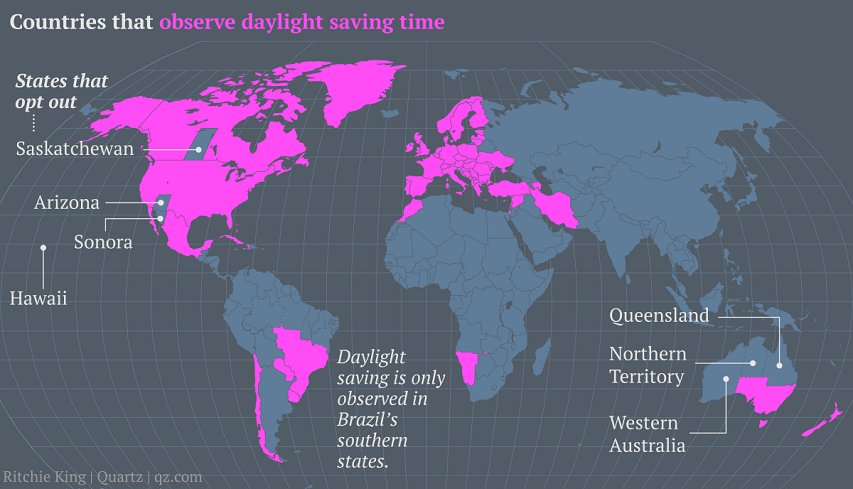
Graphic originally from Quartz, 2013.
The debate about Daylight Saving Time (DST) has reignited in both Europe and the United States. Spain’s Socialist prime minister Pedro Sánchez is lobbying the EU to put an end to the bi-annual clock change, although he hasn’t stated whether he favors permanent summer (DST) or winter time (also referred to as Standard Time/ST) — which means more light in the evening or morning, respectively. It is a rare point of agreement between the Spanish premier and Donald Trump, who also wants to scrap the clock change, in his case to make summer time permanent.
Both leaders seem to have the public on their side. In a 2018 survey of 4.6 million European citizens, 84% favored abolishing the twice-yearly time changes (in Spain, that figure rose to 93%). A recent poll in the US found that just 12% are in favor of retaining the status quo; 47% are opposed to DST (including 27% who are “strongly opposed”), while 40% are neutral. Legislation passed in 1966 enabled individual states to choose whether or not to implement the practice; today, the only states that don’t are Arizona and Hawaii.
[…]
Sánchez has a strong case. Studies in the US and Europe have shown that the energy saved by DST is negligible. In the 1970s, the US Department of Transportation found that changing the clocks reduced the nation’s electricity consumption by just 1%. A report on Slovakia’s energy usage between 2010 and 2017 put that figure at 0.8%. In Indiana, which switched to DST in 2006, researchers found that the practice led to a 1% increase in consumption, as households used more power for air conditioning on summer evenings and heating on late fall and early spring mornings.
Studies have also linked clock-changing to an increased risk of mood disorders, heart attacks, strokes, and traffic accidents—all a result of the disruption caused to our internal circadian rhythms. “Left to themselves,” says David Ray, a professor of endocrinology at Oxford University, “[these] naturally align with the light–dark cycle, so the only problem comes when you start arbitrarily defining time based on a clock.” A new study by scientists at Stanford University has found that adopting permanent ST, or winter time, would be the best way for us to align with the sun’s cycle, preventing 300,000 strokes a year and resulting in 2.6 million fewer people with obesity.
Trump, meanwhile, has flagged the economic case against bi-annual clock changes. In April, he wrote on Truth Social that the idea of switching to permanent summer time is “Very popular and, most importantly, [there would be] no more changing of the clocks, a big inconvenience and, for our government, A VERY COSTLY EVENT!”


