
Spaceman Spiff explains how aspirational schemes proposed by our technocratic governments at all levels seem to quickly and effortlessly shift from a nice non-intrusive improvement in life to an overbearing imposition of ever tighter controls on our lives:
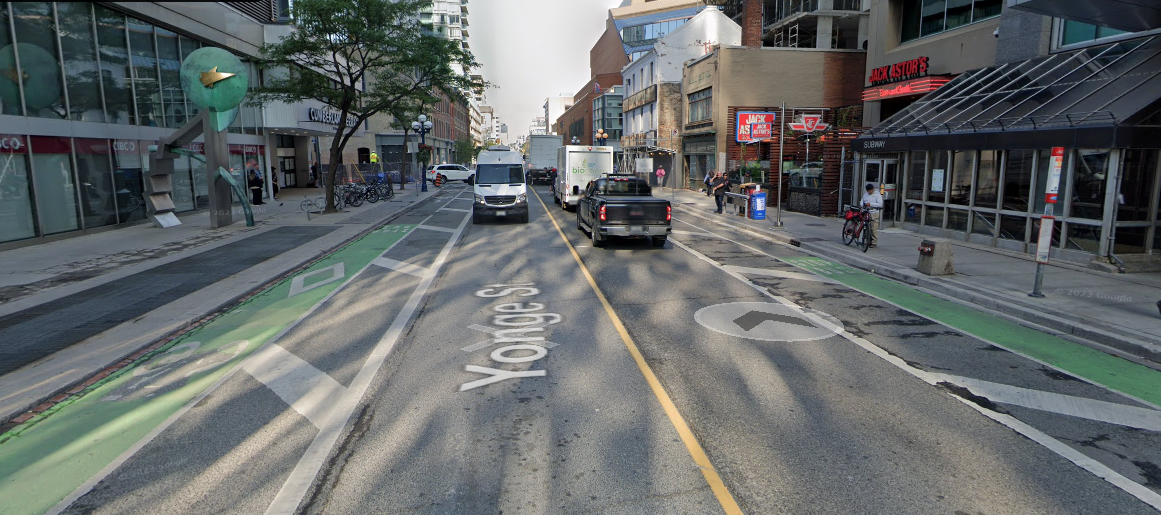
Bike lanes on Yonge Street north of Bloor Street in downtown Toronto.
Image from Google Street View
The adoption of cultural novelties follows a predictable path. Some bright idea is proposed and there is nominal support or at least not widespread opposition.
Soon after implementation begins its opposite is condemned. This is the first warning the lunatics have taken over the asylum. We move from a positive, optimistic drive to condemning a perceived negative. By then the intolerant are amassing, attracted to a secular pulpit with which to lecture the rest of us.
More time passes and condemnation of the opposite is not enough. We are commanded to behave in ways more pleasing to our public servants. We learn a key aspect of our future has been decided by a shadowy committee we have never heard of. A well-meaning experiment has become an imperative used to control us.
This absurd sequence is more common than it should be.
A common example in Britain is the creation of bike lanes.
The idea sounds benign. Let’s build cycle lanes to encourage exercise. It is broadly popular, a kind of inoffensive fad to encourage better health despite the weather being an impediment for most.
Few people actively object which is taken to mean they endorse these projects.
It is not long before support for helping cyclists degenerates into discouraging cars since people should be cycling more anyway. The initiative lends moral weight to an otherwise fringe view. The construction of the bike lanes accelerates these ideas as roads are narrowed and traffic slows, frustrating many. There are too many vehicles on the road we are told, all the more reason to get on your bike.
Soon suggestions are made to ban cars completely. The new idea proposed is to shut down the congested roads and replace them with even more bike lanes and pedestrian zones.
Some even openly discuss intentionally making driving awkward and expensive as an explicit goal. The technocratic mind often forgets its charges are people not slaves.
Before long everything shifts, then we wonder how we got to the point our own paid employees can openly gloat we will soon be banned from travelling in ways they dislike as if they are our controllers.
An idea appealing to a minority is imposed on all. Acquiescence to novelties becomes weaponized and subsumed into the ambitions of others. No one ever votes for these things. They seem to just appear.
The end result is often the destruction of goodwill as popular initiatives are rammed down our throats and used to berate us for failing to live up to the standards our public servants impose upon us.
We then tire of the lectures. We wonder where these lunatics come from.
A moment of complacency means unwanted bike lanes but before long it is banned cars, government-controlled IDs and digital currencies. Those who pay attention to the activist world often sense they’d build concentration camps if they could get away with it and all thanks to some benign-sounding scheme we didn’t object to.


