
Ian at The Bugscuffle Gazette provides a useful thumbnail history of modern-day Somalia and how this impacts Minneapolis, Minnesota:
In Africa national borders — and thus nations — are matters of political convenience, if not flat-out arbitrary. Only newbies to Africa even think about nationality, old hands know that tribal affiliation trumps all.
I had forgotten that.
In Somalia the borders were drawn in the late 19th century by Great Britain1 and Italy2. Make a mental note of that in case it comes up in a trivia contest somewhere, but understand that tribes and clans in that misbegotten part of the world are far more important than lines drawn on a map by 19th century British and Italian diplomats.
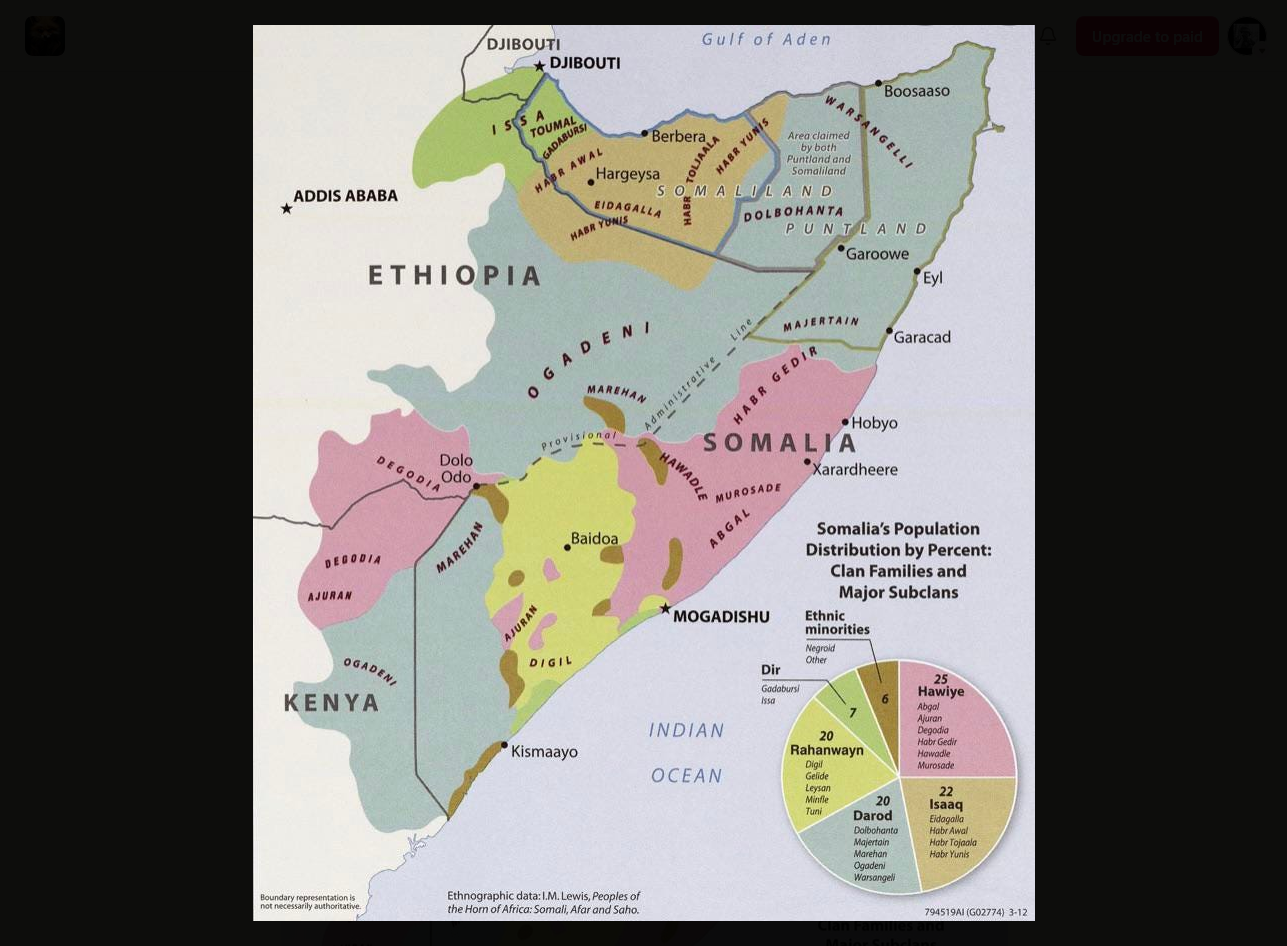
As a “for instance” let us take a look at a couple of these clans: The Daarood and the Hawiye.
The patriarch of the Daarood showed up in East Africa in the 10th Century3, and founded a clan that has become one of the largest in East Africa, and the second4 largest of the Somali clans actually in Somalia. They were the clan ruling Somalia when folks rebelled and kicked off the Somalian Civil War.5 Their current turf is sort of hourglass-shaped, with a chunk in northern Somalia, and another chunk in southern Somalia.
The Hawiye showed up in the 12th Century6, and have become the largest clan in Somalia. Their turf in Somalia is a chunk of seaside property starting at Mogadishu7 and heading north.
Yes, I know it says “Darod”. It’s properly “Daarood”.
In 1969, a Daarood bugsnipe name of Mohammed Siad Barre found hisself as HMFIC of Somalia following a bloodless8 coup-d’etat, but a whole bunch of folks Had Thoughts regarding his ascension9, and Somalia was pretty much in a constant state of rebellion from 1978 to 1991, when the full-scale Somali Civil War kicked off.
Okay, great. Fascinating even … so what does this have to do with Minneapolis of all places?
In the aftermath of that little dust-up, we imported a lot of Somali refugees. And since the clan most in need of refugee-ing was the Daaroods, we brought in a lot of Daaroods, and — being clannish — they consolidated in a clan-like fashion in Minnesota.
As a “for instance”, Ilhan Abdullahi Omar, the U.S. Representative for the 5th District of Minnesota, is a Daarood.
Things were trundling along the way they always do10 — except we’ve since imported another wave of Somalis … and these aren’t Daaroods. Any guesses as to clan affiliation? Yes! They’re Hawiye.
So. A second-generation dacoit of Daarood descent name of Omar Fateh decides he wants to run Minneapolis as warlord mayor, and he’s got the backing of his clan-mate Ihlan Omar — he’s a shoo-in!
Except a whole bunch of Hawiye in Minneapolis went, “Sod that for a game of soldiers”, and voted for the white guy.
Yay, tribal loyalty! Brings a tear to my eye, it does.
Which is all well and good11, but Omar Fateh, Ihlan Omar, and a whole bunch of Daaroods in Minnesota are capital “P” Pissed, capital “O” Off about the whole thing.
I know full well and certain how … spicy … tribal conflicts can get — and you couldn’t pay me enough to live in Minneapolis for the next few years.
- British Somaliland — actually a protectorate — starting in 1884, Crown Colony starting in 1920, self-governance in 1960.
- Italian Somaliland starting in 1884, then the Italians made the mistake of picking the wrong side during WW2, Brits took over in 1941, passed it off to the UN (whee) in 1950 (with the Italians mucking about), and formally united with British Somaliland in 1960 to form present-day Somalia.
- Maybe 11th — we’re not real sure.
- Or third, depending on whom you ask.
- This is important.
- Damned newcomers.
- We’re getting there.
- Hah! The assassination of the previous boss was insanely thorough.
- The fact that he styled himself “Victorious Leader” and loved himself some Marxism probably didn’t help.
- “Send lawyers, guns, and money …”
- For certain values of “well”, and certain values of “good”.


