Lorenzo Warby provides a bit of hopeful news that despite the ever-expanding march of feminization through our various organizations and institutions, the culture is displaying strong resistance and effective:
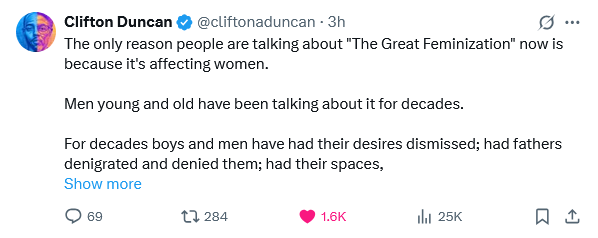
Western culture is not feminising. How can I tell? The travails of Disney. Disney spent billions buying male-centric franchises — Star Wars, the Marvel Cinematic Universe, Indiana Jones … It then proceeded to so alienate the fan bases of those franchises that it is now reduced to openly discussing how to appeal to male audiences that it spent billions acquiring and further billions alienating.
If Western culture was feminising, then Disney should have had no trouble with its feminised products. Clearly, it has had problems. Meanwhile, the Top Gun: Maverick sequel to a 1986 movie can do excellent box office ($1.5bn) precisely because it knows what it is about.
The question then becomes, how and why did Disney so alienate those male-dominated fanbases it spent billions acquiring entree to? A simple answer would be that Disney was a Princess-story factory and it turned its new acquisitions into Princess-stories — stories not necessarily with literal princesses, but with female protagonists.
There is certainly a fair bit of that. A recent study found that Disney has tended, over time, to feminise male characters in its animated movies.
For it was not only that the Disney turned those franchises into launch pads for new Princess stories. Yes, Rey in the Star Wars sequels is an obvious example of doing precisely that. Nevertheless, there was rather more going on.
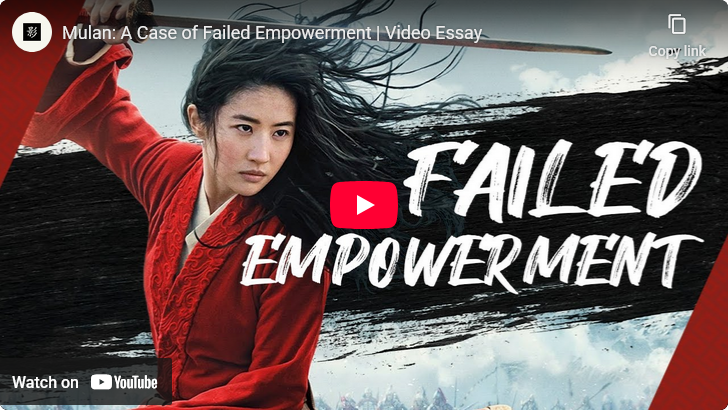
We can tell this from the Mulan live-action remake. The original 1998 Disney animated Mulan — despite controversy at the time of its cinematic release — acquired some popularity in China. It was seen as an engaging adaptation of the original story: a story deeply familiar to Chinese audiences. Worldwide, the film was a box office success.
The 2020 live-action Mulan remake was not a box office success. It was not for many reasons, but it was also emblematic of the problems of what YouTube critic Critical Drinker calls our post-creativity era.
2020 Mulan turned a female-protagonist story into a “woke” great-because-girl female-protagonist story. It turned a story of filial piety — a girl disguising herself as a boy to train and become a soldier in place of her disabled father, and struggling to overcome the limitations inherent in that — into something rather different.
Animated Mulan becomes accepted into the team of soldiers and triumphs through cleverness and teamwork. What makes the story resonate so well is there is nothing special about Mulan. She takes what she has and works hard at becoming better and succeeds in, and through, doing so. There is no hint of great-because-girl: rather it is fine being girl. Being a girl imposes limitations on her that she has to deal with and overcome: which she does — but not without genuine struggles — by sheer persistence and being clever, a problem-solver.
The key difference between a traditional Disney Princess story and contemporary Disney “woke” Princess story is the injection of great-because-girl. Live-action Mulan is a prodigy warrior with extra qi (or chi) who can do what the boys can do, but better. This is a cinematic version of a classic failing of feminism — by taking a blank slate view of humans, turning what men do into the standard for women. Women are great because they can do everything men can do, but even better. Feminist antipathy for stay-at-home mothers expresses this valorisation of matching men.
Live action Mulan is also much more politically conformist, even retrograde, in its denounement of Mulan celebrating service to the Emperor and going off to be a soldier. Animated Mulan rejecting a job as imperial advisor, and returning to her beloved father, is much less deferential to public authority.
The live-action film virtue-signals at the expense of story and understanding. It sacrifices clever cultural engagement for much flatter message-signalling.
If you want to watch a story set in China about women warriors, then the recent Chinese drama (C-drama) hits of Legend of the Female General and Shadow Love are available. These are smart, character-driven stories with the pervasive professionalism and sense of beauty—anchored in the cultural confidence—that one expects from contemporary costumed C-dramas, which are very much not based on trashing cultural heritage or we-know-better disrespect for source material.
Costumed C-dramas regulary have strong female lead characters while also having strong male lead characters. (As it happens, the male lead characters in both the aforementioned dramas are played by Cheng Lei; the female leads by Zhou Ye and Song Yi respectively.)
Update, 5 November: Welcome, Instapundit readers! Please do have a look around at some of my other posts you may find of interest. I send out a daily summary of posts here through my Substack – https://substack.com/@nicholasrusson that you can subscribe to if you’d like to be informed of new posts in the future.