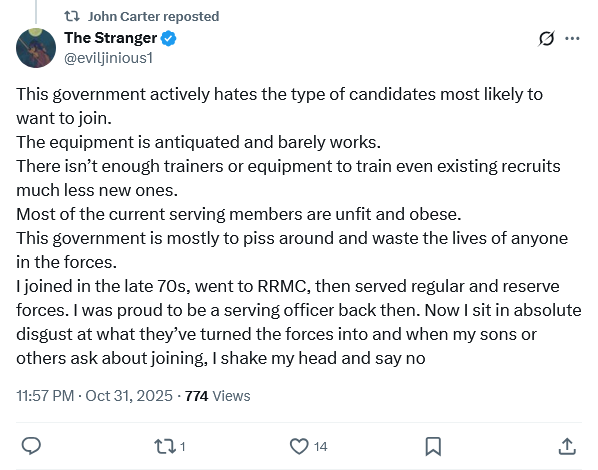
 The Canadian military used to be one of the best in the world. We “punched above our weight” as the hoary old cliché had it. But it was true. Then came Lester Pearson and the notion of peacekeeping, which is related to but not the same thing as having a military prepared to fight. Then came Pierre Trudeau and his loyal acolyte Paul Hellyer and the notion that merging the Canadian army, the Royal Canadian Navy (RCN), and the Royal Canadian Air Force (RCAF) into a single organization — the Canadian Armed Forces (CAF) — would magically reduce our military spending while maintaining our military power. It may have saved some money on paper, but its real impact was allowing the federal government to cut, cut, cut until the CAF was no longer capable of fielding significant numbers of combat troops, aircraft, or naval vessels and we began quietly withdrawing from our NATO and UN commitments (while still propagandizing about being a “soft power” superpower and persuading Canadians that we were still world leaders in peacekeeping).
Later Canadian governments have made noises about correcting the mistakes of the past half century and getting proper equipment — and enough of it to matter — and resurrecting the fighting capabilities (and numbers) of the CAF … even bringing back the proper names of the RCN and RCAF … but the promises were rarely implemented and even more rarely maintained beyond the life of a given government.
Our allies have been urging us to take the military more seriously for so long that it seems inevitable that any new expansion plans will fade into the mist just as quickly as all the previous fever dreams. Even when the government actually provides new funding, the bureaucracy is so incapable that time expires before they actually spend some or even all of it. All of which is why I’m highly skeptical that ongoing noises about increased military spending will actually result in anything more than a higher head-count in the civil service and lots (and lots, and lots) of re-announcing the spending plans:
In summer 2023, NATO held its largest-ever air exercise in Germany. Canada did not take part because its fleet was up on bricks.
Understaffed by around 10,000 regular soldiers, thanks to a 12 per cent attrition rate, the CAF was rocked by sexual misconduct scandals and chastised by a government more focused on culture change than war fighting.
Critics like Mark Norman, a former vice-chief of the defence staff, said Canada was increasingly seen as irrelevant in Washington.
But Norman said he is encouraged by the Carney government’s moves.
“Let’s be clear, the Forces are still in a decrepit state. We haven’t resolved the fighter jet or recruitment problems, or produced a defence industrial strategy. But I acknowledge that the prime minister has done a lot to try to refocus the government and, more broadly, Canadians,” he said.
A major problem for all governments has been actually spending money approved by Parliament. This week’s PBO report said that between 2017/18 and 2023/24, actual capital spending fell short of planned expenditure by $18.5 billion. Every year, the Department of National Defence failed to spend an average of $2.6 billion of its procurement budget.
“The scale of the planned increase raises questions about the government’s capacity to manage a higher volume of procurement activity and the domestic defence industry’s ability to support it,” the report said.
Norman suggested the new Defence Investment Agency, headed by former banker Doug Guzman, is a positive development. “The public service is not designed to produce operational outcomes, so the (appointment of an outsider) is encouraging,” he said.
According to David Pugliese, the Canadian Army is looking to vastly expand the existing army reserves:
The Canadian military has set in motion an initiative to increase the number of its part-time soldiers from the current 28,000 to 400,000 as part of an overall mobilization plan, according to a directive approved by senior leaders.
The directive, signed by Chief of the Defence Staff Gen. Jennie Carignan and defence deputy minister Stefanie Beck on May 30, 2025, outlines the need to increase the current reserve force from 23,561 to 100,000 and supplementary and other reserves from the current 4,384 to 300,000.
Beck and Carignan approved the creation of a “tiger team” which will work on setting the stage for a Defence Mobilization Plan or DMP to accomplish such a goal. That team will examine what changes are needed to government legislation to allow for such a massive influx of Canadians into the military.
Beck and Carignan pointed out that the plan would require a Whole of Society or WoS effort, meaning that all Canadians would have to contribute to the initiative.
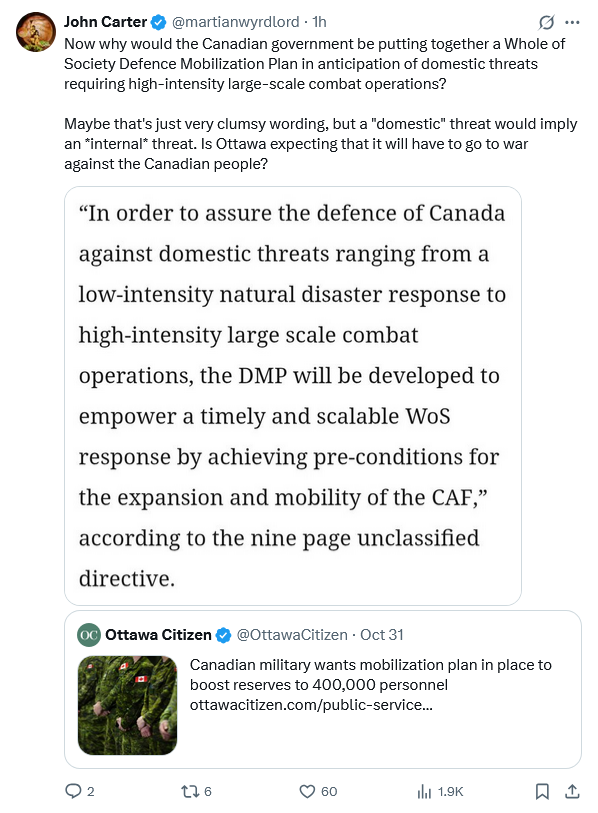
“In order to assure the defence of Canada against domestic threats ranging from a low-intensity natural disaster response to high-intensity large scale combat operations, the DMP will be developed to empower a timely and scalable WoS response by achieving pre-conditions for the expansion and mobility of the CAF,” according to the nine page unclassified directive.
The initiative has drawn some critical responses on the social media site formerly known as Twitter: