Quotulatiousness

August 28, 2025

A civil society can’t allow young Scottish hellions to brandish weapons at immigrants harassing them

Filed under: Britain, Law, Liberty — Tags: , , , , — Nicholas @ 05:00

At least, the headline expresses how the sky people probably frame the situation where a young girl felt she needed to scare off a threat to herself and her friend. This is from an X post which claims to be describing what actually happened rather than what the media has been reporting:

One of many, many images posted to X on this incident.

I spoke with the mom of one of the girls (Mayah) and got the entire story that the media is covering up and lying about.

So first of all, the reporting got the names of the girls mixed up. There were 3 girls who were there who were accosted and attacked by the migrants.

Lola – Lola is the hero from the video. She’s the one with the axe defending her sister from the migrant attackers

Ruby – Lola’s older sister who was attacked and hospitalized

Mayah – Ruby’s best friend who was with them and went to call the police after Ruby was attacked by the migrants

Here’s the summary of what happened from Mayah’s mother:

“Yes. So what happened was the girls where out just walking and the man in the picture made comments to lola(the younger girl) calling her sexy and other sexual remarks then the girls started to tell this man to leave them alone and stop following them and making sexual remarks to them. After that the man’s sister (also in the picture) came around the corner and physically attacked ruby(the older sister) she grabbed her hair dragged her to the floor started to punch her then both the man and woman where kicking her in head while she was on the floor. At this point my daughter (mayah) called the police so my daughters account after that is all abit blurry. But that is when lola had the weapons she pulled them out to protect ruby. After that the man came back at lola recording her making sure she showed the weapons to the camera and antagonising her. Ruby was hospitalised after the attack with a severe concussion a tennis ball sized lump to the back of her head aswell as lots of bruises.”

John Carter reacts to the original image, also on X:

This should be a turning point, but god knows how many such the British elites have ignored so far. Another graphic from X expresses what may happen if this is also ignored:
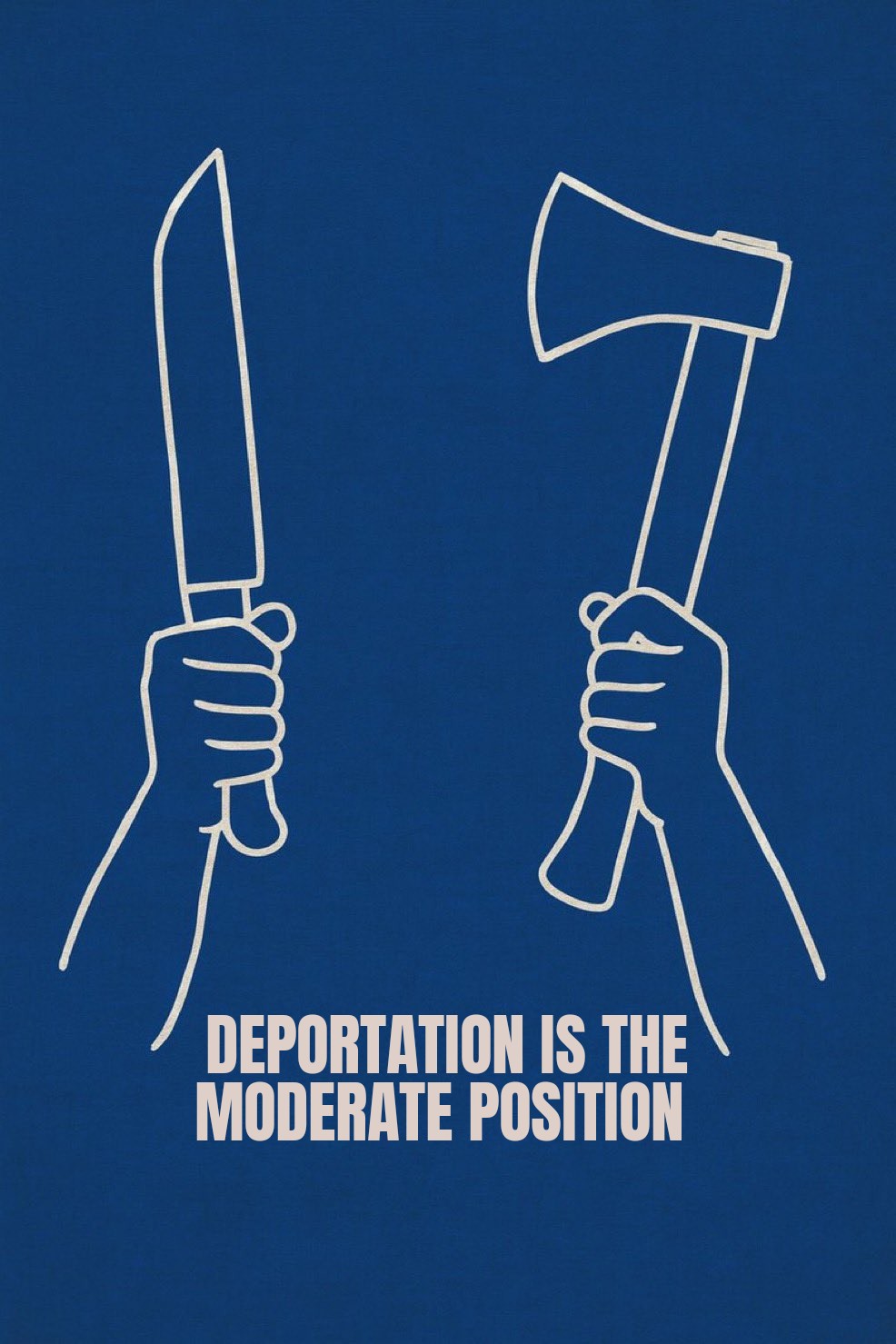
Even the Brits can be pushed too far and we can’t be very far from that point now. And the way the British media is handling this and pretty much every other confrontation is not helping:

You can’t have missed her, if you’re on social media at all, the dual-wielding 14-year-old Scottish lass raising two blades in defiance of the “migrant” seemingly intent on assaulting her and her 12-year-old friend.

The name of this hero won’t be released due to her age, and police were right on the scene to arrest the violent attacker.

That’s right: the little girl is in jail, charged with possession of a bladed weapon. Two weapons, actually — what appear to be a large santoku-style blade and a small hatchet.

In the widely-circulated clip, her would-be attacker (with the non-British accent) can be heard taunting her to show the blades on camera. Why? The answer is obvious: he’s well aware that self-defense is illegal in Britain, and he also knows she’ll be the one the cops take away.

And he was correct on both counts.

[…]

Culturally, things are so crazy that the BBC didn’t just blur out our heroine’s face, they even blurred out her blades. And now you understand the screencap at the top of this column. Mustn’t ruffle any feathers, you see.

How about pepper spray and the like? Sorry, mate, but pepper spray was banned as a “prohibited weapon” (!!!) in 1968.

In Britain, the only legal defense against rape is a whistle — which is to say, no defense at all.

That 14-year-old girl found it necessary to possibly defend herself and her friend against two possible assailants: would-be rapists and the British criminal justice system. The day came, and she proved herself a hero.

She warded off the former, but God only knows what indignities she’ll suffer at the hands of the latter.

What’s the next little British girl’s defense against that?

Prices are critical economic signals that we ignore at our peril

Filed under: Economics — Tags: , , — Nicholas @ 04:00

At the Foundation for Economic Education, Tim Worstall explains the importance of prices in a free market economy:

Prices matter. Now, I’m a free market, capitalistic type, so of course I’m going to insist that everyone be tied down to mere gilt and pelf in how they live their lives. Yet it is still true that prices really, really matter.

Let’s walk through why that’s true, regardless of your political tribe. Any one thing — any economic resource, fresh water, human labour, cash, capital itself and so on — can be used for a multitude of different things. At any one time, the market price for that thing is the balance between the supply of it and the value in using it to do — in aggregate — all those multitudinous things. Yes, we can even mutter that perhaps the information doesn’t flow here instantaneously and perfectly efficiently. Nevertheless, in its simplest terms, what something costs reflects the value of whatever uses we can put it to.

If we decide that we want to do something new, we need a measure of whether we should or not. In a world where resources are finite, the resources we’ll consume doing this new thing already have prices, thanks to their use in all the other things we’re already doing. So, this new thing we desire to do must add value. We must make a profit doing it. No, this doesn’t mean something that tophatted capitalists get to squirrel away in their subvolcanic secret lair. Rather, it means that the value of the output must be higher than the costs of the inputs. If that’s not true, then we are subtracting value from those resources. Other people could have used them to do their thing and generated value instead.

If something makes us all poorer, we shouldn’t do it. But that’s exactly what happens whenever we use valuable resources to do something which is of less value than the price we pay to do it. Say, for example, recycling disposable vapes:

“CBD Living Vape – Disposable” by weedporndaily is licensed under CC BY 2.0 .

    Vape sellers will have to pay for the disposal of the devices under plans announced by the government.

    Ministers said they would “end the UK’s throwaway culture” as they revealed measures to fund the recycling of electrical waste.

Recycling these vapes’ electronic waste uses more resources than not recycling it. This is why we’ve got to find someone to pay for it — because the value of the resources required to do the thing is greater than the value of having the thing done.

Now I am not against recycling per se — I cannot be, having dealt in scrap metal. I once shipped lorryloads of Soviet nuclear scrap off to be made into fancy car wheels for boy racers’ Escort XR3is. My only whine about that was not also gaining the furry dice concession. Even so, I made a house-sized chunk of money doing it. That’s because I’d added value by working out what the scrap could be used for and getting it to where it could be used to do just that.

But if we mandate a recycling system that makes no profit, adds no value and in fact requires an outside input of money into financing it, then we’re throwing away value and making ourselves poorer. The prices are telling us we should not be doing this thing. That’s why we ignore prices at our peril.

No surprise at all – Liberals completely overshoot temporary foreign worker targets

Filed under: Business, Cancon, Government — Tags: , — Nicholas @ 03:00

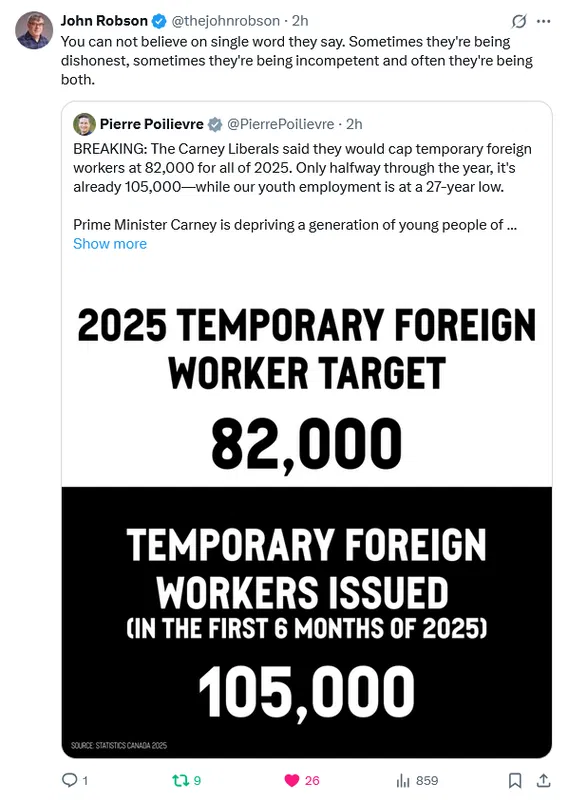
In the National Post, Tristin Hopper confirms that the Mark Carney government, having promised to cap temporary foreign worker visas at 82,000 for the year, have already brought in over 100,000 TFWs in the first six months:

Despite promises from the Liberal government that they would be curbing the sky-high immigration rates of the Trudeau era, new data from Immigration, Refugees and Citizenship Canada shows that Canada is already on track to exceed its 2025 targets.

In the first seven months of 2025, Canada accepted 246,300 new permanent residents, according to data released last week by IRCC.

If this level of intake keeps up for the rest of the year, Canada is on track to bring in approximately 422,000 new permanent residents by year’s end.

[…]

And the missed targets are even more stark when it comes to categories of temporary migrants.

For the entirety of 2025, Canada was only supposed to approve 82,000 entries under the Temporary Foreign Worker Program.

Nevertheless, Government of Canada data shows that 105,195 Temporary Foreign Worker permits were awarded in just the first six months of 2025.

Temporary migration has been disproportionately responsible for the record-breaking population growth witnessed in Canada over the last four years. Since 2021, Canada’s population has grown from 38 million to 41.7 million. This represents an average annual increase of 900,000, which puts Canada well beyond the population growth rates of any other G7 country.

In late 2024, Statistics Canada estimated that the country was home to an unprecedented three million “non-permanent residents,” be they international students or temporary foreign workers.

Temporary migration is also the category on which Ottawa has promised to crack down hardest. Late in 2024, when then prime minister Justin Trudeau announced plans to “turn off the taps” on immigration, temporary migrants represented seven per cent of the overall Canadian population.

History of Britain VII: Fall of Roman Britain

Filed under: Britain, History, Military — Tags: , , , , , — Nicholas @ 02:00

Thersites the Historian
Published 23 Feb 2025

After its efflorescence during the 2nd Century, Roman Britain entered steep decline during the 3rd Century and the benefits of Roman civilization had all but vanished by the time that the Romans withdrew their forces and support.

QotD: The rise and fall of the chariot in combat

Filed under: Books, History, Military, Quotations — Tags: , , , , — Nicholas @ 01:00

Horses had been domesticated long before the Scythians. Horses, along with dogs and reindeer, are the only animals domesticated by foragers, rather than farmers. The first significant use of horses in battle was to draw chariots. Chariot archers could shoot, and javelins could be thrown, further from a chariot than a horse.

The classic chariot was driver and archer or spearmen. A friend describes them as being like a pilot and a navigator (or bomb-aimer) on a bombing run. The pilot/charioteer concentrates on getting the pair of you where you need to be (or not to be). The archer/spearmen/navigator/bomb-aimer concentrates on killing the enemy.

The most famous driver/warrior pairing in myth and literature is Krishna and Prince Arjuna in the Mahabharata and, specifically, the Bhagavad Gita. (Normally, the driver serves the warrior, but if your driver is an incarnation of Vishnu, things work differently.) The warriors of the Iliad are also chariot-driving warriors — hence scenes such as Achilles dragging Hector‘s dead body behind his chariot. Chariots were a major element in Chinese warfare up to the Warring States period. New Kingdom Egypt was very much a chariot empire, as were their great rivals, the Hittites.

Once recurve bows able to match chariot archery from horseback arrived, chariots largely disappeared from combat in the major Eurasian civilisations. This began to occur around the time of the Assyrians — who were a transitional case using both chariots and cavalry — about a thousand years before the invention of the stirrup and even longer before the stirrup’s arrival in the Mediterranean world. Lancers — the heavily armoured version of which was the cataphract — then developed as a way of dealing with horse archers.

Lorenzo Warby, “Stirrups, a rant”, Lorenzo from Oz, 2025-02-28.

Powered by WordPress