
Ted Gioia foresees a precipitous fall in trust coming at us very soon, and I’m afraid he might be being too optimistic:
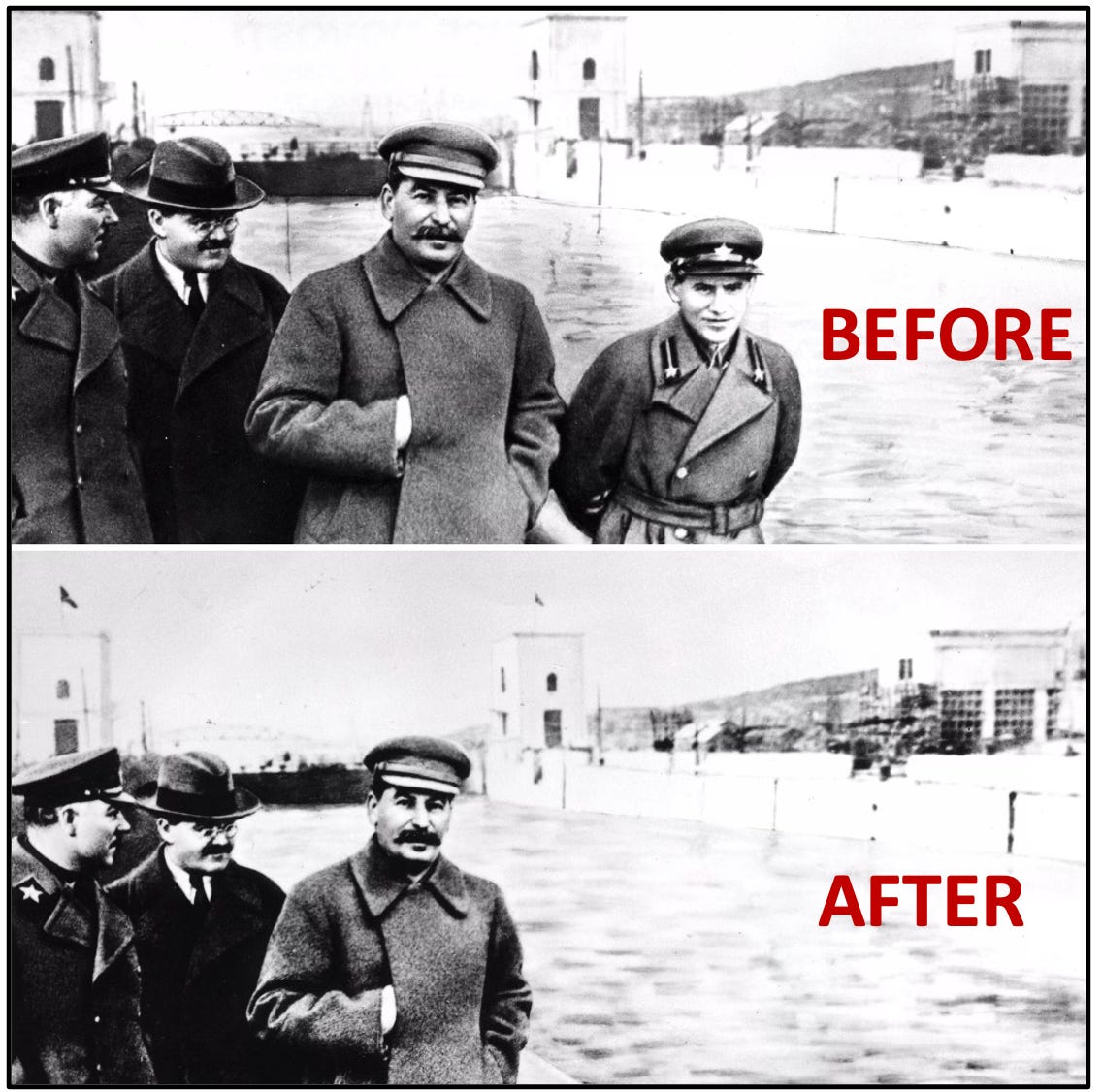
During the great purges of the 1930s, Stalin ordered the execution of a million people, including some of his closest associates. But it wasn’t enough to kill these victims — they also had to disappear from photographs.
In a famous case, Nikolai Yezhov got removed from his position next to Stalin in a photo taken by the Moscow Canal. This erasure alarmed many party elites because Yezhov, head of the secret police, had been one of the most feared men in the Soviet Union.
And now he got totally deleted.
Well, not totally. In those days of print media, original photos survived, and a paper trail made it difficult to erase history.
So this photo was later used to mock Stalin, and the pretensions of dictators. They can try to change reality, but that’s not possible.
Or is it? Maybe dictators now get the last laugh. Because in the last few months, reality has been defeated — totally, completely, unquestionably.
It is now possible to alter reality and every kind of historical record — and perhaps irrevocably. The technology for creating fake audio, video, and text has improved enormously in just the last few months. We will soon reach — or may have already reached — a tipping point where it’s impossible to tell the difference between truth and deception.
- Can I tell the difference between a fake AI video and a real video? A few months ago, I would have said yes. But now I’m not so sure.
- Can I tell the difference between fake AI music and human music? I still think I can discern a difference in complex genres, but this is a lot harder than it was just a few months ago.
- Can I tell the difference between a fake AI book and a real book by a human author? I’m fairly confident I can do this for a book on a subject I know well, but if I’m operating outside my core expertise, I might fail.
At the current rate of technological advance, all reliable ways of validating truth will soon be gone. My best guess is that we have another 12 months to enjoy some degree of confidence in our shared sense of reality.
But what happens when it’s gone?
Back in 2023, I asserted that trust is the most scarce thing in society. But that was before all these tech deceptions came online. Trust will soon get even more scarce — or perhaps disappear completely from the public sphere.
This is not a small matter.
Most discussions of this issue focus on the technology. I believe that’s a mistake. The real turmoil will take place in social cohesion and individual psychology. They will both fracture in a world where our shared benchmarks of truth and actuality disappear.
We will be — already are — in desperate need of Robert Heinlein’s Fair Witnesses:
A Fair Witness is an individual trained to observe events and report exactly what is seen and heard, making no extrapolations or assumptions. While wearing the Fair Witness uniform of a white robe, they are presumed to be observing and opining in their professional capacity. Works that refer to the Fair Witness emphasize the profession’s impartiality, integrity, objectivity, and reliability.
An example from the book [Stranger in a Strange Land] illustrates the role of Fair Witness when Anne is asked what color a house is. She answers, “It’s white on this side.” The character Jubal then explains, “You see? It doesn’t occur to Anne to infer that the other side is white, too. All the King’s horses couldn’t force her to commit herself … unless she went there and looked – and even then she wouldn’t assume that it stayed white after she left.”


