An excerpt from a work-in-progress by James Pew, from an incident during the heydey of #MeToo hysteria in the Toronto media community:
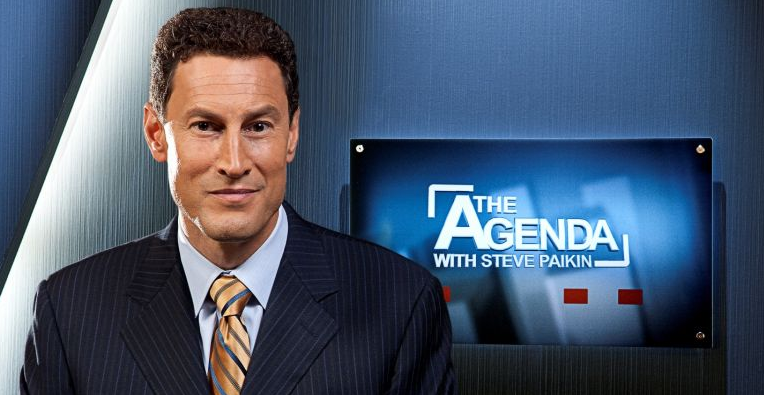
Steve Paikin is a Canadian journalist and author, and the host of TVOntario’s acclaimed flagship program, The Agenda With Steve Paikin. In his brush with #MeToo infamy, Paikin was accused of asking for, or possibly suggesting sex with a woman (who had previously appeared on his show), while at a business lunch with her at Grano restaurant in Toronto. The woman, a former Toronto Mayoral candidate who has a record of previous unsubstantiated claims against former Toronto Mayor Rob Ford, claims to have “politely” declined Paikin’s request, but said she was not invited back on his show because of her refusal to have sex with him.
The Paikin scandal was different from others which had unfolded in the hazardous year of 2018. This was a #MeToo story where the public appeared interested in both sides. Were chinks in the #MeToo armour beginning to appear? As Joe O’Conner wrote in the pages of the National Post, there was “an accusation and a vociferous denial”.1 But similar to other #MeToo narratives, the accuser was reaching deep into the past. According to Sarah Thomson, Paikin’s unwanted proposition for sex occurred in 2010.
Defending himself on Facebook, Paikin called the allegations a “complete fiction”. He wrote: “To be clear, I did not have sex, suggest, request, imply, or joke about having sex with you (Sarah Thomson)”.
Paikin had been a supporter of #MeToo. He wrote that “The #MeToo movement is too important to be undermined by spurious allegations”. Did he not realize that #MeToo means “believe all women”? Aren’t spurious allegations the type we are not supposed to believe? Wouldn’t that mean that women don’t (or can’t) make spurious allegations, but only the type of allegations that must be believed unquestioningly? Didn’t Paikin realize the contradiction in thinking that #MeToo was important, but in his case it was acceptable to cast off its intrinsic blanket credulity concerning the abuse claims of women? Paikin wrote:
Sadly, in this day and age, too many people are going to believe the lie, especially when it comes to this subject. I am mortified that in many peoples’ eyes, I have lost the presumption of innocence that I’ve previously enjoyed. But I did not do these things. There is simply no truth to these allegations.2
Surprisingly, TVO did not remove Paikin, but launched an investigation instead. In a piece published in the Globe and Mail called “The Humiliation of Steve Paikin”, Margaret Wente wrote, “Mr. Paikin was lucky not to be suspended, people say. Some luck. His name is in the headlines, generally on the same page as all the other #MeToo stories that now dominate the news. I imagine that most people who know him don’t believe a word of it. Others will think, ‘These days you never know’.”3 A fair assessment. Wente later points out “Women (just like men) lie for all kinds of reasons, including the fact that they are unbalanced or unhinged.” However, it should be pointed out that in the #MeToo era and since, women do not get cancelled and humiliated because a man (or men) made unsubstantiated allegations against them.
The most suspicious part of the story is that Thomson’s assistant was present at the lunch meeting when Paikin supposedly propositioned her. Who would do such a thing as Paikin was accused in the presence of other people? Thomson did not provide the name of her assistant, and no investigative journalists were able to find out who she was. A critical detail appeared to go uncorroborated. However, the independent investigator tracked her down and conducted an interview. Her testimony was essential to clearing Paikin, although she chose to remain anonymous.
By April of 2018, the independent investigation into the allegations against Paikin was complete. It was found that while Thomson genuinely believed that Paikin had propositioned her “the evidence brought forward by Thomson and others (did) not support her account of what happened”.4 Rachel Turnpenney, the lawyer who conducted the investigation, referred to Thomson’s former assistant as “Witness J” – whose testimony contradicted Thomson’s account. Witness J told investigators that Paikin did not proposition Thomson or make any inappropriate sexual comments during the lunch.
But even if the allegations were true, was what Paikin alleged to have done really so bad? Aren’t men taught to ask for consent? Isn’t that what “propositioning” Thomson would have been? It could be argued, had the allegations turned out to be true, that Paikin demonstrated inappropriate, perhaps insensitive conduct. Clearly it would have been poor judgement, but should a man like Paikin be fired for a slip in judgement where no crime occurred? In hypothetical defense of a mis-step that never occurred, is it not possible to argue that a man might misread body language or other signs from a woman, and interpret them as mutual sexual interest? Getting this wrong can be embarrassing for both parties involved, but does it meet the severity of a cancellable offense? As Margret Wente wrote, “The truth is that not all men are guilty of what they’ve been accused of, and others aren’t that guilty of very much”.
But the social justice contingent is obsessed with power dynamics. According to them, any man who holds a professional position elevated over a woman he is attracted to, will automatically use his power to coerce the woman for sexual favours. In spite of the high-profile example in figures such as former American movie mogul Harvey Weinstein, it is insane to assume this is the default position of successful men, or men in places of authority or influence, just as it is insane to believe all women unconditionally.
Turnpenney felt that while Paikin’s testimony was consistent and credible, Thomson made “leaps without sufficient evidence to do so and she linked evidence together without factual foundation. Thomson’s evidence also veered toward being exaggerated and untrue.” Even though Paikin was ultimately exonerated, he was humiliated by the experience. In the initial statement he made defending himself, he characterized Thomson’s actions as defamatory. However, lucky for Thomson, Paikin chose not to sue. Thomson paid no penalty for all the trouble she caused, and most people felt Paikin was fortunate to have dodged a #MeToo bullet. As of this writing, Steve Paikin is still the host of The Agenda.
1. A #MeToo story with two sides: Steve Paikin fires back at sexual harassment allegations
2. ‘My turn’: Steve Paikin responds to sexual misconduct allegations – Sudbury News
3. The humiliation of Steve Paikin – The Globe and Mail
4. TVO host Steve Paikin cleared by investigator after sexual harassment accusations | CBC News