
For Project 44, Nathan Kehler describes the role of the 1st Canadian Infantry Division as the western-most part of Montgomery’s 8th Army landings on the southern tip of Sicily:
In the days leading up to Operation Husky, the Canadian contingent suffered two major losses – one in leadership and one in logistics. Though the landings would ultimately succeed, these events cast a shadow over the operation before a single boot touched Sicilian soil.
The Death of General Salmon
On July 2, 1943, Major-General G.G. Salmon, commander-designate of the 1st Canadian Infantry Division for the Sicily campaign, was tragically killed when his Hudson aircraft crashed near Barnstaple, Devonshire, shortly after takeoff from Hendon Airfield. Also on board were several senior officers, including Rear-Admiral P.J. Mack, the Canadian naval force commander, and Lt.-Col. C.J. Finlay, the newly appointed senior logistics officer for the division. All were killed.
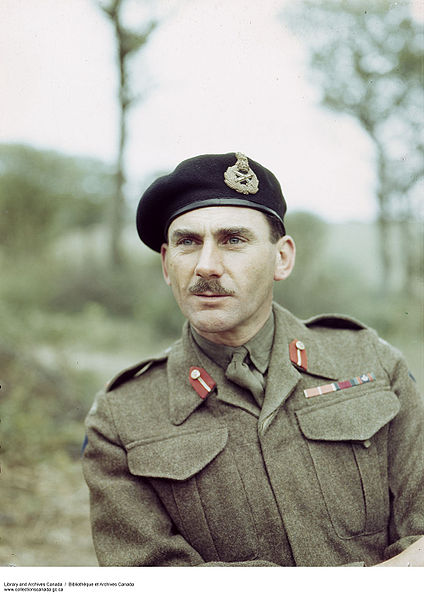
Major General Guy Simonds, commanding 1CID.
General Salmon had been hand-picked to lead Canada’s first major amphibious campaign. His death, just days before the invasion, shook the command structure. With no time to replace him formally, Major-General Guy Simonds was appointed in his place. Simonds was known for his drive, discipline, and tactical focus. The loss of Salmon meant an abrupt shift in leadership style and planning assumptions on the eve of battle.
Sinking of Canadian Troop Ships
Only days later, Canadian forces suffered another blow. Between 4–5 July, as convoys moved across the Mediterranean from North Africa toward Sicily, Axis submarines attacked Allied shipping near the Algerian coast. Three ships were torpedoed: the St. Essylt, City of Venice, and Devis.
While the first two sinkings resulted in relatively few casualties, the loss of the Devis was severe. Carrying 261 Canadian troops, the ship was hit and engulfed in fire. Fifty-two Canadians were killed, with many trapped in the holds below deck. In total, the convoy lost over 500 vehicles and 40 guns, along with critical headquarters and signals equipment. Divisional Headquarters suffered particularly heavy equipment losses, forcing last-minute improvisation in communications and command coordination.
Despite these losses, the Canadian Division adapted quickly, and the operation went forward as planned. These early setbacks, however, underscore the high cost and uncertainty of even reaching the battlefield in the Second World War.
Canadian Beaches
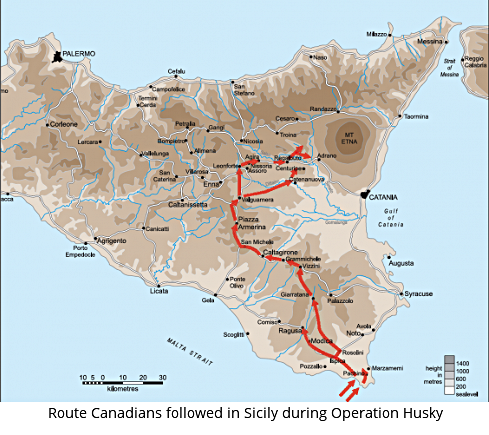
On 10 July 1943, the 1st Canadian Infantry Division landed in southeastern Sicily as part of Operation Husky – the Allied invasion of Europe’s “soft underbelly.” The division’s assault was split across two main beaches: “Roger” Beach to the east and “Sugar” Beach to the west of the village of Le Grotticelle. These beaches formed the right flank of the British Eighth Army’s landings.
General Simonds’ plan for the Canadians was a two-brigade front:
- The 1st Canadian Infantry Brigade would land on Roger Beach and push inland to destroy a coastal battery near Maucini, seize the Pachino airfield, and establish contact with nearby British forces around Pachino town.
- The 2nd Canadian Infantry Brigade would land on Sugar Beach, clear beach defences, support the adjacent British Special Service Brigade landing on the far left, and advance north past the Pantano Longarini marshes.
- The Special Service Brigade (British Commandos) would land west of Punta Castellazzo, eliminate enemy resistance in their zone, and cover the Canadians’ western flank from elevated ground north of the marshes.
The landings were scheduled for 2:45 a.m., with Commandos hitting the shore ten minutes earlier. Objectives were clear: knock out coastal defences, secure strategic positions, and quickly link up with Allied forces to expand the beachhead.
The Landings
Despite rough seas from a storm the day before, the landings went ahead as planned in the early hours of 10 July 1943. Just after 1:00 a.m., British Commandos began landing west of the Canadian sector, encountering only light resistance. By 1:34 a.m., the 2nd Canadian Infantry Brigade – the Seaforth Highlanders of Canada and Princess Patricia’s Canadian Light Infantry – were heading for Sugar Beach under covering fire from naval guns, including the 15-inch guns of HMS Roberts.
Navigation errors caused the Seaforth Highlanders to land to the right of the Patricias, reversing their intended order. But the heavy surf helped carry landing craft over a false beach, and both units came ashore with minimal opposition. They quickly cleared light beach obstacles and scattered Italian machine-gun posts. By 3:00 a.m., both battalions had successfully landed and were advancing inland toward their objectives.
On Roger Beach, however, the 1st Canadian Infantry Brigade faced delays. Their assault relied on DUKWs and landing craft (LCTs) arriving from Malta. When these were delayed, Brigadier Howard Graham initiated a backup plan, switching to Landing Craft Assault (LCAs). Confusion and the heavy swell caused further delay, with some units landing as late as 5:30 a.m. – nearly three hours behind schedule.
Despite the setbacks, the Hastings and Prince Edward Regiment and the Royal Canadian Regiment landed successfully. The Hastings had one reserve company land 5,000 yards off target in the Commando sector but regrouped without major issue. Both units met minimal resistance. The RCR encountered light shelling from the Maucini battery, but naval gunfire quickly silenced it.
By 6:45 a.m., all three lead brigades had secured their assigned beachheads, with support units and armour – including Shermans from the Three Rivers Regiment – beginning to land. The 48th Highlanders of Canada and The Edmonton Regiment followed their respective brigades ashore, some accompanied by pipe bands.
Opposition during the landings was light overall. Many Italian defenders withdrew as the naval bombardment and confusion of the assault overwhelmed them. However, isolated machine-gun fire and limited artillery shelling still resulted in several Canadian casualties, primarily on Roger Beach.
The pre-invasion loss of ships to enemy submarine or air attack was taken fully into account during the weeks before the convoys set out. But as with all military planning, the enemy gets a vote too.


