Quotulatiousness

July 8, 2025

Korea: War Without End by Richard Dannatt and Robert Lyman

Filed under: Asia, Books, China, History, Military, USA — Tags: , , , — Nicholas @ 05:00

Taylor Downing reviews the latest co-operative work between former British Chief of the General Staff Lord Dannatt and Dr. Robert Lyman:
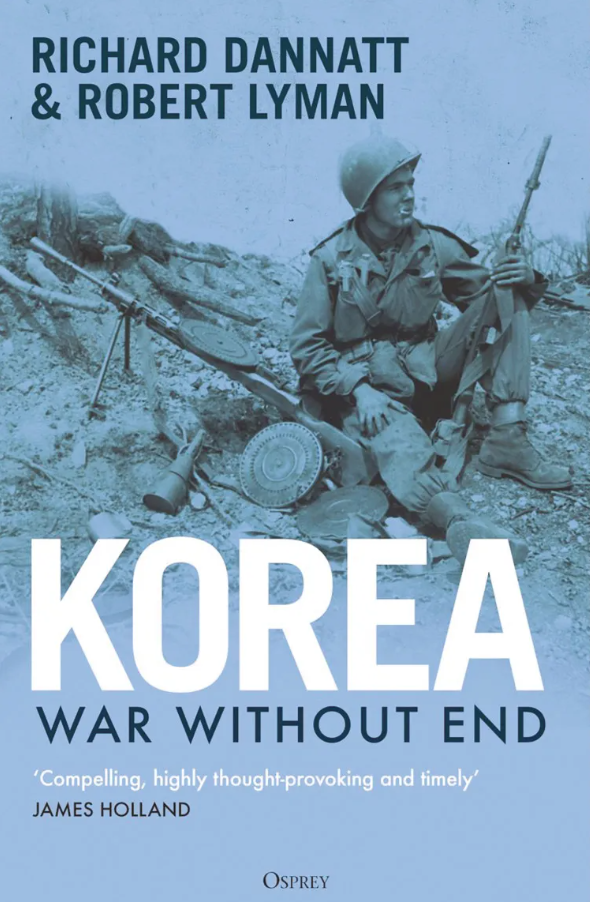
Their book has three premises. First, that the conflict in Korea is a forgotten one that very much deserves retelling. Second, that the war is very topical today partly because it shows how to fight (or not to fight) a conventional war in a nuclear age, and partly because it shows how politics must always take precedence over military ambition. And, third, the authors argue that the war was not a single conflict but was in fact two wars, quite separate but consecutive.

The “first” war is the story of the surprise invasion of South Korea by the North Korean People’s Army (NKPA), or the In Mun Gun, in June 1950 as their leader Kim Il Sung sought to reunite the Korean peninsula under Communist control without having any sense of the political response he would unleash. What followed was a rapid advance towards the southern city of Pusan in a form of Blitzkrieg that had not been seen since World War II.

This early phase covers the establishment of a US-led United Nations force for the first time in its history – only formed because the Soviet Union was boycotting the Security Council at the time. US troops finally slowed the NKPA advance and then, in a brilliant counterstroke masterminded by General Douglas MacArthur, an amphibious troop landing took place behind enemy lines at Inchon. This resulted in a complete reversal in the fortunes of the North Koreans and their retreat to pretty well their starting lines on the 38th Parallel that had divided the peninsula since 1945.

This, the authors argue, is where the war should have ended. The UN had achieved its aim of liberating the south from a Communist takeover. But instead a “second” war unfolded in which General MacArthur, convinced that he was fighting a crusade against world Communism, advanced rapidly through North Korea towards the Yalu River and the border with Communist or (as he called it) “Red” China. For him, victory had to include total defeat of the enemy. In scenes of remarkable hubris, MacArthur was convinced he had the war wrapped up and his troops would be home by Christmas. Instead, he provoked an attack by the Chinese People’s Volunteers on a massive scale, leading to the humiliating rout of US troops and a midwinter retreat back into southern Korea.

This “second” war had as its next phase the final standstill along lines roughly similar to the 38th Parallel and two years of stalemate, before an armistice was signed. The breakdown of the war into two separate conflicts is a fine way of interpreting the remarkable see-saw events of the first year of fighting. Seoul was captured and recaptured four times in nine months. Pyongyang was captured and lost, becoming the only Communist capital to have been taken in battle during the entire Cold War.

In the first stages of the conflict, UN troops, largely Americans who had been sent in from keeping the peace in Japan and who were entirely untrained and unprepared for combat, were thrown back so rapidly that many simply threw down their weapons and retreated. The NKPA, using the tactics the Japanese had used in their invasions of Malaya and Burma, completely outclassed the unprepared US forces.

Then, a few months later, the US-led advance made the Americans feel completely unstoppable as they headed north, only to be turned once more by the Chinese. Again, tactically outclassed and totally unprepared for mountain warfare in midwinter, where conditions were brutal, the UN forces collapsed. It is a remarkable story that very much merits the retelling.


The dangers of whiplash when “the narrative” suddenly changes

Filed under: Government, Law, Media, Politics, USA — Tags: , , , , , — Nicholas @ 04:00

I’ve never been to Los Angeles, although I did spend a couple of weeks working in the San Francisco area a few decades back, so I’m inclined to think Chris Bray is reporting closer to the objective reality than most of the mainstream media are doing:

Federal agents raided MacArthur Park in Los Angeles today, and that’s shocking! It’s HORRIBLE! Why on earth would they do that?!?!?!? (MY GOD, THEY WERE EVEN ARMED!)

Also, here’s local NPR station KCRW, a very few months ago:

Opening paragraphs:

    For more than a century, MacArthur Park, just west of Downtown Los Angeles, has been an urban oasis for residents of the surrounding Westlake District and the wider city. But in recent years, MacArthur Park has also become synonymous with fentanyl, the synthetic opioid that can be 50 times more powerful than heroin. Open fentanyl abuse is now so common, the drug might as well be an unofficial symbol of the park.

    Scenes of fentanyl abuse, and what it does to the body and mind, are everywhere, with people passed out or staring dead-eyed as they clutch drug pipes and small containers of fentanyl residue.

More recently, the Los Angeles County DA’s office announced a bunch of felony indictments for an aggressive retail theft ring that used MacArthur Park to recruit and organize its army of professional thieves:

    LOS ANGELES — Los Angeles County District Attorney Nathan J. Hochman announced today that Blanca Escobar has been charged with receiving over $350,000 in stolen merchandise from retailers including Target, Macy’s, TJ Maxx, CVS, and Walgreens at her business near MacArthur Park.

    “This case is an important step toward cleaning up MacArthur Park, a community that has long struggled with crime and safety concerns,” District Attorney Hochman said. “Combating organized retail theft in close partnership with LAPD and other law enforcement is a priority for my administration. My office will vigorously prosecute this case and send an unmistakable message to criminals: Retail theft will not be tolerated under my watch.”

Note that the DA called the indictments “an important step toward cleaning up MacArthur Park”. Why? Why did prosecutors think MacArthur Park needs cleaning up?

“One of the problems with being a writer is that all of your idiocies are still in print somewhere”

Filed under: Books, Economics, Humour, Liberty, Media, Politics, USA — Tags: , , , , , — Nicholas @ 03:00

At the Foundation for Economic Education, Itxu Díaz considers the work of P.J. O’Rourke:

Though P.J. O’Rourke passed away three years ago, his sharp wit and defense of freedom continue to resonate in a world still tempted by interventionist solutions. Reclaiming his work is more vital now than ever. What he told us through laughs and jabs in recent decades has proven to be one of the sharpest diagnoses of the dangers of postmodern left-wing ideology — and one of the most inspired reflections on why we must root our societies in individual liberty, private property, the free market, and the Judeo-Christian values that shaped the West for centuries.

Progressives want bigger government, and often conservatives don’t want it as small as we ought to like. O’Rourke knew all too well that the larger the state grows, the smaller individuals become. He devoted much of his work to explaining this in a way anyone could understand — even those not particularly interested in politics. His words resonate today in a new light, and fortunately, they remain easy to access: the Internet is full of O’Rourke’s articles, and all his books are still in print. The ideas, the jokes — the profound, the outdated, and even the ones that haven’t aged all that well — are still out there, waiting to be discovered by any digital wanderer with a sense of humor and a thirst for sharp thinking. It’s almost frightening to realize that some of O’Rourke’s tech-related jokes would go completely over a Millennial or Zoomer’s head today. And it’s even more pitiful to think that some of his old comments would be cancelled in today’s dull, hypersensitive postmodern world. Perhaps it’s because, as he once said, “One of the problems with being a writer is that all of your idiocies are still in print somewhere”. Incidentally, that’s where O’Rourke found his only point of agreement with environmentalists: “I strongly support paper recycling”.

The hippie student he was in the ’60s lost his enthusiasm for leftist ideas the following decade, as soon as he got his first paycheck from National Lampoon: a $300 check that filled him with joy — until he was told $140 would be deducted for taxes, health insurance, and Social Security. That day, he got mad at the government, and the grudge never faded. Before that, while still sporting what he called “a bad haircut” — think John Lennon’s worst style — he’d decided to tell his Republican grandmother he’d become a communist. Her response threw him off: “Well, at least you’re not a Democrat”.

O’Rourke was never one to romanticize his drug-fueled college days. “Oh God, the ’60s are back,” he wrote. “Good thing I’ve got a double-barreled 12-gauge with a chamber for three-inch magnum shells. And speaking strictly as a retired hippie and former beatnik, if the ’60s come my way, they won’t make it past the porch steps. They’ll be history. Which, for God’s sake, is what they’re supposed to be.”

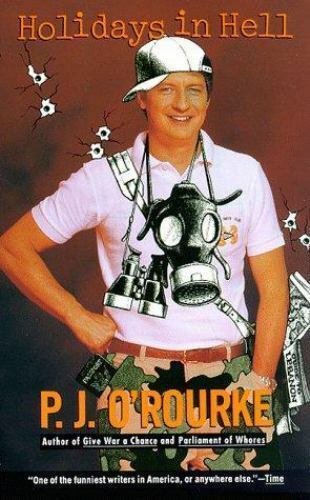
From his time as editor-in-chief of National Lampoon in the ’70s, we got his account in The Hollywood Reporter, “How I Killed National Lampoon“. The job was a blast, but the environment was hell: “Having a bunch of humorists in one place is like having a bunch of cats in a sack”. As a satirical war correspondent covering every late-century conflict, O’Rourke filled countless pages describing the struggle to find a damn glass of whiskey in the burning countries at the “end of history”. His last dangerous assignment was in Iraq. “I’d been writing about overseas troubles of one kind or another for twenty-one years, in forty-some countries, none of them the nice ones. I had a happy marriage and cute kids. There wasn’t much happy or cute about Iraq,” he wrote in Holidays in Heck.

Paul’s Drawer Tour | Paul Sellers

Filed under: Tools, Woodworking — Tags: , , , — Nicholas @ 02:00

Paul Sellers
Published 21 Feb 2025

What’s the question? Why did Paul put the drawer in such a dumb place, or what does Paul use the drawer in his bench apron for?

Well, this drawer is pretty much my catchall for all of the small tools and bits of equipment that would definitely go astray in quick-time if I didn’t have it.

The hundred and more pieces and fifty types cannot be housed in any kind of order without my becoming obsessive and compelled. It gives me efficiency and economic ability minute by minute, and to say it’s opened a hundred times in a given day would not be an exaggeration.

Those odd moments of inconvenience when something in my vise stops its use are so well worth it. I love this drawer exactly where it is.
(more…)

QotD: Sixty years of intelligence service operations going sideways

Filed under: History, Military, Quotations, USA — Tags: , , , , , , — Nicholas @ 01:00

Taking a wild-ass guess (because that’s the best I can do), I imagine any Intelligence Service is going to bat below the Mendoza Line, because the Enemy gets a vote, too — when his best and brightest are doing their best to fool your guys, it’s certain your guys are going to get fooled a lot.

There’s also another version of the Historian’s Fallacy in play with Intelligence work:

    The historian’s fallacy is an informal fallacy that occurs when one assumes that decision makers of the past viewed events from the same perspective and having the same information as those subsequently analyzing the decision. It is not to be confused with presentism, a similar but distinct mode of historical analysis in which present-day ideas (such as moral standards) are projected into the past. The idea was first articulated by British literary critic Matthew Arnold in 1880 and later named and defined by American historian David Hackett Fischer in 1970.

Things that seem obvious in retrospect weren’t at the time. That’s the “formal” Historian’s Fallacy, if you like. But there’s another one, that we could call the “Narrative Fallacy” or the “Assumed Rationality Fallacy” or something (I stink at titles). Historians are, or at least should be, acutely sensitive to the danger of seeing patterns that aren’t really there (in a very real sense, “conspiracy theorists” e.g. McGowan are just Historians manqué. Coincidences are coincidental, and without training and practice and — crucially — an experienced hand to smack you upside the head for going farther than the available sources allow, it’s easy to run wild with them. So-and-So knew Joe Blow … yes, but that does not automatically mean that So-and-So conspired with Joe Blow).

Compounding it further: It’s indeed rational to assume rationality on your enemies’ part, so some catastrophic intelligence “failures” have come because analysts were unwilling to acknowledge that the enemy was, in fact, making a mistake. It’s a bit pricey, but I highly recommend James Wirtz’s The Tet Offensive: Intelligence Failure in War (here’s a preview page of a review at JSTOR, which points to a trade journal, American Intelligence Journal. Wirtz is a professor at the Naval Postgraduate School; I bet his book rattled a lot of cages that needed rattling). Breaking it out a bit further, and these categories are mine, not Wirtz’s:

In the case of Tet, there was top-level structural “failure” that hardly deserves the term “failure” — the NVA’s intelligence boys were no fools; they were bright guys doing their damnedest to put one over on the American intelligence crew, and they had some success at it. That’s only “failure” in the sense that in binary system, a win for them is a loss for you — you “failed” to win the game against a highly skilled, highly motivated opponent. The Americans didn’t fail to recognize that The Enemy Gets a Vote; they just didn’t realize how he’d voted.

But there was what I’ll call “Narrative” failure, and that’s all on the Americans. They seem to have decided that the North Vietnamese were not only losing the war, but knew themselves to be losing the war. So what the North Vietnamese saw as merely “the next phase of the plan”, the Americans saw as “increasing desperation”. Which led to other Narrative Failures. I might be misremembering the details, so check me on this, but I believe that the Americans were correct despite themselves about the attack on the big Marine base at Khe Sanh — it was indeed a diversion. But the Americans somehow concluded that it was a diversionary attack, specifically a “spoiling attack”, on something the NVA shouldn’t have known about in the first place — a top secret operation called “Muscle Shoals” (in Wiki under Operation Igloo White).

In reality, the Khe Sanh attack was a diversion against the main Tet operation, and it worked so well that it took a week or more, IIRC, for Westmoreland to come around. He insisted on interpreting the Tet “uprising” as yet a further diversion — a diversion in support of what he assumed was the main NVA operation, the attack on Khe Sanh!

Those are Narrative Failures. Twitter didn’t exist then, but we could nowadays profitably call them “Twitter Failures”. Whatcha gonna believe, your own lying eyes or the blue checkmarks in the Pocket Moloch?

All of which was aided and abetted by the third kind of failure, that “Assumed Rationality” failure. One CIA analyst, Joseph Hovey, not only predicted the Tet Offensive, but got large parts of it exactly right. But Hovey had a hard time believing his own analysis, because its central assumption was that the North Vietnamese were, in fact, making a mistake. The North Vietnamese did not, in fact, have the forces in place to do what they wanted to do. They were suffering a catastrophic Narrative Failure of their own, one endemic (it seems reasonable to say) to Communist regimes — since political officers are highly encouraged to submit exaggerated reports of unit strength and morale (and often lethally discouraged from reporting the opposite), the NVA thought they had far more, and far better prepared, forces than they actually did.

In an Alanis-level irony, US military intelligence had a better idea of the NVA’s strength than the boys in Hanoi did. (They confirmed this, in fact, when they nabbed a high-level NVA defector, who only “rallied” because the formation he was sent south to lead didn’t actually exist!). When faced with the possible conclusion that the Enemy is about to make a big mistake, it’s only rational to assume that something else is going on. Hovey knew that, of course, and that’s one of the main reasons his analysis went nowhere — being a conscientious professional, he noted at the outset that his analysis was premised on the NVA setting up to make a big mistake, which seemed extremely unlikely.

Given all that, if I had to guess, I’d bet that the KGB had a similar record, if the truth is ever known, because they had similar problems. They had a different, more systematic kind of Narrative Failure, I’d imagine — “Marxism-Leninism” vs. “bow-tied Ivy Leaguers running around cosplaying Lawrence of Indochina” — but it probably all washed out in the end. It’d be extremely interesting to hear about the Vietnam War from the KGB’s side …

Severian, “Friday Mailbag”, Founding Questions, 2023-04-15.

Powered by WordPress