
At The War Room, Dr. Robert Lyman explains how and why General (later Field Marshal) William Slim was able to turn around British and allied military fortunes in Burma and drive the Japanese out of India to their eventual defeat:
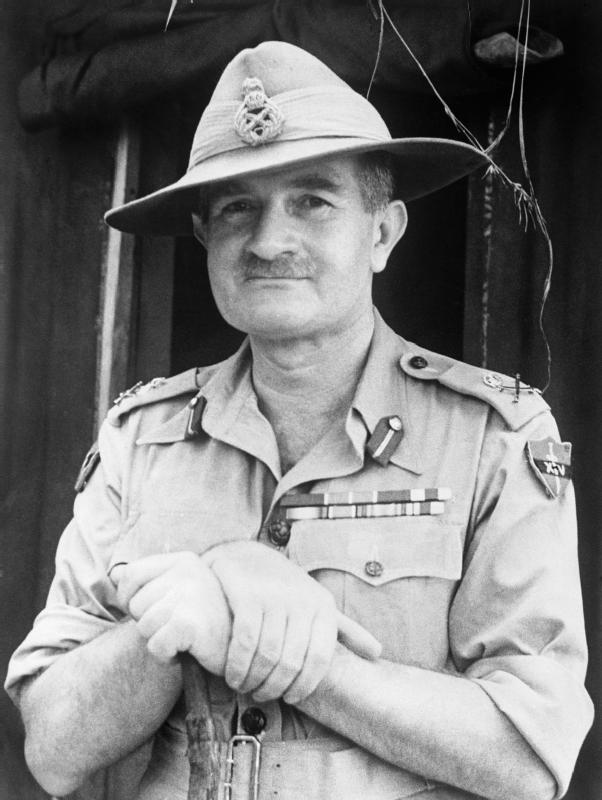
Field Marshal Sir William Slim (1891-1970), during his time as GOC XIVth Army.
Portrait by No. 9 Army Film & Photographic Unit via Wikimedia Commons.
“Burma and the Birth of Modern Warfare” is the subtitle to my 2004 book and PhD about General Slim’s command of the 14th Army in Burma during the last war, titled Slim, Master of War, a use of Sun Tzu’s description of a “heaven-born” commander. It may appear a rather grand claim, and perhaps it is, but the purpose of the subtitle reflects that fact that Slim’s conduct of operations in India and Burma in 1944 and 1945 represented an entirely new style of warfighting to that experienced by the British Army during the war. Instead of looking back to the lessons of World War One, Slim’s conduct of operations looked forward to reflect a style of warfare that would only be adopted as formal doctrine by the British Army in the 1980s. In the mid-1940s it remained alien to the vast bulk of similar British military experience and understanding.
My argument wasn’t that Slim was the best general who had ever commanded men in the history of warfare. That may or may not be true, but for the sake of my argument is irrelevant. My proposition, rather, is that:
Slim was the foremost British exponent in the Second World War of the “indirect approach” and that in his conduct of operations in 1944 and 1945 he provided a clear foreshadowing of “manoeuvre warfare”.
My idea, which first saw expression in my 2004 book, has been developed since then in my subsequent writings, including that of Japan’s Last Bid for Victory, which deals with the great events in the Assam and Manipur in 1944 (2011) and A War of Empires (2021). A major reason for the continuing amnesia in British military thinking about the warfighting characteristics of the Burma Campaign – apart from the fact that it is a long way to go for a staff ride – seems to be the fact that Slim’s style of warfighting remained largely alien to the British Army’s doctrinal precepts until the late 1980s. Until then, Slim’s strategic conceptions had been considered an aberration, and Slim himself regarded merely as the epitome of a fine military leader, and nothing more. Then, in a doctrinal revolution which began in the 1980s, the old firepower-based foundations – which themselves were largely a product of Montgomery’s approach to war in 1944 and 1945 – in which the supreme military virtue was the effective and coordinated application of force, were replaced. This revolution in doctrine and thinking about warfighting exchanged the old foundations with new ones based on an entirely different conception, that of manoeuvre at the operational level of war, in which notions of subtlety, guile and psychological dislocation came to be emphasised in an entirely new and refreshing way. My belief is that it was the effective and pragmatic employment of manoeuvre at the operational level of war by Slim in Burma that was the direct cause of the extraordinary victories the 14th Army achieved in 1944 and 1945 and which led to the two greatest defeats the Japanese Army suffered in the field in the Second World War, the first at Imphal-Kohima in India in 1944 and the second at Mandalay-Meiktila in Burma in 1945. My argument I suppose is that Slim’s exercise of command in Burma makes him not merely a fine example of a “manoeuvrist” commander but in actuality the template for modern manoeuvrist command.
[…]
First, the 14th Army was the only truly joint formation in the British armed forces during WW2. Nothing else, in North Africa, Italy or North-West Europe came close to it. Slim insisted on nothing less than full integration. Not only were headquarters joint, but operational and tactic delivery was also joint. At every level of command air and land headquarters were completely interlinked. I became convinced of this fact when I discovered that the RAF and the Army even shared messes! Strategic air transport, winning the air war, the operational reach and flexibility provided by air power underwrote Slim’s conception of battle, to the extent that the senior RAF officer in the theatre ruefully concluded in 1945, and I quote, that:
Slim was quicker to grasp the potentialities and value of air support in the jungles of Burma than most Air Force officers.
There was no snobbery and no shibboleths with Slim: if it worked, it was pressed into action.
[…]
Professor Dixon argues [in On the Psychology of Military Incompetence] that, unusually for a senior commander of his ilk in WW2, Slim was non-ethnocentric. He had no intrinsic prejudices about the virtues of one race over another. Slim, after all, was an officer of the Indian Army, and I have yet to come across any evidence that British regimental officers of the Indian Army regarded their soldiers in any way inferior to themselves. He was commonly known to those who served under him as “Uncle Bill” from the special affinity British troops had to him: the remarkable fact, however, was that at least 87% of his Army of several hundred thousand men recalled him as “Cha Cha Slim Sahib”: 14th Army was, after all, very largely Indian, Gurkha and West and East African. I certainly cannot think of any other Indian Army general who had such an impact on British troops. He became, of course, Chief of the Imperial General Staff following Field Marshal Montgomery, in 1948, which securely establishes this feat. On that note, I cannot conceive of “Uncle Bernard” when referring to Field Marshal Montgomery!
The Burma campaign was as much a struggle for mastery of logistics as it was a struggle for mastery on the battlefield, and it was about risk as much as it was about adherence to logistical principles. Slim had an implicit understanding of the constraints placed on warfare by the demands of logistics. Great efforts were made to increase the quantity of supplies to Burma. Railways were extended, roads built and surfaced, sunken ferries refloated and repaired, barges and rafts built for use on the numerous waterways. In this regard Archibald Nye, the VCIGS under Alan Brooke, regarded Slim’s mastery of logistics to be the most significant measure of his greatness as commander of 14 Army in Burma:
He never had enough to do what he had to do and this … is the measure of his greatness.
The practice of war in Burma by Slim was so startling in its modernity, and unlike any other pattern of warfighting by operational level British commanders in the war. My view of Slim as a commander can be interpreted at two levels. He was, first of all, a great commander and leader. Being a master of strategy, of logistics, of technical proficiency and so on are important in themselves when considering the nature of leadership in war, but by themselves they remain insufficient. Successful military command requires someone who can, through dint of personality and inspirational leadership, wield all of the components of fighting power together so that an extraordinary result transpires. What marks Slim out from the crowd was much more than just his winning of a succession of extraordinary battles. His strength lay in his ability to produce a decisive effect from scratch; to mould thousands of disparate individuals together into a single team with a single goal; to persuade a defeated army that it had the potential to turn the tables on their enemies; to master the complexities of terrain, climate and administrative deficiency so that self-help, resourcefulness and ingenuity could become as much prized as fighting skill. In these individual areas, and more, Slim proved the master. His genius for war was the consequence of his ability to bring together all of these elements to create an extraordinary result, the visible sign of which was the greatest defeat suffered by the Japanese on land during the Second World War.


