
On the social media site formerly known as Twitter, The Food Professor celebrates the latest achievement in Canada’s omni-competent supply management system:
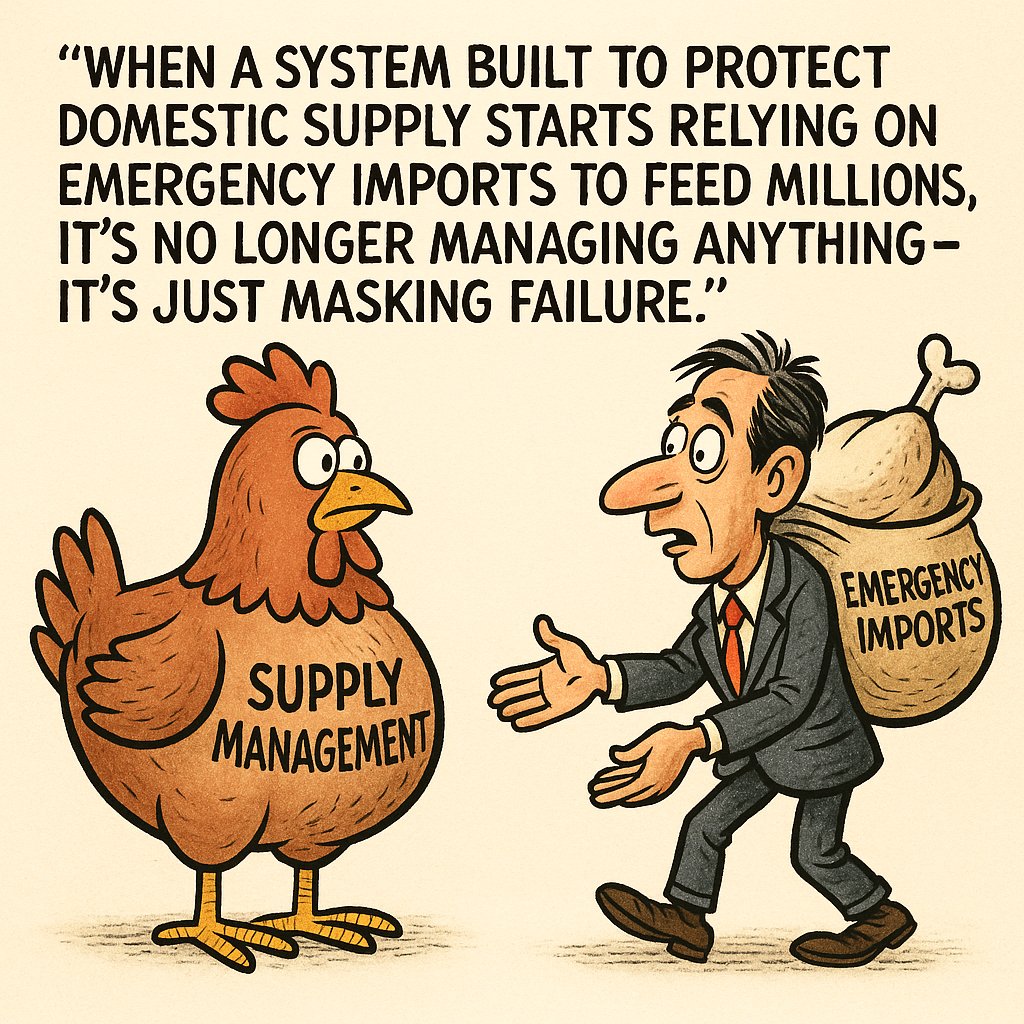
The Chicken Crisis Supply Management Won’t Admit
Canada’s supply management system—once heralded as a pillar of food security and agricultural self-sufficiency—is failing at its most basic function: ensuring reliable domestic supply.
According to the latest figures from the Canadian Association of Regulated Importers (CARI), Canada imported over 66.9 million kilograms of chicken as of June 14 — a 54.6% increase from the same period last year. To put that in perspective, this volume could feed 3.4 million Canadians for an entire year, based on per capita poultry consumption. That’s roughly 446 million individual meals — meals that, under a tightly managed quota system, were meant to be produced domestically.
To be fair, the avian influenza outbreak in Canada has disrupted poultry production, and it partially explains some of the shortfall. But even accounting for that disruption, the numbers are staggering. Imports under trade quotas established by the WTO, CUSMA, and CPTPP are all running at or near pro-rata levels, signaling not just opportunity — but urgency. Supplementary import permits — meant to be emergency tools — have already surpassed 48 million kilograms, exceeding the total annual import volumes of some previous years. This is not a seasonal hiccup. It is systemic failure.
Canada’s poultry sector is supposed to be insulated from global volatility through supply management. Yet internal shocks — like the domestic avian flu outbreak — have shown how fragile the system truly is. When emergency imports become routine, we must ask: what exactly is being managed?
The original intent of supply management was to align production with domestic demand while stabilizing prices and farm incomes. But that balance is clearly off. The A195 production period, ending May 31, 2025, showed one of the worst underproduction shortfalls in more than 50 years. Producers remain constrained by rigid quota allocations, while consumers continue to face rising poultry prices. More imports. Higher costs. Diminished confidence.
Some defenders will insist this is an isolated event. It’s not. This is the second week in a row Canada has reached pro-rata import levels across all chicken categories. Bone-in and processed poultry products — once minor parts of emergency programs — are now central to keeping the market supplied.
The dysfunction extends beyond chicken. Egg imports under the shortage allocation program have already topped 14 million dozen, up 104% from last year. Just months ago, Canadians were criticizing high U.S. egg prices — yet theirs have fallen. Ours haven’t.
All this in a country with $30 billion in quota value, intended to protect domestic production and reduce reliance on imports. Instead, we are importing more — and paying more.
Meanwhile, Bill C-202, now before the Senate, aims to shield supply management from future trade negotiations, making it even harder to adapt or reform. So we must ask: is this what we’re protecting? A system that fails to meet demand, relies on foreign supply, and costs Canadians more at the checkout?
Our trading partners are seizing the moment. Chile, for instance, has increased its chicken exports to Canada by over 63%, now representing nearly 96% of CPTPP-origin imports. While we double down on rigidity, others are gaining long-term footholds in our market.
It’s time to face the facts. Supply management no longer guarantees supply. And when a system meant to ensure resilience becomes the source of fragility, it’s no longer an asset — it’s an economic liability.


