
Some ideas are so horrible that they never, ever die. The Canadian Senate nearly got an age verification and website blocking ban into law during the last Parliament, and as Michael Geist discusses, they’re not giving up now:
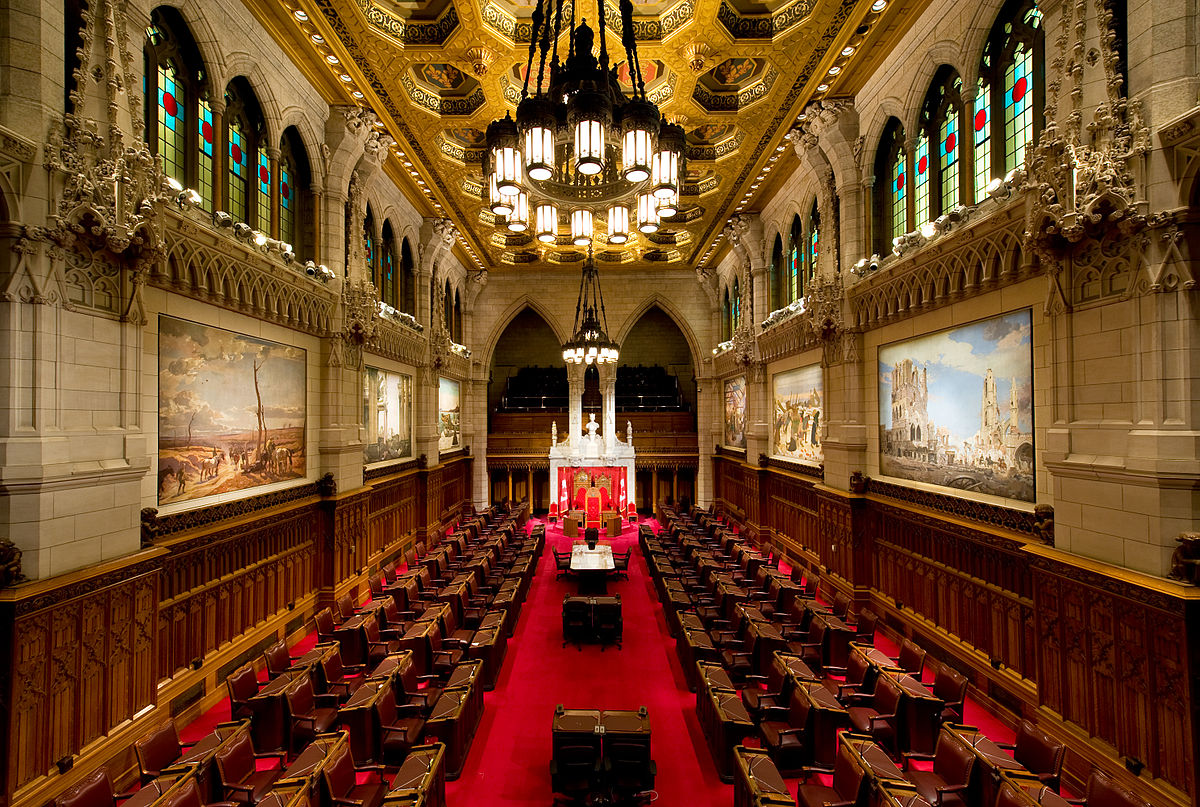
“In the east wing of the Centre Block is the Senate chamber, in which are the thrones for the Canadian monarch and consort, or for the federal viceroy and his or her consort, and from which either the sovereign or the governor general gives the Speech from the Throne and grants Royal Assent to bills passed by parliament. The senators themselves sit in the chamber, arranged so that those belonging to the governing party are to the right of the Speaker of the Senate and the opposition to the speaker’s left. The overall colour in the Senate chamber is red, seen in the upholstery, carpeting, and draperies, and reflecting the colour scheme of the House of Lords in the United Kingdom; red was a more royal colour, associated with the Crown and hereditary peers. Capping the room is a gilt ceiling with deep octagonal coffers, each filled with heraldic symbols, including maple leafs, fleur-de-lis, lions rampant, clàrsach, Welsh Dragons, and lions passant. On the east and west walls of the chamber are eight murals depicting scenes from the First World War; painted in between 1916 and 1920.”
Photo and description by Saffron Blaze via Wikimedia Commons.
The last Parliament featured debate over several contentious Internet-related bills, notably streaming and news laws (Bills C-11 and C-18), online harms (Bill C-63) and Internet age verification and website blocking (Bill S-210). Bill S-210 fell below the radar screen for many months as it started in the Senate and received only cursory review in the House. The bill faced only a final vote in the House but it died with the election call. This week, the bill’s sponsor, Senator Julie Miville-Dechêne, wasted no time in bringing it back. Now Bill S-209, the bill starts from scratch in the Senate with the same basic framework but with some notable changes that address at least some of the concerns raised by the prior bill (a fulsome review of those concerns can be heard in a Law Bytes podcast I conducted with Senator Miville-Dechêne).
Bill S-209 creates an offence for any organization making available pornographic material to anyone under the age of 18 for commercial purposes. The penalty for doing so is $250,000 for the first offence and up to $500,000 for any subsequent offences. The previous bill used the term “sexually explicit material”, borrowing from the Criminal Code provision. This raised concerns as the definition in the Criminal Code is used in conjunction with other sexual crimes. The bill now features its own definition for pornographic material, which is defined as
any photographic, film, video or other visual representation, whether or not it was made by electronic or mechanical means, the dominant characteristic of which is the depiction, for a sexual purpose, of a person’s genital organs or anal region or, if the person is female, her breasts, but does not include child pornography as defined in subsection 163.1(1) of the Criminal Code.
Organizations can rely on three potential defences:
- The organization instituted a government-approved “prescribed age-verification or age estimation method” to limit access. There is a major global business of vendors that sell these technologies and who are vocal proponents of this kind of legislation.
- The organization can make the case that there is “legitimate purpose related to science, medicine, education or the arts”.
- The organization took steps required to limit access after having received a notification from the enforcement agency (likely the CRTC).
Note that Bill S-209 has expanded the scope of available technologies for implementation: while S-210 only included age verification, S-209 adds age estimation technologies. Age estimation may benefit from limiting the amount of data that needs to be collected from an individual, but it also suffers from inaccuracies. For example, using estimation to distinguish between a 17 and 18 year old is difficult for both humans and computers, yet the law depends upon it. Given the standard for highly effective technologies, age estimation technologies may not receive government approvals, leaving only age verification in place.


