
At The Rewrite, Peter Menzies looks back to the bombshell claims that horrified the nation, yet went unquestioned by pretty much all of the mainstream media:
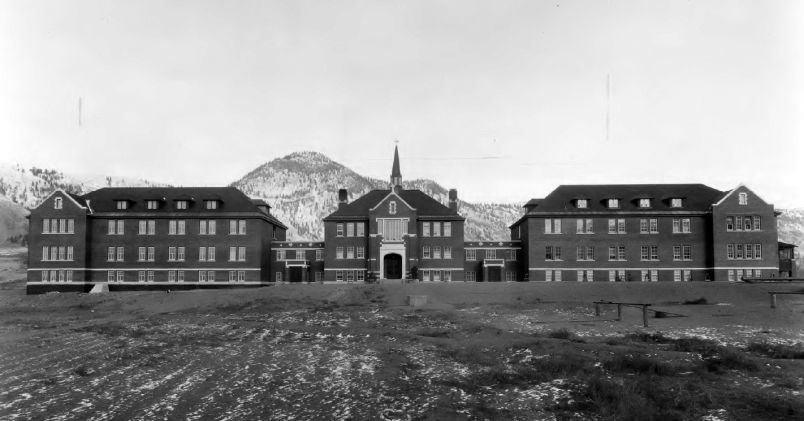
Kamloops Indian Residential School, 1930.
Photo from Archives Deschâtelets-NDC, Richelieu via Wikimedia Commons.
This week marks the fourth anniversary of the day Canada’s media broke faith with the public that funds it.
May 27, 2021, was when the Tk’emlúps te Secwépemc First Nation announced the “confirmation of the remains of 215 children” discovered at the former Kamloops Residential School site. Most, if not all, media reported this statement, which was based on anomalies shown on ground penetrating radar, without challenging its veracity.
Not long after, the Cowessess First Nation in Saskatchewan announced that ground penetrating radar had located 751 unmarked graves in a community cemetery adjacent to the former location of a residential school.
Talk of “mass graves” ricocheted across the country and the world. Prime Minister Justin Trudeau was in Saskatchewan in a flash on bended knee with teddy bears. It didn’t matter that the markers in the cemetery had been removed decades ago by a rogue priest; Anderson Cooper and a 60 Minutes crew were already flying in to Regina. The impression left by the coverage was that children had been murdered en masse. Statues were toppled or put in storage and close to 200 churches were burned — many to the ground — or vandalized in the months and years that followed. Pope Francis visited Canada in 2022 to atone once again for the Roman Catholic church’s role in operating many of the schools.
All because no one had the courage to ask: “This is a very serious allegation – how can you be certain?” and then, in the immortal words of the City News Bureau of Chicago, check it out.
The coverage at the time showed little evidence journalists looked for proof beyond the Tk’emlúps te Secwépemc allegation or gave sufficient play to Cowessess Chief Cadmus Delorme’s efforts to establish context.
Since then, the Tk’emlúps te Secwépemc have revised their confirmation of bodies so that they now maintain the radar showed anomalies that possibly could be graves. No bodies have been found or, for that matter, searched for. The band has received millions of dollars to assist it with its investigation and the school is now a national historic site.
The original stories remain online and, in many cases, uncorrected, leaving the public’s understanding of the matter unchanged. Here’s one example from CTV/Canadian Press. The headline — “Remains of 215 children found buried at former B.C. residential school” — is still there. CBC has made an effort to update its stories, but its original headlines remain and recent incidents suggest staff still believe the initial version.
As Marco Navarro-Genie of the Frontier Centre for Public Policy recently wrote, media may even have been enlisted as allies to ensure the allegations went unchallenged:
“According to The Knowing by Tanya Talaga, “select journalists” were given embargoed details to ensure “sensitive and impactful” coverage. CBC journalist Angela Sterritt admitted she was in contact with the Tk’emlúps te Secwépemc the day before the announcement and was one of only a few journalists granted access to the June 4, 2021, video conference, where live-streaming was prohibited. This raises serious questions about whether the CBC acted as a passive reporter or an active participant in promoting an unverified claim.”
Shamed domestically and internationally, the nation’s flags went to half mast for months before being raised only in deference to Remembrance Day. A new holiday was declared for federal employees and the Prime Minister took advantage of the first one to go surfing.
There is no question that children died at residential schools. I have stood by and honoured the once unmarked graves — including those belonging to children of the school’s principal — at the reclaimed site of the Indian Industrial School outside Regina. Nor is there doubt that many students suffered from cultural dislocation, shaming and abuse. But that is no excuse for media not reporting the original Tk’emlúps te Secwépemc claim and the Cowessess news professionally and instead wildly and widely misinforming the public, raising the spectre of mass murders and traumatizing many. It’s one thing to make a mistake, quite another to leave it uncorrected because you prefer the impression it made.


