
Daniel Jupp uses the famous Jacques-Louis David painting of the 1793 assassination of French revolutionary leader Jean-Paul Marat by Charlotte Corday to illuminate the twisted dealings of the various radical factions within the larger revolutionary movement:
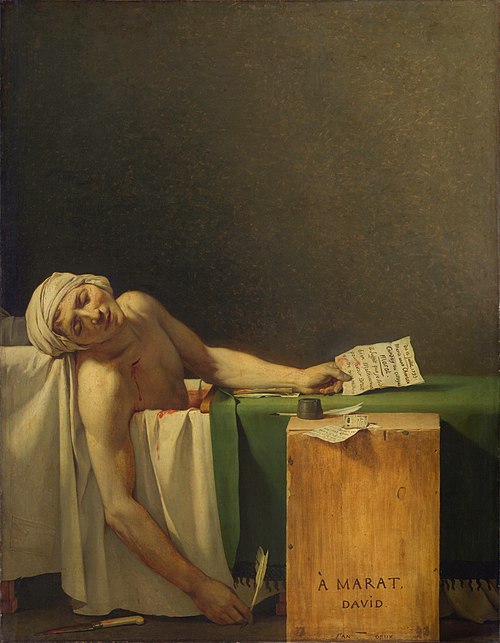
La Mort de Marat (The Death of Marat) by Jacques-Louis David (1748-1825)
From the Royal Museums of Fine Arts of Belgium via Wikimedia Commons.
One of the most famous and celebrated works of art in European history is a painting about a political assassination. That painting is The Death of Marat (La Mort de Marat in French) by Jacques-Louis David. It was painted in 1793. David was already one of the most respected French artists of the 18th century, a leader of French Neoclassical art. He was also himself a political figure, a prominent member of the Montagnard faction (itself a subset of the Jacobins) and a member of the revolutionary Committee of General Security.
It’s an overtly political painting in every way, created by a man who was as much a French Revolutionary politician as he was an established and esteemed artist. It’s about a shocking political event, and it was crafted as an exercise in propaganda. […] The painting shows us Marat in his bath, immediately after being assassinated by Charlotte Corday on the July 13, 1793. It is a beautifully composed image of political martyrdom. Marat’s posture, for anyone with the slightest awareness of Western art traditions, immediately shows where the sympathies of the artist lie (and also, where the sympathies of the artist lie).
Marat’s pose is, of course, a deliberate mirroring of the pose of Christ in hundreds if not thousands of Western art traditional depictions of the Crucifixion. The pale, slim but muscular figure, marked by the assassin’s blade but in a manner that might be compared to the puncture wound inflicted by the Spear of Longinus or to the stigmata nail wounds of crucifixion on Christ himself, has that peculiar serenity in death that other artists place in depictions of Jesus. The blood is present as proof of supreme sacrifice, but artistically minimised, prevented from distracting from the clean, shining, almost marble-like flesh of the deceased, who is already a kind of heroic statue in repose, fixed for the admiration of the ages. The dead man has a gentle, compassionate smile on his lips, as if interrupted in the process of forgiving his murderer. The angle, the gentleness, the delicacy of it all suggests Christ-like self sacrifice, as if Marat has chosen his death knowingly, given his life willingly.
Here is the martyr of the Revolution. A new Christ, as good as the old one … if not better.
[…]
It’s at this point that we should mention the central dishonesties here. Christian self sacrifice and martyrdom is a very different thing to one politically radical extremist being murdered by another. Marat was, in reality, about as far away from this movingly gentle depiction of him as one could imagine. As one of the most radical and zealous figures of the Revolution, Marat was a lesson for the ages in the exact opposite way to the one that David depicts. He wasn’t a gentle figure of self sacrifice. He wasn’t a Lamb bringing Peace in the manner of Christ. He wasn’t an innocent. He was a brutal, grasping, rapacious sadist. He was one of the leaders of the storming of the Bastille, and that too has symbolic and practical importance – the terrible monarchical regime had hardly anyone in its most hated prison, whereas the Revolutionary “liberators” soon stuffed it full of their political enemies.
Even at a point where many murders were already being committed, Marat was noted as an unusually brutal proponent of Revolutionary excess. His assassin was from a rival, supplanted Jacobin faction, the Girondists. The Girondists too had supported the earliest uses of violence, riot and uprising within France, and were a “war party” who wanted to export the Revolution abroad and topple monarchical dynasties across Europe. These two factions did not really differ on whether you should murder your political enemies or not, but the Girondists were at times embarrassed by Montagnard violence when it was at its most indiscriminate. The Girondists tended to be the most intellectualised of the Revolutionaries. They were the writers of pamphlets and doctrines of great length and increasingly mind-numbing tediousness. Marat, although also a street-level gutter pamphleteer, was much more of a bloody handed man of action, more akin to a modern terrorist. But the two were aligned in the creation of the bloodshed, even if the Girondins wanted it to be more focused and controlled and ultimately directed outside France:
Temperament largely accounts for the dividing line between the parties. The Girondins were doctrinaires and theorists rather than men of action. They initially encouraged armed petitions, but then were dismayed when this led to the émeute (riot) of 20 June 1792. Jean-Marie Roland was typical of their spirit, turning the Ministry of the Exterior into a publishing office for tracts on civic virtues while riotous mobs were burning the châteaux unchecked in the provinces.
The split between the two factions came to a head as a fall out from the September Massacres of 1792. Marat, a leader of the peasant sans-culottes mobs, was personally engaged in the orgy of bloodshed. Girondist leaders were alarmed, already sensing that previously aligned Revolutionaries or widespread mob violence could turn on them. Typically, the Girondists took defensive measures that were mainly concentrated on written statements, declarations or on bureaucratic ministries, whereas the Montagnards gradually took control of revolutionary militias and the people who were prepared to actually decide, at the point of a sword or via the barrel of a musket, who got killed and when. Neither side could be described as moderates, but one side were more ruthlessly pragmatic, which is why it was the Girondists who ended up being put on the execution lists of the Terror.
At the time that Corday assassinated Marat, Girondists had already been ousted from positions of power and arrested. Marat, along with Danton and Robespierre, was one of their three most prominent denouncers and enemies. Corday stated that she had “killed one man so that 100,000 could be saved”. It’s clear that she had hoped her action would save her arrested Girondin allies and personal friends, but it had the opposite effect and sealed their subsequent trial and executions.


