
In general terms, you would expect the government — in this case the Ontario provincial government — to pass the laws and the courts — when called upon — to rule on their legality. We don’t expect courts to act as if they can overrule legislation passed by the government unless it clearly contravenes the Charter or goes beyond the powers assigned to that level of government. But Canadian courts seem to be choosing to expand their powers to curtail the actions of elected government more and more these days:
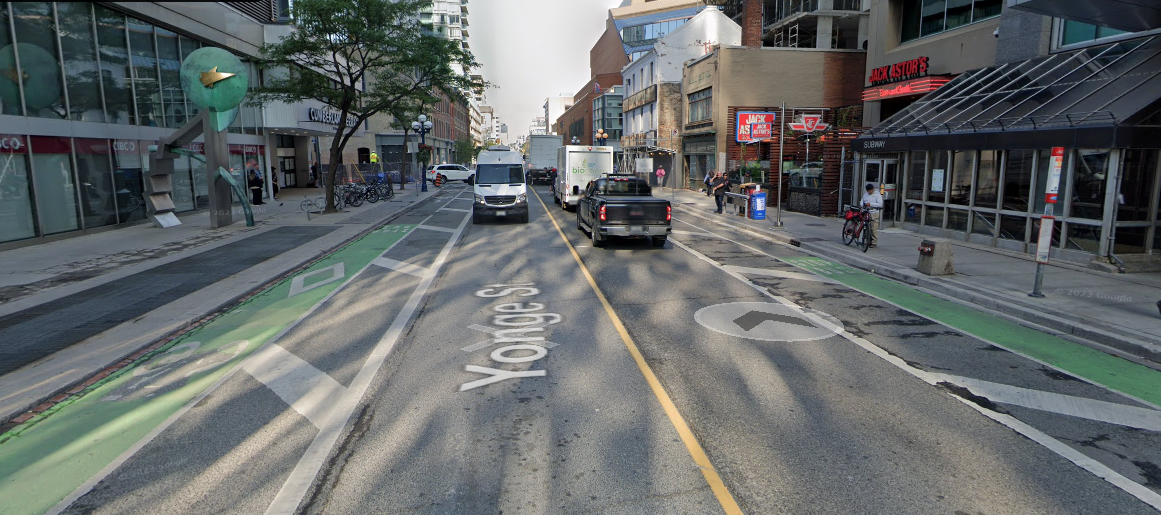
Bike lanes on Yonge Street north of Bloor Street in downtown Toronto.
Image from Google Street View
In the weeks of the election period, Canadian courts were busy preventing any legislation of controversy from taking effect — and they went relatively unnoticed. On March 28, the Ontario Superior Court of Justice blocked the Ontario government from banning supervised consumption sites near schools and daycares. It struck again on April 22, halting the Ontario government from removing Toronto’s bike lanes.
Days later, on April 24, the Quebec Superior Court cancelled the province’s planned mega-tuition hike for out-of-province students.
In the case of Toronto’s major bike lanes — on Bloor Street, Yonge Street and University Avenue — Ontario Premier Doug Ford had, in theory, all the power he needed to remove them. Municipalities are creatures of the province, and traffic regulation is also a provincial domain; thus, provincial legislatures can override just about anything that a city council does, especially if related to roads. So, in November, Ford legislated the removal of the lanes, which were previously constructed by city authorities (he was later re-elected premier, so clearly bike lane preservation wasn’t a priority for voters).
In December, cycling advocates launched a court challenge that, really, should have been laughed out of the room. They argued that the removal of bike lanes amounted to a violation of their Charter rights, specifically the Section 7 catch-all right to life, liberty and security.
It remains to be seen whether there is a Charter right that guarantees two per cent of the population the right to have specialty lanes built for their commuting pleasure — the trial process is still underway. In the meantime, Ontario’s Judge Paul Schabas, a Liberal appointee, has granted the cycling advocates an injunction to keep the lanes in place, because allowing their dismantling to go forward would impose an injunction-worthy risk of “irreparable harm” to Toronto’s cyclists.
“There is no evidence that the government has engaged in any planning as to how the bike lanes will be removed or what will replace them,” Schabas wrote in the decision. “The demolition and reconstruction will create its own impacts on traffic — both for cyclists and motor vehicles — and will likely result in considerable disturbance and congestion while that is taking place. Cyclists who continue to use these routes will be at risk of irreparable physical harm for which … the government will not provide any compensation in damages.”
And, just like that, a judge overruled a decision of the elected legislature, opting instead to take, temporarily, the zero-risk-tolerance advice of unelected government consultants. It’s at least good that Ford is appealing Schabas’ decision.


