
Jesse Kline refutes Mark Carney’s recent diss against libertarians:

The Liberal Boomer in his natural state (spotted on social media, 20 April, 2025).
“The capacity of the federal government to invest in the economy, to support businesses and individuals, will ensure that we bounce back strongly.”
That was Prime Minister Justin Trudeau announcing an $82-billion support package at the beginning of the COVID-19 pandemic, but it could just as easily have been Carney, who said over the weekend that, “In a crisis … government needs to step up.”
At a Saturday news conference, the Liberal leader unveiled his party’s election platform, which includes $130 billion in new spending over four years to fend off the threats posed by U.S. President Donald Trump.
“It’s said there are no atheists in foxholes, there should be no libertarians in a crisis,” Carney argued to justify the continued spending spree.
This offends me as both a libertarian and an atheist. In fact, Canada would be in much better shape today if there were a few libertarians in the room when the Liberals were dealing with the numerous emergencies they’ve faced over the past decade.
The problem with crises is that there’s no way to predict when the next one will hit. But a prudent government should expect the unexpected and leave some fiscal room in the budget to address unforeseen events, while working to fortify the economy during good times so it can withstand the bad. This is not what the Liberals have done.
They took a $1.9-billion surplus in the 2014-15 fiscal year and turned it into a $25-billion deficit in 2016-17.
[…]
And so, we got more Big Government programs that we could ill afford, while Trudeau turned away world leaders looking to Canada to help solve an energy crisis resulting from Russia’s invasion of Ukraine.
Now, as Carney prepares to launch another massive spending spree to deal with the effects of U.S. tariffs, he’s pledging hundreds of millions of dollars for unnecessary programs, including permanent funding for the Sexual and Reproductive Health Fund to make it easier to abort babies, and $400 million for IVF treatments to create new ones in a test tube.
Needless to say that if there were some libertarians around the cabinet table during the crises of the past 10 years, we likely wouldn’t be facing a major economic upheaval with a $40-billion budget deficit, which Carney wants to increase to $62 billion, and a national debt approaching $1.26 trillion.
Spending always appeals to the voters at election time, and the Liberals have been past masters of using that to get into power. But even though there may be a lot of ruin in a nation, even the biggest of nations eventually runs out of money. According to a report from Policy Horizons Canada, an in-house government think tank, we’re well on the way to reaching that ruin and nobody will like what that looks like:
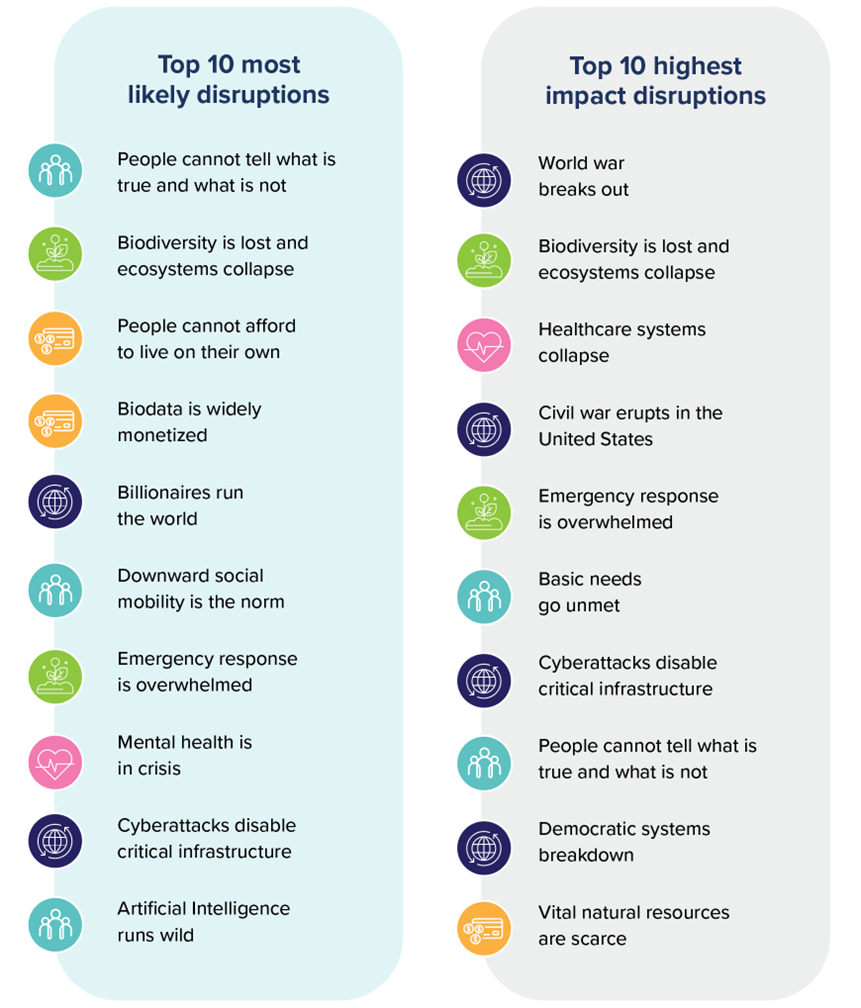
The report warns that by 2040, housing affordability is essentially limited to the wealthy or those with family help; most new homeowners get help from family, some depend on intergenerational mortgages and have several generations of family living together, and others enter “alternative” household mortgages with friends, with a growing percentage of homeowners also owning rental properties.
“Inequality between those who rent and those who own has become a key driver of social, economic, and political conflict,” reads the report.
Moreover, the report highlights a growing dependence on intergenerational wealth, noting that by 2040, inheritance is widely seen as the only reliable path to prosperity. “Society increasingly resembles an aristocracy,” it states, as family background — particularly property ownership — becomes the defining factor in determining one’s opportunities.
Canadians in this future rarely mix with others of different socio-economic status, and there is a clear disconnect between the aspirations of the country’s youth and economic realities, which leaves most with limited expectations of success.
And finally, the rapid propagation of artificial intelligence has dramatically reshaped the labour market. By 2040, the rise of artificial intelligence will have significantly diminished the availability of jobs in creative and knowledge-based professions, once seen as stable paths to upward mobility.
[…]
As a result of the six factors, Canada’s economy could shrink or become less predictable, with the consumer economy shrinking in size, and a higher proportion of very wealthy, older people holding the capital capacity for investment in new businesses. Labour unions could also grow in power and size from a frustrated population. The mental health of Canadians could suffer from living cost challenges.
With these upward mobility issues, Canada may become a less attractive destination for immigrants, and there could be an exodus of young workers, which would exacerbate the issues with supporting the public and social services that support the country’s growing cohort of seniors. This could also result in a labour shortage in industries where artificial intelligence is most difficult.
Perhaps most dystopian is a partial reversion of Canadian society to a trade-and-barter and neo-hunter-gatherer society by 2040, in response to declining trust in formal systems and reduced access to traditional economic opportunities.
[…]
The report’s vision of a future Canada — where trust in institutions collapses, effort no longer yields reward, and people yearn for systemic change — carries echoes of that dangerous historical crossroads, where ideological extremes once flourished in the face of prolonged despair.
With all that said, how likely is this precarious scenario of Canadian society in just 15 years from 2025?
According to Policy Horizons Canada, its “research suggests that it is plausible and would create challenges across a range of policy areas.”


