Quotulatiousness

October 7, 2010

Feschuk and Reid don’t think adding Moss will help the Vikings

Filed under: Football — Tags: , , , , — Nicholas @ 17:22

The Two Scotts are rather sniffy about how much, if any, improvement the Vikings will see by adding Randy Moss:

Feschuk: So Randy Moss is back with the Vikings — because nothing inspires a veteran to new heights than returning to the scene of his greatest suckouts, hissy fits and feigned moonings that make Joe Buck cry. Clearly, this is an attempt to appease Brett Favre, which is a waste of time because everyone knows you can’t please old people.

     Coach Childress: Hey, Brett, look! I brought you a shiny new deep threat!

     Brett: Bah. Nobody visits me and ham doesn’t taste like it used to.

Pick: New York.

Reid: The Moss deal got me to thinking: Mabye we could get traded back to the PMO. Sure, Harper would be a bit different to work for than Martin — there would be fewer free-wheeling debates, more cats and way more waterboarding. But wouldn’t it be nice to tear it up big in the old town again? I guess that’s the nostalgic glow that’s roped Randy Moss back to Prince territory. Here’s a fun party game: Add Randy Moss’ age to the number of seasons Brett Favre has played, then divide by the total touchdown passes that Bernard Berrian has caught this year. If it comes out zero, congratulations. You’re not only correct, you’re Brad Childress — watching your season circle the toilet bowl. I’m not saying this looks desperate but the Vikings may have to change their name to Danny Bonaduce. Pick: New York.

Breaking: Historians confess they invented “ancient Greeks”

Filed under: Europe, Greece, History, Humour, Media — Tags: , — Nicholas @ 12:41

As many had suspected for years, the entire history of ancient Greece was fabricated by historians:

A group of leading historians held a press conference Monday at the National Geographic Society to announce they had “entirely fabricated” ancient Greece, a culture long thought to be the intellectual basis of Western civilization.

The group acknowledged that the idea of a sophisticated, flourishing society existing in Greece more than two millennia ago was a complete fiction created by a team of some two dozen historians, anthropologists, and classicists who worked nonstop between 1971 and 1974 to forge “Greek” documents and artifacts.

“Honestly, we never meant for things to go this far,” said Professor Gene Haddlebury, who has offered to resign his position as chair of Hellenic Studies at Georgetown University. “We were young and trying to advance our careers, so we just started making things up: Homer, Aristotle, Socrates, Hippocrates, the lever and fulcrum, rhetoric, ethics, all the different kinds of columns — everything.”

[. . .]

According to Haddlebury, the idea of inventing a wholly fraudulent ancient culture came about when he and other scholars realized they had no idea what had actually happened in Europe during the 800-year period before the Christian era.

I’m glad that they’ve finally come clean on this huge historical fraud. Especially The Iliad, which “was a bitch to write, by the way” but “it seemed to catch on.”

QotD: The dangers of being a novelist

Filed under: Books, Humour, Media, Quotations — Tags: , , — Nicholas @ 12:30

I’m in the middle of starting a new novel right now, and the bad thing about that strange phase of existence is that everything you see and hear somehow relates, in the wankmulch your brain has become, to that novel. Even a shopping list becomes a mass of notation and connective lines — because you’re convinced that the six things on it reveal something phenomenal about the world and your place in it, and there’s a place in the novel where you can shove all that in.

Deep down, there’s a little James Joyce homunculus in our hearts, presumably chatting up a saucy-looking ventricle and asking it if it shags, and also spreading the beautifully toxic notion that his book Ulysses actually contains all of Dublin in it and, should it ever be destroyed, a new Dublin could be generated from it like a backup copy, if needs be. And so we peer around at everything, to see if we can image it on a hard drive of a book, ghosting the real world.

Also it’s important to note that when writers — or at least I — get into this condition, we talk very fast and make not a lot of sense.

Warren Ellis, “Ghosting the real world”, Wired (UK), 2010-10-07

Not only is the science not “settled”, we still need to learn far more

Filed under: Science — Tags: , , — Nicholas @ 07:49

Counter-intuitively, although the sun has been going through a period of decreased activity over the last few years, a new study in Nature claims that there’s been an increase in the amount of visible light and near-infrared energy:

New data indicates that changes in the Sun’s output of energy were a major factor in the global temperature increases seen in recent years. The research will be unwelcome among hardcore green activists, as it downplays the influence of human-driven carbon emissions.

As the Sun has shown decreased levels of activity during the past decade, it had been generally thought that it was warming the Earth less, not more. Thus, scientists considered that temperature rises seen in global databases must mean that human-caused greenhouse gas emissions — in particular of CO2 — must be exerting a powerful warming effect.

Now, however, boffins working at Imperial College in London (and one in Colorado) have analysed detailed sunlight readings taken from 2004 to 2007 by NASA’s Solar Radiation and Climate Experiment (SORCE) satellite. They found that although the Sun was putting out less energy overall than usual, in line with observations showing decreased sunspot activity, it actually emitted more in the key visible-light and near-infrared wavelengths.

These shorter wavelength forms of radiated heat penetrate the atmosphere particularly well to heat up the Earth’s surface — just as the same frequencies get in through car windows to heat up its interior. The hot seats and dashboard — in this case the seas, landmasses etc — then radiate their own increased warmth via conduction, convection and longer-wave infrared, which can’t escape the way the shortwave energy came in. This is why the car, and the planet, become so hot.

Thus the Sun, though it was unusually calm in the back half of the last decade, was actually warming the planet much more strongly than before.

If this research is confirmed, it certainly provides a lot of ammunition to the folks who don’t want to spend huge sums to try to cut down carbon emissions.

Isn’t this a barbaric practice for a free society?

Filed under: Law, Liberty, USA — Tags: , , , , — Nicholas @ 07:25

I’m generally fine with our American neighbours, our societies are similar in so many respects, but this whole “Pledge of Allegiance” thing is something that I just don’t get. A country that theoretically prides itself on being the “home of the free” can still put you in jail for failing to recite it on command?

Danny Lampley (who clerked for me in law school), was jailed by Chancery Court Judge Littlejohn in Tupelo for failing to recite the pledge of allegiance in open court today. Danny was one of the local lawyers who represented the plaintiff in the Pontotoc school prayer case years ago, working with the ACLU and People for the American Way.

I’m informed that Danny rose and was respectful, but did not recite the pledge.

Is this just Judge Littlejohn being a prick, or does this sort of thing happen regularly? What penalty would he get for not singing the national anthem?

H/T to Radley Balko for the link.

The sad tale of the used book hunter

Filed under: Books, Economics, Media — Tags: , — Nicholas @ 00:04

By way of Walter Olson’s Twitter feed, a story of real life arbitrage — the Confessions of a Used Book Salesman:

I make a living buying and selling used books. I browse the racks of thrift stores and library book sales using an electronic bar-code scanner. I push the button, a red laser hops about, and an LCD screen lights up with the resale values. It feels like being God in his own tiny recreational casino; my judgments are sure and simple, and I always win because I have foreknowledge of all bad bets. The software I use tells me the going price, on Amazon Marketplace, of the title I just scanned, along with the all-important sales rank, so I know the book’s prospects immediately. I turn a profit every time.

I’m pretty sure I first heard about the practice of shopping for books with laser scanners in a story on NPR, which, as I recall it, disparaged their use as classless. And, really, it is precisely this. The book merchant of the high-cultural imagination is a literate compleat and serves the literate. He doesn’t need a scanner, because he knows more than the scanner knows. I fill a different niche — I deal in collectible or meaningful books only by accident. I’m not deep, but I am broad. My customer is anyone who needs a book that I happen to find and can make money from.

My economics side says this is a good thing: connecting buyers with their desired purchases. My bibliophile side says this is somehow morally wrong . . . or if not precisely wrong, then tainted or shady. I’m not sure how to reconcile my feelings.

October 6, 2010

Follow up: burning the free market for government failure

Filed under: Economics, Government, Liberty, Media, Politics — Tags: , , , — Nicholas @ 17:06

The story about the fire department letting the house burn down has been used to “prove” that it’s a case of market failure and that free markets can’t provide public goods. Given that it wasn’t actually a “free market” entity, that argument doesn’t hold much promise:

National Review’s Daniel Foster jumps in to say that this is why conservatives need to curb their enthusiasm for the market economy. A colleague in the “anarcho-capitalist” camp stuck his head into Daniel’s office to explain that fire protection is not a human right, so it makes sense that the house was allowed to burn. Paul Krugman (he never goes away) adds that this is a case against the market in general. “Do you want to live in the kind of society in which this happens?”

I don’t get this debate at all. It is not even a real debate. The fire-protection services were government services. The fee in question was a government-mandated fee. The county lines in which the fee was applicable is a government-drawn line that is completely arbitrary. The policy of not putting out the fire was a government policy enforced by the mayor. As he said, in the words of a good bureaucrat, “Anybody that’s not in the city of South Fulton, it’s a service we offer, either they accept it or they don’t.”

So why is the market being criticized here? This was not a real market. Instead, this is precisely what we would expect from government. In a real market, there is no way that a free-enterprise fire service would have refused to provide the homeowner service. They would be in business to provide that service. The fire would have been put out and he would have been charged for the service. It is as simple as that. It is the same as lawn-mowing services or plumbing services or any other type of service. Can we know for sure that the market would provide such services? Well, if insurance companies have anything to say about it, such services would certainly be everywhere.

As it was, the fire burned down as a result of government policy, a refusal of service because the homeowners did not pay what amounted to a tax! The poor homeowner begged for help and offered to pay. He had paid the year before and the year before, so his credit was good. Even so, the bureaucracy refused!

Montessori school raided by New Mexico drug cops

Filed under: Education, Law, USA — Tags: , , , , — Nicholas @ 13:10

You can rest easy, knowing that a potentially dangerous grow op has been investigated by New Mexico Schutzstaffel drug cops:

“We were all as a group eating outside as we usually do, and this unmarked drab-green helicopter kept flying over and dropping lower,” she said. “Of course, the kids got all excited. They were telling me that they could see gun barrels outside the helicopter. I was telling them they were exaggerating.”

After 15 minutes, Pantano said, the helicopter left, then five minutes later a state police officer parked a van in the school’s driveway. Pantano said she asked the officer what was happening, but he only would say he was there as a law-enforcement representative.

Then other vehicles arrived and four men wearing bullet-proof vests, but without any visible insignias or uniforms, got out and said they wanted to inspect the school’s greenhouses. Pantano said she then turned the men over to the farm director, Greg Nussbaum.

Ms. Pantano must have nerves of steel . . . most schools would have gone into emergency lock-down at the sight of all those paramilitary types deploying in the driveway.

The comments on BoingBoing were good, and this one was great:

The War on Organic Produce continues to go well. Each of those tomatoes cost the taxpayer $75.00 US! WE WILL NOT BE SATISFIED UNTIL THE DRUG CZAR IS RUMOURED TO CURE GOUT BY WASHING THE FEET OF THE AFFLICTED.

Seriously: What the fucking fuck fuck happened to Probable Cause in this day and age? “We’re spending $20,000 on this operation because we herd thai leik mudkips, so we kipped in thair mud so thai can mud whail thai kip.” In the immortal words of Plato, NON FUCKING SEQUITUR is NOT a RIVER in EGYPT!

“What else floats the same as a Cannabis Sativa plant??? – er, WOOD! – Good, what else? – well, tiny rocks. – OH! A DUCK! – Right! So if the suspects are raising ducks — THEN THEY’RE RAISING POT! – WELL /DONE/!”

Law Enforcement by Superstition is horse-shit.

Gun hobbyist’s dream

Filed under: Liberty, Randomness, Technology — Tags: , , — Nicholas @ 12:23

L. Neil Smith, in an ideal world (that is, after the Libertarian revolution), would like to do some serious gunsmithing:

I have some interest in reclaiming good technology that has been abandoned by our civilization, usually for the most stupid of reasons. Living in a free country would mean that I could return to a dream I’ve had for years, of becoming a weapons-manufacturer. For example, as a gunsmith, I don’t believe that history and humanity are quite through with the design known as the “Broomhandle Mauser”, the first commercially successful semiautomtic pistol. The Broomhandle is so different in conception and execution from the Browning-invented weapons we’re all used to, as to seem like the product of an alien mind.

If you’re not familiar with the Broomhandle Mauser, here’s a picture from http://www.g6csy.net/c96/database.html:

Some folks don’t like the Mauser’s grip, which I find perfectly comfortable, and seem to forget that we almost never shoot a revolver today with handles shaped like its frame. I love neoprene grips like the Pachmayr “Presentation” model, myself. They make shooting magnums pleasant. Others don’t like magazines situated in front of the trigger, rather than inside the handle, but they’re happy with sport-utility rifles like the AR-15 and the AK-47 built exactly the same way.

What killed the “Broomie” was the inadequate cartridge, 7.63x25mm, it was made for. By the time a more effective offerng was available — 9mm Mauser Export, which rivaled the .357 Magnum — it was too late. Browning designs and their imitators had taken the field over. But with modern steels and production techniques, in effective calibers — like .40 S&W, 10mm, or .45 ACP — there is still a place for the Mauser design. I’d even like to make a miniature that shoots .22 Long Rifle.

Make no mistake, I absolutely venerate St. John Moses Browning’s 1911, and his P35 Browning High Power is also “of the best” — or at least it would be if it could be made for a worthwhile cartridge without messing up its marvelous handling qualities, as I find the .40 caliber version does. I have some fresh ideas in this area, beginning with a 145-grain .375 bullet loaded into a modified 8mm Nambu parent case.

The Browning 9mm was first handgun I ever fired, and is still one of my favourites:

At the same time, however, I would bring the Dardick pistol back, an absolutely revolutionary design that combines the best qualities of automatics and revolvers, without any of the drawbacks of either. Critics at the time of its introduction said it looked too weird — rather like an oldtime Weller soldering gun — but how do you suppose the Broomhandle, the Luger, and the 1911 looked to generations of revolver-shooters? Aesthetics are arbitrary, and shooters would get used to the Dardick as they did to other weapons, if it served them well.

The Dardick was indeed an odd-looking weapon:

The Dardick used special plastic-cased cartridges with a roundly triangular, or trochoidal, cross-section, loaded with a .38 caliber bullet. It was pretty clearly aimed at the police market, where the standard at the time (the late 1950s) was the wildly-successful Smith & Wesson Model 10, of which it is said more than six million were produced.

There’s no reason that the Dardick concept couldn’t be mated with much better calibers than it was offered in. With its double-action works, and an astonishing magazine capacity (in 1958) of fifteen “trounds”, it might well have nudged the Model 10. But it fell victim, not to the market, but to a corporate boardroom dispute, and history lost one of the most effective devices for personal defense ever invented.

As Neil pointed out in one of his books, the Dardick was the answer to a bad crime writer’s prayers: it was literally an automatic revolver. (For those following along at home, an “automatic” has a magazine holding the bullets which are fed into the chamber to be fired by the action of the weapon: fire a bullet, the action cycles, clearing the expended cartridge and pushing a new one into place, cocking the weapon to fire again. A “revolver” holds bullets in the cylinder, rotating the cylinder when the gun is fired to put a new bullet in line with the barrel to be fired. The Dardick is the only example I know of that combines both in one gun.)

It’s probably a good thing that I live in Canada, where owning handguns is a legal marathon, otherwise I’d probably have another expensive collecting hobby . . .


British forces facing imminent cuts

Filed under: Britain, Economics, Military — Tags: , , , , , — Nicholas @ 12:15

Lewis Page makes what I think is the correct call for the British government’s National Security Council to keep the Royal Navy’s carrier program and gut the RAF deep bomber fleet and the army’s heavy combat arm:

Thus it is a good bet that the first of the two new carriers for the Royal Navy will go ahead. The second may be downgraded to serve as an amphibious-warfare ship full of troops and helicopters rather than combat aircraft, or it might be cancelled altogether — which means British shipbuilding would be kept alive by bringing forward plans for a new generation of navy frigates.

The RAF and even the Army will be offering up massive cuts of their own — it is expected that the entire Tornado deep-bomber fleet will be retired years early, and the current Cold War style armoured-warfare juggernaut of tanks, mobile artillery and infantry fighting vehicles is set for a major trim back — so there is only one way that the government can preserve a two-carrier navy.

A navy with pretensions to independent action requires aircraft carriers. Plural. A single carrier isn’t enough, and places too much of your naval “capital” in a single hull. Two is the minimum (and three would be even better): you can, with care, always have at least one carrier fully worked-up and ready to deploy.

Even if the RN gets both carriers through the NSC flensing mill, they still face other cuts:

That one way is to finally cut the Royal Navy’s force of frigates and destroyers — collectively known as “escorts”, as their primary role is to protect and defend major warships — down to numbers suitable for actually escorting our biggest ships. For the past many decades, for reasons of history and jobs for the boys, the RN has actually maintained far more escorts than it needs to escort major units such as carriers and amphibious task groups.

Realistically, a combat carrier can actually protect herself using aircraft far more effectively than her escorts can: but it is reasonable to say that sending a carrier out to a major war alone, when just one bomb or missile or torpedo could eliminate Britain’s reach into a given theatre — perhaps cutting off air cover, supplies, even the chance of evacuation for our troops ashore — is a gutsy call.

Reducing the number of frigates and destroyers would make a lot of sense (except if you’ve “spent your whole life in an effort to be a frigate captain”). A bigger-ticket item than the carriers themselves is the required aircraft to equip the ships. Current plans are for the role to be given to the ultra-expensive F-35B. Politics aside, it would make brilliant economic and military sense to replace those techno-wonders with slightly less capable F-18s:

Really we need a maximum total escort fleet of say 10, as compared to the Navy’s current lineup of 23. Savings just in running costs over the next decade would add up to at least £11bn. Then we can save at least another billion-odd in acquisition costs by not buying the last two Type 45s and their dubious missile systems. All this is far and away more than enough to ensure that the second carrier is built, and to give the two ships catapult launch. This in turn would permit the purchase of much cheaper and more powerful aircraft for them, easing the problems caused for the MoD budget by the rising costs and delays facing the F-35B supersonic stealth jumpjet (currently grounded following the discovery of technical snags during flight testing).

And why would I, a former ground-pounder, be so enthusiastic about aircraft carriers? Because the British experience has been that the RN has been there for the army when needed:

It hasn’t been often that British troops have needed fighter cover since World War II, but when they’ve needed it they’ve really, really needed it. Just ask the Welsh Guards, chopped to pieces by Argentine jets at Bluff Cove. When there has actually been any fighter cover for British troops in combat since World War II, it has come from the navy, not the RAF. Every time a British fighter has shot down an enemy aircraft since 1945, it took off from a ship to do so. Even back during WWII, lack of carrier air killed a lot of sailors and soldiers — and the presence of it saved many more.

Patriots trading Randy Moss?

Filed under: Football — Tags: , , , — Nicholas @ 09:02

An interesting development, indeed: NFL.com is reporting that a deal to send wide receiver Randy Moss back to Minnesota is “99 percent complete”:

The Patriots would receive a 2011 third-round draft pick in exchange for the seven-time Pro Bowl wide receiver, who started his NFL career with the Vikings in 1998. Had New England allowed Moss to leave in free agency next offseason, it would have received a third-round selection in the 2012 draft as compensation.

Moss, who’s in the final year of his current contract, is scheduled to make $6.4 million in base salary this season. He wants a new deal, but he wouldn’t receive one from the Vikings as part of the trade, Lombardi reported.

[. . .]

What could change is the uniform that Moss wears, although he knows it well.

A first-round draft pick out of Marshall, Moss played in Minnesota from 1998 to 2004 and posted six 1,000-yard seasons. He was traded to the Oakland Raiders and had two mediocre seasons before being dealt to New England, where he enjoyed a resurgence. He caught an NFL-record 23 touchdown passes in 2007, his first season with the Patriots, and hasn’t had fewer than 1,000 receiving yards in a full season with the team.

If so, great! I was very sorry to see Randy leave the team, and it’s been an open secret for years that Brett Favre wanted to play with Moss. The Vikings are desperate for a number one receiver while Sidney Rice recovers from surgery, so this would be a no-brainer. I really hope this isn’t just empty rumours . . .

Update: It’s supposedly a done deal.

More than 38 years after quarterback Fran Tarkenton returned to the Vikings after once being traded away, receiver Randy Moss has gone home, too.

With the chances of the deal hovering in the high 90th percentile only an hour ago, the deal has been completed, according to Adam Schefter of ESPN.

The Vikings get Moss, and the Patriots get a third-round pick in the 2011 draft.

The looming deal was first reported by Jay Glazer of FOX, who also reports that the deal is done. Glazer reports that the Vikings hope to get Moss to Minnesota ASAP in order to commence preparations for the Monday night game against the Jets. Practices begin on Thursday.

We haven’t done the research, but we’re assuming that Moss is the first player in NFL history to appear in back-to-back Monday Night Football games.

The parallels between Moss and Tarkenton are eerie. Both players started their careers with the Vikings and spent six years with the team. Both players were gone for five years. Both players eventually returned.

Let’s hope that the Tarkenton parallels continue . . . Tark was a key component of the dominant Viking teams that went to three Superbowls.

Update, the second: Randy Moss jerseys already on sale at the Vikings store:

October 5, 2010

Let me read that again

Filed under: Britain, France, Military — Tags: , — Nicholas @ 13:01

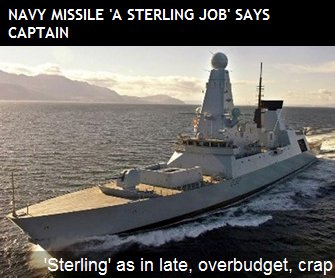
The Royal Navy has had some of their new Type 45 destroyers in service for a while, but they’ve only just gotten around to arming them?

The Royal Navy’s new £1bn+ Type 45 destroyers, which have been in service for several years (the first is already on her second captain), have finally achieved a successful firing of their primary armament.

The Ministry of Defence (MoD) announced yesterday that HMS Dauntless, second of the class, has made the first firing from a Type 45 of the French-made Aster missiles with which the ships are armed. All previous trial shoots were carried out using a test barge at French facilities in the Mediterranean.

Well, at least they’re getting closer to being armed and equipped as they were originally supposed to be:

Each of the six Type 45s will now cost the taxpayer £1.1bn and counting. At the moment the only weapons they can use operationally are their basic 4.5-inch “Kryten” gun turrets and light 30mm autocannon, principally useful for bombarding undefended foreshore targets or shooting up pirate dhows and the like. This is armament barely above the gunboat level.

The big attraction to the (very expensive) PAAMS/Sea Viper missile system is its claimed ability to shoot down the latest generation of Russian supersonic anti-ship missiles . . . oh, and that it wasn’t the cheaper (and proven) American AEGIS system.

As it is, we will pay at least double and get none of these things. Our Type 45s will have no serious ability to strike targets ashore, and we will continue to have no capabilities against ballistic missiles. Most glaringly of all, the Type 45 will have no weapon other than its guns with which to fight enemy ships — Sea Viper has no surface-to-surface mode.

You might feel that preservation of British high-tech jobs in some way justifies such horrific overspending for such lamentable amounts of capability, but in fact the relatively few Brit workers concerned have now mostly been fired anyway.

We can’t poke too much fun at the Royal Navy over the jobs issue: most major purchases for the Canadian Forces are driven more by “spin-offs” and regional employment concerns than either cost or military efficacy.

I did like The Register‘s cheeky graphic:

The Guild, Season 4 episode 12

Filed under: Gaming, Humour — Tags: , , — Nicholas @ 07:52

<br /><a href="http://www.bing.com/videos/watch/video/season-4-episode-12-guild-hall/y016gv5e?fg=sharenoembed" target="_new"title="Season 4 - Episode 12 - Guild Hall">Video: Season 4 &#8211; Episode 12 &#8211; Guild Hall</a>

I thought this only happened in the bad old days

Filed under: Government, Liberty, Politics, USA — Tags: , , — Nicholas @ 07:49

One of the arguments that used to appear regularly whenever anyone proposed privatizing public services is that “in the bad old days”, when fire departments were run by insurance firms, they’d only put out fires that endangered paying customers. Apparently that sort of thing still happens today:

Imagine your home catches fire but the local fire department won’t respond, then watches it burn. That’s exactly what happened to a local family tonight.

A local neighborhood is furious after firefighters watched as an Obion County, Tennessee, home burned to the ground.

The homeowner, Gene Cranick, said he offered to pay whatever it would take for firefighters to put out the flames, but was told it was too late. They wouldn’t do anything to stop his house from burning.

Terrible, isn’t it? A strong refutation to that whole crazy libertarian notion of privatizing essential services. So which greedy corporation runs the fire service?

Each year, Obion County residents must pay $75 if they want fire protection from the city of South Fulton. But the Cranicks did not pay.

The mayor said if homeowners don’t pay, they’re out of luck.

Interesting.

H/T to BoingBoing, where many of the comments seem to be from folks who didn’t read that it wasn’t a private fire service.

The next stage of wine competition?

Filed under: Health, Science, Technology, Wine — Nicholas @ 07:30

Kim Willsher reports on a new device to measure the levels of antioxidants in red wine:

The matchbox-size device can measure antioxidants in a drop of wine placed on a test strip and is expected to sell to wine producers for around €2,000 (£1,720). The Swiss manufacturers Diagnogene are planning a model for wine drinkers. “I can absolutely see people choosing to buy one wine over another because they can see it is healthier for them,” said Hoda. “It will also help producers make wine with more polyphenols. We know these antioxidants come from the skin of the grapes, that red grapes are better than white, and that the levels can be determined by the length of fermentation and other factors.”

He said the Swiss pilot test had revealed pinot noir grapes to have the greatest health benefits. “Let’s be honest, it must be better to have a glass of wine than to take a pill. Within moderation, of course.”

Claims for the positive properties of wine — particularly red — on the heart and brain have long been made and not only by French bons vivants. In 2006 a study by British scientists published in Nature said: “Regular, moderate consumption of red wine is linked to a reduced risk of coronary heart disease and to lower overall mortality”.

Of course, given past experience, don’t expect regulators in Canada or the US to suddenly allow any claims of health virtue to appear on wine bottle labels. Wouldn’t want to encourage drinking, you know.

« Newer PostsOlder Posts »

Powered by WordPress