
I see that Prince Abdul-Rahman bin Abdulaziz al Saud died the other day. If you’re having trouble keeping track of your Saudi princes, well, I don’t blame you. Unlike the closely held princely titles of the House of Windsor, the House of Saud is somewhat promiscuous with the designation: there are (at the time of writing) over 10,000 Saudi “princes” running around the country — and, in fact, at this time of year, more likely running around Mayfair and the French Riviera, exhausting the poor old blondes from the escort agencies. I believe that’s Abdul-Rahman at right, although to be honest all Saudi princes look alike to me, except that some wear white and others look very fetching in gingham. As I once remarked to Sheikh Ghazi al-Ghosaibi, the late cabinet minister, he was the only Saudi I knew who wasn’t a prince.
Abdul-Rahman was a longtime Deputy Defense Minister, whose catering company, by happy coincidence, held the catering contract for the Defense Ministry. The first Saudi prince to be educated in the west, he was a bit of a cranky curmudgeon in later years, mainly because of changes to the Saudi succession that eliminated any possibility of him taking the throne. But he nevertheless held a privileged place as the son of Ibn Saud, the man who founded the “nation” and stapled his name to it. When I say “the son”, I mean a son: Ibn Saud had approximately 100 kids, the first born in 1900, the last over half-a-century later, in 1952, a few months before ol’ Poppa Saud traded in siring for expiring.
Abdul-Rahman’s mother was said to be Ibn Saud’s favorite among his 22 wives — or, at any rate, one of the favorites. Top Five certainly. She also had the highest status, because she bore him more boys — seven — than any other other missus. They’re known as the Sudairi Seven or, alternatively, the Magnificent Seven. She also gave him seven daughters. They’re known as the seven blackout curtains standing over in the corner. This splendidly fertile lady’s name was Hussa bint Ahmed, and she was Ibn Saud’s cousin once removed and then, if I’m counting correctly, his eighth wife. But she’s a bit like the Grover Cleveland of the House of Saud — in that he’s counted as the 22nd and 24th President of the United States, and she’s the eighth wife and also either the tenth or eleventh. He first married her when he was 38 and she was 13. But he divorced her and then remarried her. In between their marriages she was married to his brother, but Ibn Saud was a sentimental lad and never got over his child-bride-turned-sister-in-law, so he ordered his brother to divorce her.
Don’t worry, though: In the House of Saud, it’s happy endings all round. Two of their daughters wound up marrying two of the sons of another brother of Ibn Saud. The Saudi version of Genealogy.com must be a hoot: “Hey, thanks for the DNA sample. You’re 53.8 per cent first cousin, and 46.2 per cent uncle.”
Mark Steyn, “The Son of the Man who Put the Saud in Saudi Arabia: Prince Abdul-Rahman bin Abdulaziz al Saud, 1931-2017”, Steyn Online, 2017-07-18.
October 7, 2023
QotD: Saudi princes
July 31, 2023
QotD: Stranger in a Strange Land at 50
Sexual mores changed but not, for most, in that direction. Living in southern California in the eighties, the view that seemed most common among young adults — many of those I associated with would have been people I met through the SCA,1 a subculture that had noticeable overlap with both science fiction fandom and hippiedom — was very different. The ideal pattern was stable monogamy but who could be so lucky? Insofar as it had been replaced it was mostly by the increasing acceptability and practice of casual sex.
There has been some development since Stranger was published, in practice and theory, along the lines of group marriage of a somewhat different sort. Polyamory is more self-conscious and, at least in theory, more structured than what we see in Stranger. Partners are classified as primary or secondary and a good deal of attention paid to what those terms mean and what behavior they imply. The result is in theory closer to the Oneida Commune of the 19th century, on a much smaller scale, than to the nest described in Stranger.2
This fits not only what happened in the real world but what happened in Heinlein’s fictional worlds. Consider a more sophisticated version of group marriage, the line marriage in The Moon is a Harsh Mistress. It is highly organized, with new members brought in at the low age end on a regular pattern of alternating gender. There is extensive search/courtship. And the protagonist offers a plausible explanation of its social role, why the institutions developed and what purposes it served.
Finally, consider Friday, a later novel. The protagonist, surprisingly naive given her profession — secret agent — joins a group marriage, makes a substantial commitment to it and is booted out, her share of the assets stolen, when it is discovered that she is an artificial person, the superior product of genetic engineering. Her much later commitment to a second group marriage follows more careful research.
David D. Friedman, “Odds and Ends”, David Friedman’s Substack, 2023-04-29.
1. The Society for Creative Anachronism, a historical recreation organization I have been active in for a very long time.
2. The practice sometimes ends up as open marriage, monogamous for purposes of producing and rearing children but with no obligation to sexual exclusivity — an option made possible by reliable contraception.
May 31, 2023
The War Against The Patriarchy, updated
Janice Fiamengo responds to a recent Joel Kotkin op-ed in the National Post discussing the “war of the sexes” and the long, long string of victories chalked up by the “weaker sex”:
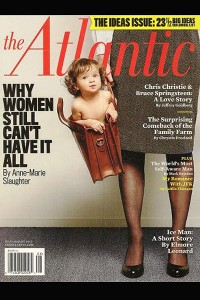
The war between the sexes has ended, and rather than a co-operative future that could benefit all, it has turned out to be more like a lopsided win for the female side.
So begins Joel Kotkin’s National Post op/ed “Women have won the ‘war between the sexes’, but at what cost?” It is a welcome but disappointing analysis that starts with a show of defiance and ends in quiet desperation. Of course, it’s good to find anyone in a major newspaper willing to cast a less-than-adulatory eye on “The Future [that] is Female” or to write sympathetically about men, and Kotkin, a prolific author on cities and technocracy, proves his good faith on the strength of that opening statement alone. Aside from the wishful thinking of believing feminism to be winding down (was #MeToo a prelude to ceasefire?) or ever having envisioned a co-operative future (he should take a look at Kate Millett’s incendiary “Theory of Sexual Politics“), Kotkin is to be commended for daring to name as a war the decades of post-1960s activism, in which all the decisive victories have been claimed by feminists against men.
Kotkin, however, isn’t able to continue in the take-no-prisoners style he chose for his opening salvo. He is prevented, either by his own prudence, his lack of deep knowledge, or the paper’s editorial insistence, from targeting feminist ideology and policies in the rest of the article. In fact, the article doesn’t name a single piece of debilitating feminist legislation or even make one reference to the many expressions of anti-male contempt that are now deeply embedded in our public culture. The result is a curiously disembodied discussion in which serious social problems linked to male decline are pointed to without any attempt made to say exactly how they came about or how they might be reversed.
“The crux of the problem,” Kotkin tells us to start off, “lies in the fact that as women rise, men seem to be falling.” Here we see him start to draw back from the attack, as if afraid to say what he really thinks. His phrasing makes male decline sound like a natural phenomenon, an illustration of the primordial principle of Yin and Yang. Or perhaps it is simply that men, with their allegedly fragile egos and hegemonic masculinity, haven’t been able to compete against all that female ability, once dammed up by the patriarchy, now finally being let loose on the world (though always with calls for more to be done to assist women).
[…]
Kotkin refers to men “left behind” in the economy, but he keeps mum about the decades of affirmative action in higher education and hiring (detailed by Paul Nathanson and Katherine Young in Legalizing Misandry, pp. 81-124) as well as draconian sexual harassment legislation that have made work life unrewarding and often punitive for men.
He stresses the loss of sexual amity and of willingness to marry, but avoids discussing the nightmare of family law that has made marriage or even cohabitation perilous for many men.
The sins of omission do not end there. Perhaps working on the assumption — not without basis — that any discussion of social problems will need to focus on women at least as much as on men, Kotkin proceeds to backtrack on his earlier claim about women’s victory in the sex war, outlining instead a downbeat portrait of women’s troubles. Citing research by Jonathan Haidt, he tells us that adolescent girls have been severely affected by depression and self-harm, that many young women, without reliable men to support them, have had to fend for themselves in a difficult economic climate, and that single mothers, left with few options, are unable to offer stability to their children. It looks as if the decline of men mentioned early in the article has mainly hurt women and their children.
What Kotkin neglects to mention — surely deliberately — is that adolescent boys commit suicide at 4 X the rate of girls, resolving their depression decisively enough that Haidt seems not to have felt the need to account for them; that women are the ones who choose divorce in approximately 70% of cases; and that divorced fathers are too often denied a real role in their children’s lives while being burdened past endurance by exorbitant support payments. In other words, for every sad woman held up for our concern, there is a plurality of equally sad men rendered invisible in the conventional reporting. The staggering statistics on male suicide provide a stark illustration of Kotkin’s initial contention about the casualties of the sex war — yet he leaves these aside, choosing instead to voice the now-obligatory concern about the trans threat to women’s sports.
Perhaps most importantly, Kotkin suggests through his word choice that the data he cites are simply “trends”, occurrences that came about through economic and demographic factors independent of the sex war initially evoked. But they aren’t. They flow directly from a feminist vision in which the family — explicitly understood by feminist leaders to be a source of abuse and oppression — must be transformed and women liberated from reliance on the fathers of their children. Under this vision, a more just and equitable world will be ushered in by women’s superior leadership once they are freed from their unpaid labor in the home and the many sexist barriers that hold them back. That freedom must be aided, according to conventional wisdom, through abundant contraception, unfettered abortion, collectivized child care, no-fault divorce, programs and propaganda to urge men to do more housework, and non-stop encouragement to women — in movies, sit-coms, advertising, articles, and government equity programs — to give up on their men.
April 20, 2023
When You Get Distracted Easily
It’s a Southern Thing
Published 19 Jan 2021Just keep nodding and try to hang in there.
(more…)
March 8, 2023
“By fostering intense family loyalties and strong nepotistic urges”, cousin marriage “makes the development of civil society more difficult”
Ed West on what he calls the worst western foreign policy disaster since 1204, the Iraq quagmire:

Mohammed Saeed al-Sahhaf, better known in the West as “Baghdad Bob” or “Comical Ali”, Iraqi Minister of Information for President Saddam Hussein.
This month marks the 20th anniversary of the greatest western foreign policy disaster since the Fourth Crusade. It was the pre-eminent modern-day example of folly, driven by wishful thinking, utopianism and a lack of interest in history and how human societies differ. This was mostly carried out by good people, including our own Tony Blair, and promoted by thoughtful and humanitarian commentators who thought they were making the world a better place.
The White House regime which brought chaos and misery to Iraq were most of all entranced by The Weekly Standard, the now-defunct magazine most associated with neoconservative foreign policy. Had any of them read The American Conservative instead, they might have avoided the whole tragedy. In particular they ought have read Steve Sailer’s “The Cousin Marriage Conundrum“, printed in the run-up to the invasion and in which the author made a seemingly curious argument for why nation-building in Iraq would fail — its high rates of cousin marriage.
Pointing out that between 46 and 53 percent of Iraqis who married did so to first or second cousins, Sailer wrote that: “By fostering intense family loyalties and strong nepotistic urges”, cousin marriage “makes the development of civil society more difficult”. The neocon dream of jumpstarting democracy was therefore clearly doomed to failure.
Even those with a cursory knowledge of the country knew that Iraq was split between Sunni and Shia Arabs, as well as Kurds in the north, each group’s area of dominance roughly corresponding to three former Ottoman provinces. However, these were further subdivided into “smaller tribes, clans, and inbred extended families — each with their own alliances, rivals, and feuds”, in total about 150 tribes comprising some 2,000 clans.
Saddam’s politics were mired in blood, in both senses. He came from the al-Bu Nasir, a tribe comprising some 25,000 people based in the town of Tikrit, and his regime was filled with his relatives. His political career had begun in 1957 when the 20-year-old had joined the revolutionary Ba’ath (“Resurrection”) Party, following his uncle Kharaillah Tulfha, who had fought against the British in the Second World War. Tulfha would become his father-in-law, for Saddam also married his first cousin, although he later took a second wife. Family life wasn’t entirely harmonious, and the man who introduced that couple, Saddam’s food taster, was later stabbed to death by the dictator’s psychotic eldest son Uday at a party thrown by Egyptian president Hosni Mubarak.
The unfortunate food taster was an Assyrian Christian, and within Saddam’s regime religious minorities could rise high, as is often the case in empires, because they presented no threat. His foreign minister, Tariq Aziz, was also a Christian, his birth name being Mikhail Yuhanna.
The family was everything in Saddam’s Iraq. Mark Weiner wrote in The Rule of the Clan of countries governed by “clannism” that: “These societies possess the outward trappings of a modern state but are founded on informal patronage networks, especially those of kinship, and traditional ideals of patriarchal family authority. In nations pervaded by clannism, government is co-opted for purely factional purposes.” The inevitable result of clannism is kin-based corruption whereby resources, positions and other rewards are monopolised by family groups. In these societies, Weiner wrote, “the nuclear family, with its revolutionary, individuating power, has yet to replace the extended lineage group as the principle framework for kinship or household organisation”.
The Weekly Standard was called the in-flight magazine of Air Force One, but presumably there weren’t that many White House staffers reading the American Conservative at the time, a publication started by Pat Buchanan, the great Republican critic of neocon foreign policy. So the Coalition blundered into a disastrous invasion that cost hundreds of thousands of lives, wrecking Iraq and leaving many areas newly-divided along sectarian lines, while minorities like the Christians and Mandaeans were driven almost to extinction.
January 22, 2023
The Scientific Reason Your Wife Is Always Right. Don McMillan
A Little More Dry Bar
Published 23 May 2022The scientific reason your wife is always right as presented by Don McMillan in this clip from his first ever Dry Bar Comedy special. Whether you’re someone who appreciated power points and graphs, or you just enjoy a good laugh, this clip form Don McMillan’s Dry Bar Comedy special is sure to have you laughing from start to finish.
(more…)
December 10, 2022
Ed West finds nice-ish things to say about the French
It’s actually part two, which I’m sure would astonish many a Brit:
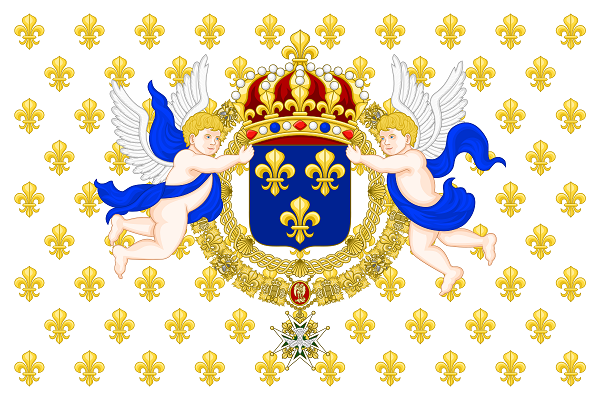
The Royal Standard of the King of France (and by default, the national flag), used between 1638 and 1790.
Wikimedia Commons.
“When, after their victory at Salamis, the generals of the various Greek states voted the prizes for distinguished individual merit, each assigned the first place of excellence to himself, but they all concurred in giving their second votes to Themistocles,” wrote the great 19th-century historian Edward Creasy. “This was looked on as a decisive proof that Themistocles ought to be ranked first of all. If we were to endeavour, by a similar test, to ascertain which European nation has contributed the most to the progress of European civilization, we should find Italy, Germany, England, and Spain, each claiming the first degree, but each also naming France as clearly next in merit. It is impossible to deny her paramount importance in history.”
France is central to the story of Europe, and indeed of Britain. It is almost impossible to understand England’s history without appreciating the relationship with its closest continental neighbour. It is a love-hate affair originating in a grand inferiority complex, a long rivalry that continues tomorrow [Saturday] when England meet France in the World Cup quarter-finals.
In a piece last year I cited some of the most endearing/maddening things about the French, all of which contributed to a sense of amused frustration on our part:
Only in France would football fans protest that a local restaurant had lost a Michelin Star, as happened in Lyon two years ago. Only in France would an expedition to the Himalayas — of huge national importance — fail because it was weighed down by eight tonnes of supplies, including 36 bottles of champagne and “countless” tins of foie gras. And only in France would you get actual wine terrorists, the Comité Régional d’Action Viticole, who have bombed shops, wineries and other things responsible for importing foreign produce. This is a country which only reluctantly in the 1950s stopped giving school children a nutritious drink for their health, by which the French meant not milk but cider.
This is a country where mistresses are so much part of life that they can legally inherit, and where murder doesn’t really count if it’s done for love. One of France’s most famous socialites, Henriette Caillaux, shot dead the editor of Le Figaro just before the First World War and received just four months in jail because it was a crime passionnel. So that’s all right then.
But there are so many other things to love about our strange neighbours …
The Anglo-French relationship is a difficult one, reflected in the troubled history of royal marriages. Charles I’s Catholic wife Henrietta Maria was a drag on his popularity among excitable Protestant radicals, and turned out to be the last French consort; in the 14th century Edward II’s wife Isabella overthrew him and, perhaps, conspired to have him killed, after a rocky marriage that began badly when he brought his lover to the coronation and acted inappropriately affectionate towards him. But then, as Edith Cresson pointed out, this is to be expected when you marry an Englishman.
In 1514 Louis XII married an English bride, Henry VIII’s sister Mary; she was 18, he was 53, and had syphilis, so she must have been delighted about the whole thing; however, within weeks she had “danced him to death”, the sex apparently proving too exciting for his nervous system. Francesco Vettori, Florence’s ambassador to Rome, wrote that King Louis had a lady “so young, so beautiful and so swift that she had ridden him right out of the world”.
***
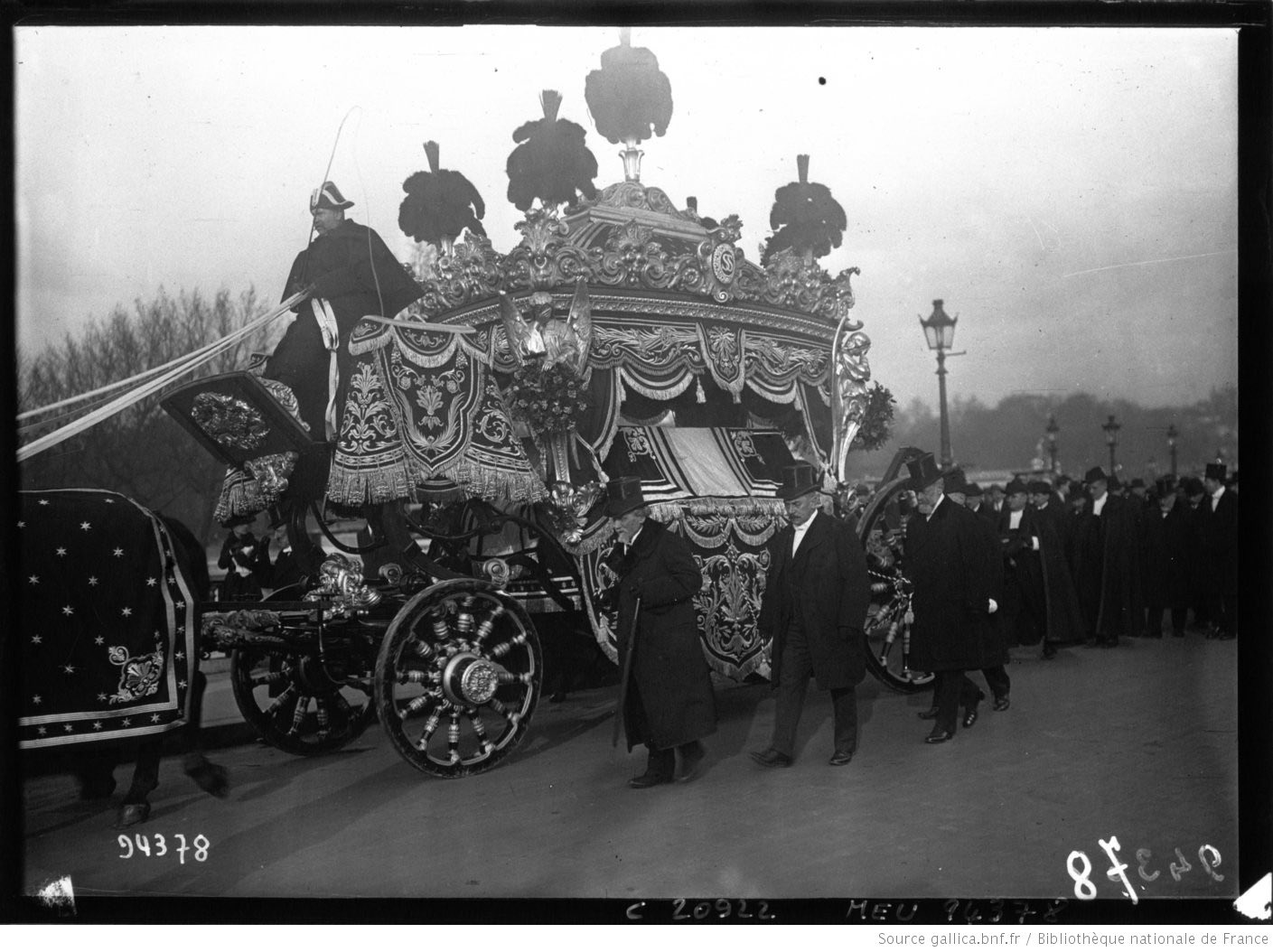
Perhaps not a terrible way for a Frenchman to go, and not the last French head of state to die in a similar manner. President Félix Faure expired in 1899 while with his mistress, after which his funeral featured this very understated carriage.
***
Numerous French presidents have had affairs, although Francois Mitterrand actually had a secret second family while in the Élysée Palace. Mitterrand’s last meal was also ultra-French: “He’d eaten oysters and foie gras and capon — all in copious quantities — the succulent, tender, sweet tastes flooding his parched mouth. And then there was the meal’s ultimate course: a small, yellow-throated songbird that was illegal to eat. Rare and seductive, the bird — ortolan — supposedly represented the French soul. And this old man, this ravenous president, had taken it whole — wings, feet, liver, heart. Swallowed it, bones and all. Consumed it beneath a white cloth so that God Himself couldn’t witness the barbaric act.”
***
The French are world outliers in their attitudes to adultery, the only country where a majority of people think it’s fine. Germany is number two in this index of permissiveness while the Americans, of course, are the most disapproving western nation.
October 19, 2022
Jonathan Kay reviews 18 Months by Shannon Thrace
At Quillette, a review of a new book on the breakdown of a once-happy marriage when one partner decides that mere transvestism isn’t enough any more and becomes transgendered:
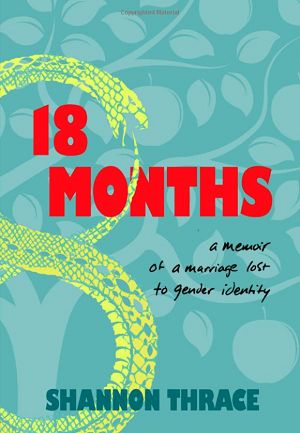
The trans community is diverse, especially when it comes to attitudes toward sex. As writer Angus Fox noted in a seven-part Quillette series, When Sons Become Daughters, some biologically male trans-identified teenagers live a sexless existence; and are drawn to puberty blockers and androgynous aesthetics precisely because they seem to offer safe harbour from male sexual development. In the case of middle-aged men who abruptly adopt a trans identity later in life, on the other hand, it can be the opposite: the presentation is often hyper-sexualized.
(more…)
June 29, 2022
It’s not your imagination: young women are becoming more liberal
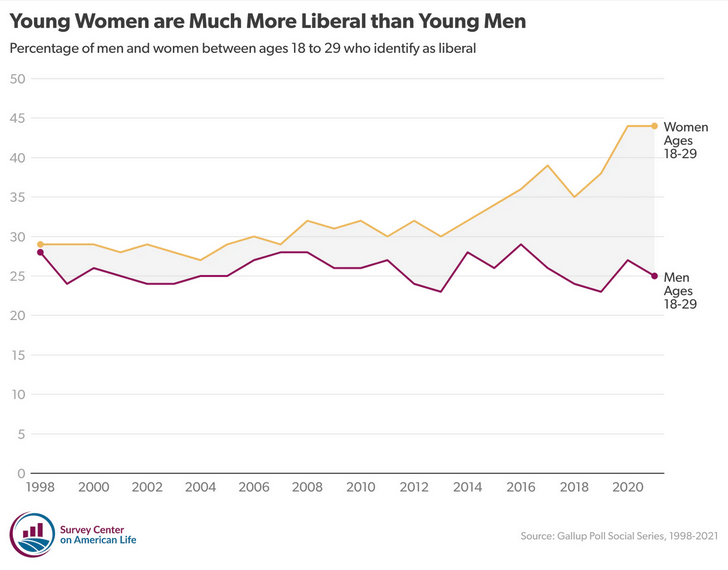
Daniel Cox looks at the noted shift in political opinions among young women (aged 18-29) compared to their male counterparts, and not just on the current hot-button topic of abortion rights:
… In fact, young women have become significantly more liberal over the past decade whereas the political identity of young men has remained largely unchanged over time.
Rise of Unmarried Women
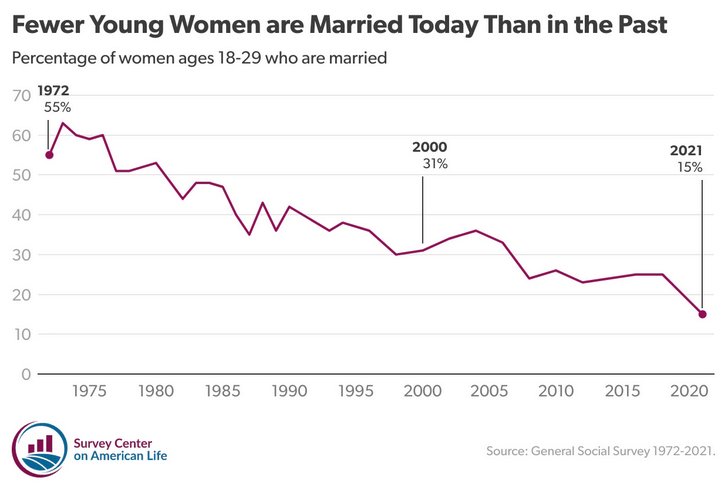
There are a few reasons for the increasingly liberal politics of young women. One explanation may lie in their marital status. Compared to previous generations of young women, far more women under the age of 30 today are unmarried. Only 15 percent of young women today are married compared to more than one-third of young women two decades ago.
Why does this matter? Research has shown that unmarried women feel more connected than their married counterparts to other women — a phenomenon known as “linked fate” — and it can lead them to support more liberal policies. In their fascinating 2017 study, Christopher T. Stout, Kelsy Kretschmer, and Leah Ruppanner argue that “women consistently earn less money and hold less power, which fosters women’s economic dependency on men. Thus, it is within married women’s interests to support policies and politicians who protect their husbands and improve their status.” This phenomenon of “linked fate” was not found to be evident among men, so even though young men are also less likely to be married compared to older generations, their marital status may have less of an impact on their politics than for women.
The Growing Education Divide
Over the past several decades, women’s educational attainment has far outpaced that of men’s; “Women in the United States have earned more bachelor’s degrees than men every year since the mid-1980s”, writes Derek Thompson in the Atlantic.
American colleges and universities now enroll roughly six women for every four men. This is the largest female-male gender gap in the history of higher education, and it’s getting wider.
The education divide between men and women has become more politically relevant because of the stronger connection between educational attainment and political behavior. In recent elections, college graduates have become a much more loyal Democratic constituency. And on a range of issues, college-educated Americans are more liberal than those without a Bachelor’s degree.
February 18, 2022
QotD: Historical legal context of marriage
John Stuart Mill, The Subjection of Women, 1869.
July 31, 2021
Rowan Atkinson Live – With friends like these AKA the wedding from hell
Rowan Atkinson Live
Published 24 Sep 2010Also know as the wedding from hell, Rowan plays 3 very different but horribly hilarious characters including a priest who talks about fellatio …

August 7, 2020
QotD: Celibacy and chastity
There has been some pretty elevated stuff written on that subject, and if you want to take that particular high road, then Professor Robert George of Princeton is your guy. But consider the low road, too. There’s another conclusion, maybe a little bit cynical, that could be drawn from this: If you are a sexually frustrated young man, the smart play would be to join a church.
Kevin D. Williamson, “Advice for Incels”, National Review, 2018-05-10.
March 28, 2020
QotD: A man’s view of home decoration projects
Potentially offensive language warning — hence the NSFW tag — so the QotD is below the fold:
August 17, 2019
QotD: Bridal traditions
Left unspoken: Didn’t do jack. You’d think the Brides in Italy would have figured this out in short order, eh? “Here, my child. Soak your dress in lavender. It will calm your nerves.” Did it work for you, mama? “No, I spent the morning sobbing and throwing up in rank terror, since I had only met your father the previous night, and he had the breath of cheese far gone with mold. But this is what we do, for we are superstitious peasants whose worldview is derived not from empirical observation of the world, but sage wisdom Grandmama got from her great-grandmama. Now put these grape stems up your nose so your first-born will be a boy.”
James Lileks, Star Tribune, 2004-05-24.
April 29, 2019
Father of The Bride Speech – Rowan Atkinson
Ralph Lindberg
Published on 16 Jan 2010Looking for great father of the bride speech? How about this father of the bride speech from Rowan Atkinson aka Mr. Bean


