
Quotulatiousness

February 8, 2011

Hookers with Blackberries on Facebook

Filed under: Economics, Politics, Technology, USA — Tags: , , , , — Nicholas @ 07:17

The latest round of moral posturing by politicians has accomplished great things: more sex workers now use Facebook to communicate with prospective clients, fewer are using Craigslist. Success?

A study by sociology professor Sudhir Venkatesh on trends in the world’s oldest profession, published by Wired, estimated that 25 percent of hookers’ regular clients came through Facebook compared to only three per cent through Craigslist.

Five years before that, in 2003, nine per cent of the prostitutes regular clients came through Craiglist and none through the then infant Facebook.

“Even before the crackdown on [Craigslist’s] adult-services section, sex workers were turning to Facebook: 83 per cent have a Facebook page, and I estimate that by the end of 2011, Facebook will be the leading on-line recruitment space,” Venkatesh writes.

Venkatesh says that there’s another key indicator for those who frequently hire prostitutes:

Curiously, he found one of the three main ways a sex worker can boost her earning potential is not to get a boob job but to buy a BlackBerry. “This symbol of professional life suggests the worker is drug- and disease-free,” Venkatesh explains.

Of prostitutes that own a smartphone, 70 per cent have BlackBerries while just 11 per cent own iPhones. Feel free to write your own hilarious jokes using that information.

January 28, 2011

Finns unhappy with icy iPhones

Filed under: Europe, Law, Technology — Tags: , , , — Nicholas @ 09:23

Bill Ray reports on the source of Finnish unhappiness with Apple iPhone performance:

Finnish iPhone users unhappy at the inability of the handset to operate below zero are entitled to their money back, even if the limitation appears in the small print.

The clarification comes from the Finland’s Consumer Agency, as reported by Finnish news agency YLE.fi, in response to numerous questions from concerned Finns who are unhappy that their shiny Apple toys won’t promise to work again until the spring, at best. So unless the shop specifically stated the zero-degree operational limit, then the regulator reckons iPhone-purchasing Finns are entitled to their money back.

Finland, like the UK, requires all items sold new to operate in the way they might reasonably be expected to do. Small print can’t negate those rights, and it’s reasonable for Finns to expect to be able to make phone calls outside, so refunds would seem to be in order. Meanwhile the regulator is preparing a list of questions for Apple about how it trains its staff, and how badly the iPhone breaks down when it gets cold.

January 24, 2011

Introduction to NFC, Register style

Filed under: Technology — Tags: , , , — Nicholas @ 08:51

If you’re wondering what the buzz about Near Field Communications (NFC) might be, you’ll want to read The Register‘s Beginner’s guide to NFC:

Near-field communications (NFC) will take off very quickly — once it’s clear who can make money from it.

From the look of it, 2011 is the year that it will all become clear.

Mobile handset vendors are rushing to incorporate NFC into their roadmaps, with several high profile NFC-enabled handset launches pencilled to lauch mid-2011.

RIM recently hinted at incorporating the technology into new BlackBerry devices, the iPhone 5 is widely expected to include an NFC chip, and Samsung and Nokia are understood to be planning several NFC-enabled phones.

Mobile operators are gearing up too. In the UK, for instance, O2 is building out an NFC team and forecasts that near field communications will enter the consumer mainstream in mid-2011. Orange UK is equally bullish, forecasting sales of 500,000 NFC-enabled phones this year.

So what’s the fuss all about?

If they’re right, expect to start seeing this symbol on lots of things in the near future:

The N-Mark standard defines an embedded tag, which can communicate and provide encrypted authentication using power induced by the reader – such a tag can therefore be embedded in a credit card or key fob without needing its own power supply.


An N-Mark device, such as a mobile phone, incorporates a reader as well as a tag, to enabling communication with passive tags and other N-Mark devices. That communication takes place at 13.56MHz, but as the power is magnetically inducted the range is extremely limited – 200mm at best.

January 23, 2011

Penn & Teller’s iPhone app

Filed under: Humour, Randomness, Technology — Tags: , — Nicholas @ 00:07

Do watch both videos. One shows the app in operation, the other shows how it works.

January 13, 2011

Beer incoming!

Filed under: Randomness, Technology — Tags: , , — Nicholas @ 07:30

H/T to Lester Haines for the link.

December 7, 2010

Cool idea . . . don’t expect it to be allowed

Filed under: Bureaucracy, Law, Liberty, Technology — Tags: , , — Nicholas @ 07:24

This is a cool idea:

I am building a radar detector that plugs into your iPhone. When RadarLoc detects radar, it notifies other drivers in the area, making radar effectively visible for miles. I think of it as transparency in government. To the extent that visible traffic enforcement slows traffic, RadarLoc encourages law-abiding behavior.

RadarLoc is open source, open hardware and open data. My plan is to make the radar data available on RadarLoc.org, so anyone can build on it. If you don’t like my app, you can build your own–I tell you how to talk to the hardware and how to use the data service. Information wants to be free.

Unfortunately, radar traps are not actually there to encourage safer driving: they’re there as revenue sources. This is why (at least in some jurisdictions) you’re not supposed to warn other drivers of radar traps, even though by doing so you’re encouraging other drivers to drive more slowly (therefore making the road safer). Radar detectors of any kind are illegal in Ontario, for example.

H/T to Chris Anderson for the link.

November 14, 2010

Wandering minds or wandered researchers?

Filed under: Health, Randomness — Tags: , , , — Nicholas @ 11:02

I can’t improve at all on Chris Myrick’s comment on this article:

Harvard psychologists have determined that we are happiest when: having sex, exercising, in intense conversations with friends, listening to music or playing. Aside from their use of an iPhone app to determine this, (http://www.trackyourhappiness.org/), I’m missing the news value.

However, I see potential for a follow-up study where researchers can determine whether receiving phone messages during sex, sport or engaging conversation puts a damper on someone’s mood.

November 2, 2010

This is either App-alling or App-ealing, depending on your party affiliation

Filed under: Law, Politics, Technology, USA — Tags: , , , — Nicholas @ 09:30

There’s now an iPhone app for reporting suspicious election activity:

Just in time for Election Day, American Majority Action has created the nation’s first mobile application to help identify, report and track suspected incidents of voter fraud and intimidation. This free, cutting edge system will enable voters to take action to help defend their right to vote. Whether you’re a campaign junkie, or just want a better America, Voter Fraud will help you report violations at the election booth and serve to uphold the democratic process.

H/T to Ace of Spades HQ for the link.

September 13, 2010

Extensive wine list + iPad = increased profits

Filed under: Cancon, Technology, Wine — Tags: — Nicholas @ 15:55

Since I started paying attention to wines, I’ve run into the problem that every wine novice encounters: you know too much about the cheap plonk a typical restaurant offers (and except in rare cases, it’s vastly over-priced), but you don’t know enough (or earn enough) to sample all the higher-priced offerings at better restaurants. In Ontario, where all imported wines must go through the LCBO, it’s easier to get a handle on less expensive offerings.

It’s when we’re travelling that the wine list quickly becomes a daunting trek through French, Italian, Spanish, and other producers’ wines. A possible solution is being tried out at Bone’s, in Atlanta:

Given the old-school setting, it could not seem more incongruous.

At Bone’s, Atlanta’s most venerable steakhouse, a clubby place of oak paneling and white tablecloths, the gold-jacketed waiters now greet diners by handing them an iPad. It is loaded with the restaurant’s extensive wine list, holding detailed descriptions and ratings of 1,350 labels.

Once patrons make sense of the touch-pad links, which does not take long, they can search for wines by name, region, varietal and price, instantly educating themselves on vintner and vintage.

Since their debut six weeks ago, the gadgets have enthralled the (mostly male) customers at Bone’s. And to the astonishment of the restaurant’s owners, wine purchases shot up overnight — they were nearly 11 percent higher per diner in the first two weeks compared with the previous three weeks, with no obvious alternative explanation.

I’ve been relatively fortunate in my wine ordering in restaurants in Saratoga Springs, Boston, and Charleston, but that was by careful selection to match my dinner partner’s food choices, and a bit of luck. Something like the iPad with a full wine list including tasting notes would make the task of ordering an appropriate wine much easier (and, to be honest, I’d probably be willing to spend a bit more than usual to get a more interesting wine).

August 24, 2010

Censors to poke noses into what Aussies can load on their iPhones?

Filed under: Australia, Law, Liberty, Technology — Tags: , , — Nicholas @ 12:16

Roger Henry sent this information to one of my mailing lists and I repost it here with his permission:

An interesting bombshell in Oz. Apple iPhones, and presumably other similar devices, have been put on notice that all, or nearly all, of the apps that people buy and install should, by law, have been submitted for “Classification” (i.e., censorship). Failure to do so is a criminal offence with penalties of some AU$35,000 per offence. Purchasing said ‘apps’ without a Classification label is also a criminal offence, punishable with jail time and/or fines. Seems that getting these ‘apps’ Classified attracts a charge varying from AU$470 to AU$2,600 so a lot of money is outstanding. With 50,000 apps already in use, the government accepts that there are some practical limitations to the matter but they aren’t going to let the matter just fade away.

This is Roger’s summary from information posted in The Australian‘s weekly IT Notes. And then, in response to a “Dude, WTF?” query:

It may well be that Apple will cease making apps available in Oz. Yes. It is known that they have their own censors. This merely compounds their culpability. What might have been an accidental oversight is now clearly a deliberate attempt to A) avoid censorship and B) defraud the government. This cannot go unpunished. As for the consumers, well, they are all probable pedophiles and identified thieves. No punishment can be too severe . . . it might take awhile but Justice will be served.

While it likely will all end in a round of dignified press releases and backslaps all ’round, there’s still the outside possibility of a highly entertaining politico-technical train wreck here. Let’s hope the wilder spirits prevail.

August 11, 2010

iPhone girls are easy

Filed under: Humour, Media, Technology — Tags: , , , , — Nicholas @ 07:47

Colby Cosh links to a dating website that actually provides useful photography information:

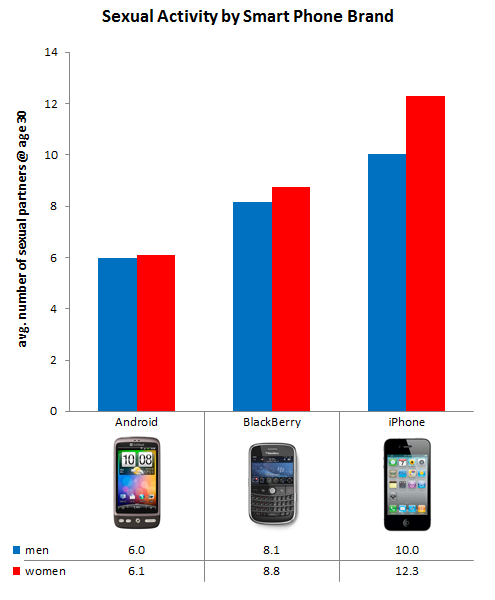
oh, also — iPhone users have more sex.

File this under “icebreakers, MacWorld ’11”. Finally, statistical proof that iPhone users aren’t just getting fucked by Apple:

The chart pretty much speaks for itself; I’ll just say that the numbers for all three brands are for 30 year-olds, so it’s not a matter of older, more experienced people preferring one phone to another. We found this data as part of our general camera-efficacy analysis: we crossed all kinds of user behaviors with the camera models and found we had data on the number of sexual partners for 9,785 people with smart phones.

Okay, I’ve posted the funny bit. The rest of the article actually does have useful photography tips, especially if you’re a user of dating websites.

August 9, 2010

Apple execs’ worst fears coming true

Filed under: Economics, Media, Technology — Tags: , , , , — Nicholas @ 12:52

Apple has seemed almost ham-handed in their attempts to control the media “storyline” since the iPhone 4 was released. If Eric Raymond is correct in his analysis, Apple will continue to struggle:

Apple’s bid to define and control the smartphone market is going down to defeat. I was going to describe the process as “slow but inexorable”, but that would be incorrect; it’s fast and inexorable. My prediction that Android’s installed base will pass the iPhone’s in the fourth quarter of this year no longer looks wild-eyed to anybody following these market-share wars; in fact, given the trends in new-unit sales a crossover point late in the third quarter is no longer out of the question.

There’s an important point that, so far, all the coverage seems to have missed. You can only see it by juxtaposing the market-share trendlines for both 1Q and 2Q 2010 and noticing what isn’t there — any recovery due to the iPhone 4. This product has not merely failed to recover Apple’s fortunes against Android, it has not even noticeably slowed Apple’s loss of market share to Android.

Forget for now the blunder the trade press has been calling “Antennagate”; I had fun with it at the time, but bruising as it was, it’s only a detail in the larger story. With the iPhone 4, Apple tried to counter the march of the multiple Androids using a single-product strategy, which was doomed to fail no matter how whizbang the single product was. As I predicted would happen months ago, the ubiquity game is clobbering the control game; Apple has wound up outflanked, outgunned, and out-thought.

As I’ve noted before, Apple had been running a very slick, very successful media image-building strategy of coolness and technological sophistication. For several years, they barely put a foot wrong in their complex dance of marketing and public-perception-influencing. When something finally did go wrong, they clearly lacked the ability to respond gracefully and recapture the wavering affections of both the reporters and the readers.

In short, the short-term effect of “antennagate” could have been limited to a one-off glitch: give the punters a free “bumper” for their phones, do it quickly and ungrudgingly, and reap the PR reward for being pro-active and showing that you care for your customers. Instead, the “smartest guys in the room” managed to squander almost all their accumulated goodwill in a few short weeks of bluster, denial, and arrogance. Nice work.

July 19, 2010

QotD: “Happy now, whiners?”

Filed under: Media, Quotations, Technology — Tags: , , , , , — Nicholas @ 10:33

On Thursday, I hoped that Apple CEO Steve Jobs would admit there’s a problem with the new iPhone’s antenna and apologize for pretending there wasn’t. I didn’t get that apology. Not even close. Instead, in a defensive press conference at Apple’s headquarters on Friday, Jobs argued that the new iPhone offers terrific, out-of-this-world reception. He blamed the media for whipping up a frenzy out of a “fact of life” that affects every phone on the market. As Jobs sees it, the only problems with the iPhone 4 are the pesky “laws of physics,” which pretty much ensure that anyone who holds a mobile phone in her hands is asking for trouble. The only reason people have been focusing on the iPhone is that blogs keep singling Apple out, perhaps because “when you’re doing well, people want to tear you down.”

Still, if you want to be a total jerk about it and keep insisting there’s a problem with your magical iPhone, Jobs has an offer for you. “OK, great, let’s give everybody a case,” he said. Happy now, whiners?

Farhad Manjoo, “Here’s Your Free Case, Jerk: Apple’s condescending iPhone 4 press conference”, Slate, 2010-07-16

July 18, 2010

Has the Reality-Distortion Field failed?

Filed under: Media, Technology — Tags: , , , , , , — Nicholas @ 12:24

Eric S. Raymond does a happy dance over the discomfiture of Steve Jobs in the (ongoing) iPhone 4 antenna debacle:

The stench of desperation must be getting pretty thick on the Infinite Loop. Can it be that the generator for Steve Jobs’s notorious Reality Distortion Field has finally broken down?

Two days ago, we learned that Jobs knew of the iPhone 4’s antenna problem before launch. They had warnings both from an in-house antenna engineer and “carrier partner”, presumably AT&T. Yes, this means all the Apple fanboys who had hissy fits at me when I said fifteen days ago that Apple was lying about the problem now get to go sit in the stupid corner.

[. . .]

A day ago, we got to watch Jobs tap-dance his way around the problem. This was a first; I cannot recall any previous instance in which the Turtlenecked One, rather than effectively controlling the agenda, has had to operate in full damage-control mode. He could have manned up and said “OK, we messed up on the antenna design, we’re recalling,” but no. Instead it’s bumper cases for all and a truly smarmy attempt to claim that everyone else in the industry is just as bad.

Way to recover your damaged reputation, Stevie boy! Time was when the wunderkind’s reality-distortion field would have somehow soothed everyone into glaze-eyed insensibility, but that’s not the way it’s going down today. Instead, there’s public pushback from both RIM and Nokia, and neither company is being shy about specifying just how far his Jobness has rammed his head up his own ass.

And there is absolutely no one else to blame for this; it’s obviously Job’s fetishism about cool industrial design, the aesthetic of the minimalistically slick-looking surface above all else, that compromised the antenna design and led him to ignore the warnings. The exact quality that Apple fanboys have been telling us would ultimately win the game for Jobs turns out to be the tragic flaw instead. And now he’s reduced to telling everyone to wrap a big ugly rubber on, it, sparky! Hubris and nemesis; this epic fail could be right out of Aeschylus.

Apple will survive this, but they need to rally the damage control teams and be pro-active, or their reputation will take years to recover . . . and it’s the reputation that allows Apple to charge more than the competition for broadly comparable goods.

July 17, 2010

Does Apple have to kill the iPhone 4?

Filed under: Technology — Tags: , , , — Nicholas @ 19:31

I discussed the PR nightmare Apple has been going through since the first problems with the iPhone 4 was introduced, but I didn’t think this extreme a solution was called for:

Image is everything. And that’s why Apple must terminate the iPhone 4 as quickly as possible.

In his Friday morning news conference, Apple CEO Steve Jobs admitted the iPhone 4 is flawed, no doubt a painful admission for a proud man known for his perfectionist ways. He even offered free cases to alleviate the signal and reception problems plaguing some iPhone 4 users.

[. . .]

But none of that matters. The iPhone 4 is now tainted in the consumer’s eyes. It’s no longer a triumph of form and function, but rather a crippled device that requires protective headgear to work properly.

We could debate the merits of the iPhone 4’s antenna design all day, but that’s beside the point. Perception is reality here, and the public now views Apple’s latest offering as The Phone That Drops Calls. And no one can blame AT&T this time either.

I don’t think it’s quite that bad for Apple, although they’ve been flying so high in public perception that any glitch will seem far more significant in comparison to their reputation. Maybe Jeff Bertolucci has it right: even if you don’t re-engineer the entire package, the PR hit will be less and the re-inforced public support will be that much greater if Apple bites the bullet sooner rather than later.

« Newer PostsOlder Posts »

Powered by WordPress
