
First let’s start with the fact that homelessness as it exists in America isn’t poverty. In fact part of the problem with it is that it ISN’T poverty. Look, regardless of what you’ve seen on the movies or TV, most homeless are not families fallen on hard times. Yes, there are some of those now, but most of those while technically “homeless” aren’t living in your local park. They’ve just taken over mom and dad’s basement, moved onto a friend’s living room or whatever. Terrible – I’ve been JUST short of that at least three times in my married life – and humiliating, but NOT “stand in the park and wheedle on yourself.”
90% of the homeless in America and the hard core ones are people with mental health issues, people with drug abuse issues and people who have found they can live without having to do anything for it, and can be “free” and outside society. I’ve overheard conversations in the park, and I suppose that most of the people who “dropped out” in the sixties are dead, but a lot of them are alive and going from soup kitchen to free clinic, with a bit of begging in between.
Yes, there are entire families in this system, including homeless children – but for them to stay in it, the parents need to have some sort of serious issue. Otherwise, even if they can’t find work, there is assistance available to get them at least into public housing, which, nightmarish though it is, is not living in the park.
I’m not going to pretend this doesn’t happen to normal families too – see where I came very close to that level and more than once too – but normal families usually tend to bounce back. They go through a few months of mess and horror, and then they claw back to some semblance of normalcy. (This might change as our economy dives and programs of necessity get cut. The ones for the DESERVING poor will be cut first, of course, since they rarely riot.)
The problem with this is that when people get appalled at the conditions the homeless live in and start offering “homeless services” there is an entire network, not just of homeless but of social workers who direct the homeless to the cities with better services.
I swear to you and I’m not even joking that right now there are plenty more homeless on Colorado Springs streets than in Denver, despite the Springs being much smaller.
The Springs also has its soup kitchens and other services downtown and within easy walking distance of each other.
This means downtown businesses are closing, except for bars and restaurants which can control access. And that the library is of course a place to camp in the cool/warm during the day.
It means more than that. We moved within easy driving distance of downtown, because when we lived downtown when we first came to Colorado Springs, I used to take walks every day. When we moved to our little mountain village, without these, I gained ten pounds a year. I used to love walking downtown, dropping by the deli and the three bookstores (only one left, and it’s MOSTLY a restaurant now) checking out the other little shops which ranged from yarn to weird import crafts.
Now those are gone. Worse – the last two times I walked downtown alone (i.e. without commanding the muscle, aka older son to go with me) someone FOLLOWED me and I had to employ stuff from my childhood to lose them. Once it was a large and addled looking male, and yes, he was following me. And once it was TWO large and addled looking males. For the icing on the cake – not related to this, but from a blog entry – I clicked on the sex offenders registry. Yes, I know, a lot of people there are there because someone accused them and was never proven. Our local one at least has notes on whether it’s accusation, trial or conviction and also whether the crime was against children or adults.
The downtown zipcode is FULL of registered sex offenders who’ve done hard time and who have committed their crimes against adults. The faces are very familiar from my walks, and yep, one was the guy who tried to follow me.
Sarah Hoyt, “Of Books, Compassion And Cruelty A Blast From The Past From June 2013”, According to Hoyt, 2020-03-10.
June 12, 2020
QotD: Homelessness in America
May 10, 2020
London’s Metropolitan Police live down to expectations … and then some
Brendan O’Neill observes the latest sweep by the Metropolitan Police, relentlessly cracking down on scofflaws and evil-doers who … were walking peacefully in the sunshine?
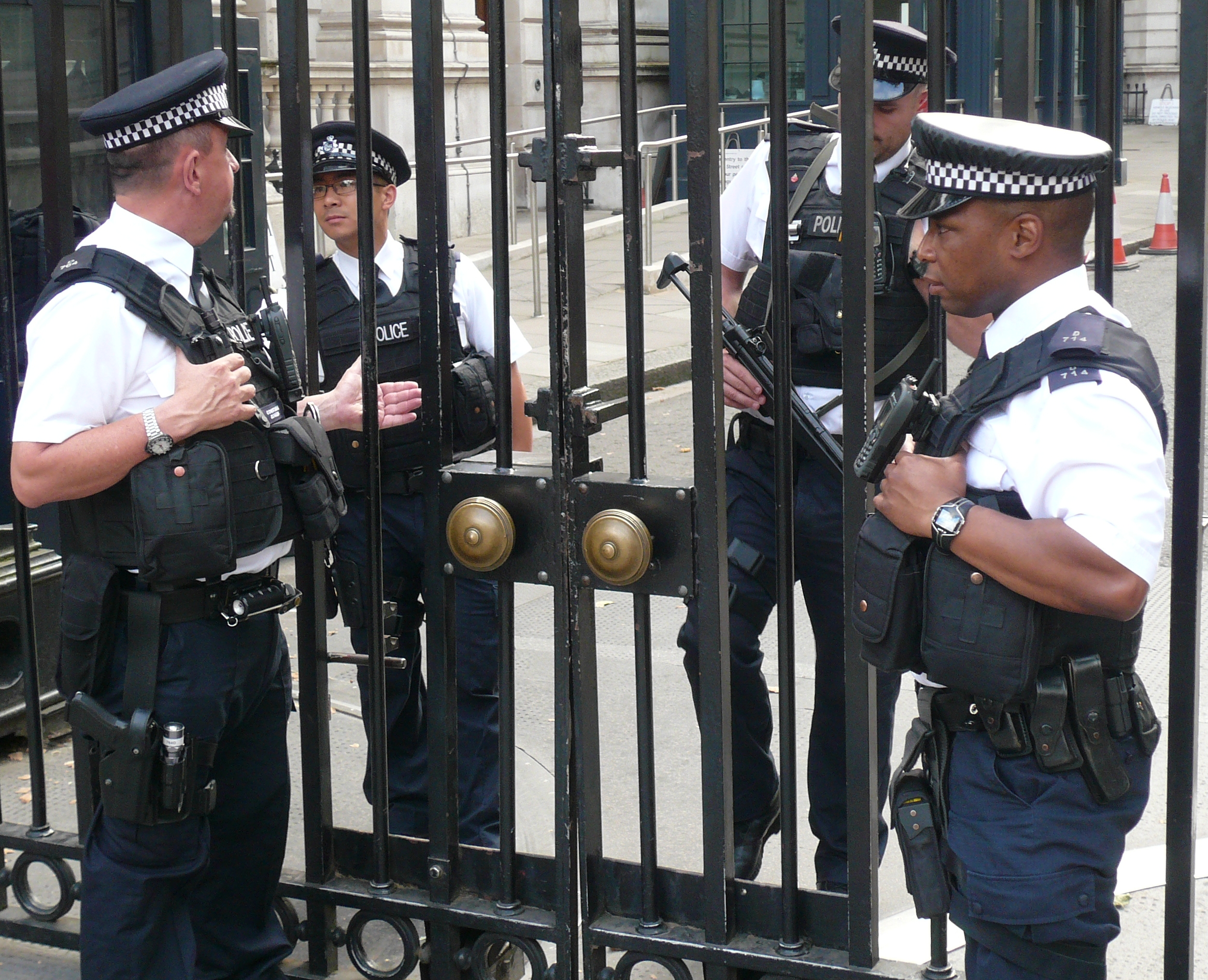
Armed Metropolitan Police near Downing Street in London.
Photo by Stanislav Kozlovskiy via Wikimedia Commons.
You heard them before you saw them. It sounded like a platoon of soldiers. The one in charge was barking orders to “move forward!” and then came the trudge of their boots. Scores of them, making military manoeuvres, marching in a long, thin line through one of Britain’s prettiest parks: St James’s Park in London. This was the Metropolitan Police today, enforcing the lockdown, sweeping through parks and streets and issuing the same warning to everyone they came across, from young lovers to dads playing football with their kids to homeless people with nowhere else to go: “Move on.” It’s one of the most disturbing things I’ve ever seen the police do.
Watching them stream through St James’s Park, looking for all the world like a line of soldiers conquering a small town, you’d think they were on their way to confront some serious organised crime. But of course their targets were sunbathers, those apparently selfish people demeaned in the media and now harassed by the cops. And a dad playing football with his toddler. “Aren’t we allowed to exercise?”, the dad asked. “For one hour”, came the reply. “How long have you been out?” And young lovers and friends. I saw a copper on horseback shouting down at two young men as if they were in the process of committing some awful crime. I guess they were in the eyes of the lockdown fanatics: they were sitting under a tree.
A young Muslim mum sitting down and watching her two kids play with little tennis bats was confused, too. Can’t kids play outside? She was told she couldn’t sit still. She had to walk. “How about walking your kids around the park?”, said the spectacularly patronising cop. They even threw out homeless people. I saw them tell four individual homeless people (ie, not a group of homeless people) to move on. Where to? Must they also walk and walk, forever, and never sit down anywhere? The most despicable thing I saw was a policeman telling an elderly homeless gentleman to move on. Inarticulately, the man explained he had nowhere else to go. I stepped in and explained to the cop that there is no home for him to go to, and he has to be able to sit down somewhere on a hot day. “I don’t make the rules”, came the snivelling, officious reply.
The police’s reputation will have taken a severe beating in London today. Anyone who argued back — as two young women did, patiently explaining that they are from the same household and that they were metres away from everyone else — was patronised or even insulted. “You’re putting other people’s lives at risk”, the women were told, which is completely untrue — being outside and socially distanced on a very warm day carries virtually zero threat of infection. I heard an officer call someone an idiot. Another officer made fun of someone who asked about his right to be outside. It was staggeringly rude and even repugnant behaviour. A politician, or someone, needs to get a grip on these people.
March 15, 2020
Those damned unintended consequences
Sarah Hoyt on the differences between intention and the real world:
Unintended consequences are the bane of social engineers. They are why the “Scientific” and centralized method of governance never worked and will never work. (Sorry, guys, it just won’t.)
Part of it is because humans are contrary. Part of is because humans are chaotic. And part of it is because like weather systems, societies are so complex it’s almost impossible to figure out what a push in any given place will cause to happen in another place.
This is why price controls are the craziest of idiocies. They don’t work in the way they’re intended, but oh, they work in practically all the ways they’re not. So, take price controls on rent. All they really do is create a market in which housing is scarce, landlords don’t maintain their property AND the only people who can afford to live in cities that have rent control are the very wealthy.
BUT Sarah, you say, aren’t rent controls supposed to make them affordable. Yeah. All that and the good intentions will allow you to go skating in hell on the fourth of July weekend.
Let’s be real, okay? I saw rent control up close and personal in Portugal. Rents were controlled and landlords were penalized for “not keeping the property up”.
In Portugal at the time, and here too, most of the time from what I’ve seen, the administration of property might be some management company, but that’s not who OWNS the damn thing. The owners are usually people who bought the property so it would support them in old age/lean times.
To begin with, you’re removing these people’s ability to make money off their legitimately owned property. And no, they’re not the plutocrats bernie bros imagine. These are often people just making it by.
Second, people are going to get the money some other way, because the alternative is dying. And people don’t want to die or be destitute. So they’re going to find the money. I have no idea what it is in NYC, etc, but in Portugal? it was “key buying.” Sure, you can rent the house for the controlled price, but you have to make a huge payment upfront to “buy the key.” From what I remember this was on the order of a small house down payment. And if you couldn’t do that, you were stuck getting married and living with your parents. And if you say “greedy landlords” — well, see the other thing you could do was leave the lease in your will. So the landlord didn’t know if they’d ever get control of their property back, and they needed to live off this for x years (estimated length of life.) So, that was an unintended consequence. The kind that keeps surfacing in rent-controlled cities in the US.
The same applies to attempts to “help” the homeless. Part of this, as part of all attempts to “fix” poverty is that the people doing it, usually the result of generations of middle class parents and strives assume the homeless and the poor are people like them.
To an extent, they’re correct. The homeless and the poor are PEOPLE. But culture makes a difference, and culture is often based on class and place of upbringing. And the majority of humanity, judging by the world, might be made to strive but are not natural strivers. Without incentive, most of humanity sits back, relaxes and takes what it’s given.
January 6, 2016
QotD: De-institutionalization and mental health
Look, part of the whole problem with the deinstitutionalisation of the mentally ill, which goes all the way back to the early seventies at least, and as far as theory is concerned probably a lot further, is that health professionals started, DELIBERATELY blurring the lines between mental illness and mental health.
Part of this was – I think – a genuine effort to make it possible for some people classified as “mentally ill” to be able to make a go of it in the community. A lot of new psychiatric drugs had been discovered which, while they didn’t heal, masked the symptoms of mental illness and therefore made it possible for these people to integrate in normal society – provided they would take their meds (more on that later.)
The other part – I know, my SIL took the mental-health portion of her MD in the late seventies – was the insane “equivalence brigade” which tried very hard to convince themselves that the US too did EXACTLY the same things the USSR did. Since the USSR put political dissenters in mental hospitals, then the people in US hospitals MUST be also political dissenters. This was hard to prove, since the Soviet system provided ideological support for mental treatment of dissenters: i.e. the Marxist system was perfect, so anyone disagreeing must be mad, while the American system mostly tried to get people off the streets who would do harm to themselves and/or others. However the medical profession found their justification in an upside-down of the Marxist system. Since Capitalism was bad for humans and other living things, then everyone who went mad under capitalism were, ipso facto, political dissenters. So, if you happened to be a woman who liked to throw rocks at strangers and go into bizarre monologues on the subject of cabbage, you weren’t mad, you were a feminist protesting male aggression.
Now I have no proof this was intentional or a coordinated AGITPROP operation. It’s entirely possible it was (merely) the predictable mix of ill-intentioned agents and well-intentioned idiot fellow travelers.
However the end result was making people too crazy to live alone into political victims and incidentally to give the USSR room to claim the capitalist system created homelessness.
Sarah A. Hoyt, “I’m Not Crazy, I’m Just A Little Unwell – A blast from the past post 10/12”, According to Hoyt, 2015-10-12.
October 29, 2013
Poverty in America
Zero Hedge recently went on a tear about “soaring poverty in America”, compiling a list of 29 items which “proved” the case. Tim Worstall indulges in a bit of fisking over the mythical claims:
2. New numbers have just been released, and they show that the number of public school students in this country that are homeless is at an all-time record high. It is hard to believe, but right now 1.2 million students that attend public schools in America are homeless.
No, I’m afraid not. In fact, this isn’t possible in the slightest. The numbers for homelessness are here.
In January 2012, 633,782 people were homeless on a single night in the United States. Most (62 percent) were homeless as individuals and 38 percent were homeless as persons in families.
At any one time we have 630,000 homeless people. We cannot therefore have twice that number of children alone being homeless at any one time. This is not one of the mathematical possibilities that this universe offers us.
What is actually being said in the original number is that over the course of a a year 1.2 million children will suffer one or more incidents of homelessness. We can still think that this is appalling, that it shouldn’t happen and that we ought to be doing more about it. But it is not true that “right now 1.2 million students that attend public schools are homeless”.
3. When I was growing up, it seemed like almost everyone was from a middle class home. But now that has all changed. One recent study discovered that nearly half of all public students in the United States come from low income homes.
Well, if you grow up in a middle class area then of course those you grow up with are likely to be middle class. But that nearly half of students coming from low income homes is indeed true. But it’s extremely uninteresting that it is. Here’s the definition of low income they are using:
To be crystal clear, the researchers were not analyzing poverty rates per se. Rather, they tracked at the percentage of children in each state who received free or reduced school lunches, which are only available to students whose families earn below 185 percent of the poverty line. For a family of four, that amounted to about $41,000 in 2011.
As it happens, median household income is around two times that federal poverty line. So, 185% of the federal poverty line is going to be pretty close to the median household income. Median household income being the amount that 50% of households get more than and 50% get less than. So, yes, we would pretty much expect that 50% of children are coming from low income families. Because it’s only in Lake Woebegon that all the children are above average. This is a statistical artifact of the measure they are using as low income, nothing else.
And, of course, the traditional mis-measurement of poverty in the US compared to pretty much every other western country:
6. According to the U.S. Census Bureau, approximately one out of every six Americans is now living in poverty. The number of Americans living in poverty is now at a level not seen since the 1960s.
No, this is not true, as I’ve pointed out in these pages many a time. Many, many, many, many times in fact.
The 15% in poverty measure is the number of people who would be in poverty if we didn’t help them by giving them money, food, housing and health care. It is not the number living in poverty. It is the number in poverty before we help them out of poverty. And as to the comparison with the 1960s, in the 1960s it really was the number in poverty after we helped, now it’s the number before we help.
As to why this is when we calculate the number below the poverty line we look only at cash incomes. This includes any actual money that people might be given to alleviate their poverty. In 1960s America pretty much the only poverty alleviation that was done was to give money to poor people (“welfare”). Today we give very little money directly. But we spend a vastly greater amount in giving people things. Medicaid, Section 8 housing vouchers, SNAP (or food stamps). We also give aid to the low paid through the tax system, with the EITC. However, we do not count all of those things, nor the EITC through the tax system, in our calculation of the number below the poverty line. So, since the 1960s the US measure of poverty has changed. From being one of people who are indeed living in poverty after whatever help they get to one of the number of people who would be in poverty before any help that they get.
When we correct for this the US poverty rate is significantly lower now than it was in the 60s. One estimate is that it is about half the 60s number.
August 10, 2013
Counter-productive attempts to ease the housing crisis for the very poor
Sometimes the very tools employed to solve problems can make the problem worse:
Progressives routinely deplore the “affordable housing crisis” in American cities. In cities such as New York and Los Angeles, about 20 to 25 percent of low-income renters are spending more than half their incomes just on housing. But it is the very laws that Progressives favor — land-use policies, zoning codes, and building codes — that ratchet up housing costs, stand in the way of alternative housing options, and confine poor people to ghetto neighborhoods. Historically, when they have been free to do so, poor people have happily disregarded the ideals of political humanitarians and found their own ways to cut housing costs, even in bustling cities with tight housing markets.
One way was to get other families, or friends, or strangers, to move in and split the rent. Depending on the number of people sharing a home, this might mean a less-comfortable living situation; it might even mean one that is unhealthy. But decisions about health and comfort are best made by the individual people who bear the costs and reap the benefits. Unfortunately today the decisions are made ahead of time by city governments through zoning laws that prohibit or restrict sharing a home among people not related by blood or marriage, and building codes that limit the number of residents in a building.
Those who cannot make enough money to cover the rent on their own, and cannot split the rent enough due to zoning and building codes, are priced out of the housing market entirely. Once homeless, they are left exposed not only to the elements, but also to harassment or arrest by the police for “loitering” or “vagrancy,” even on public property, in efforts to force them into overcrowded and dangerous institutional shelters. But while government laws make living on the streets even harder than it already is, government intervention also blocks homeless people’s efforts to find themselves shelter outside the conventional housing market. One of the oldest and commonest survival strategies practiced by the urban poor is to find wild or abandoned land and build shanties on it out of salvageable scrap materials. Scrap materials are plentiful, and large portions of land in ghetto neighborhoods are typically left unused as condemned buildings or vacant lots. Formal title is very often seized by the city government or by quasi-governmental “development” corporations through the use of eminent domain. Lots are held out of use, often for years at a time, while they await government public-works projects or developers willing to buy up the land for large-scale building.
March 15, 2012
Abusing the homeless … by giving them money to perform tasks
Chris Selley skewers the bien-pensant journalists who got so upset that some homeless people were given an opportunity to earn money:
Now, you might think homeless people, development directors at homeless shelters and anti-homelessness activists would know a thing or two about what homeless people need and want, and you would be correct. You might therefore think this was a good-news story, and you would be wrong. BBH took heavy fire from keyboard warriors who think the program was just ghastly.
Here in Canada, Maclean’s technology correspondent Jesse Brown, perhaps testing out a new hyperbole app, led the pack. He called it a “disgusting marketing ploy,” an “epic milestone in the history of bad taste,” “grotesque” and “degrading — literally.” Yes, literally.
“Yes, [the employee] keeps the money. No, that doesn’t make it okay,” he sniffed, presumably enjoying easy access to many multiples of $50 as he typed.
[. . .]
There ought to be an official term for this phenomenon, wherein well-meaning, bien-pensant carer/sharers freak out on behalf of a group of (homeless, poor, oppressed, disaster-afflicted) people, only to be told by those people to shut their goddamn pie holes. We saw it after the 2010 earthquake in Haiti, when people criticized Royal Caribbean cruise lines for continuing to sail to its private beaches in the country, where it employs locals and, for a time, donated the proceeds of its visits to relief efforts. Such bad taste!
March 1, 2010
Miami considers new ways to marginalize the homeless
Miami has a problem with the homeless, so it has come up with a new and innovative way to address it: making it even more difficult for people to (legally) help feed them.
Miami residents may have to think twice before giving up their leftovers to the homeless.
The Miami City Commission is set to consider a proposal next month that would prohibit unauthorized people and groups from feeding the homeless downtown, an ordinance proponents say will cut down on litter and ensure the safety of the food the homeless do eat.
The Miami Downtown Development Authority recently approved the measure, sending it up to the commission.
Though the change could draw objections, David Karsh, spokesman for Development Authority Chairman Marc Sarnoff, said the rule isn’t a blanket ban. He said that anybody would be able to feed the homeless, but they would have to go through formal training first — amateurs couldn’t just give up part of their lunch to help someone they meet on the street.
I’m sure there are problems . . . few people are homeless voluntarily unless they have other issues (commonly mental health problems). But this proposal appears to be moving in the wrong direction, by discouraging individual efforts to help. Give a homeless man a sandwich and face a $300 fine? Two predictable results 1) fewer ad hoc efforts to help the homeless, and 2) fewer meals for the homeless.


