
Protest-theatre is a creation of the political left, which uses it in an attempt to endow quotidian political fights with the dignity and importance of genuine popular struggles for fundamental rights. It is designed to endow debates over teacher pensions or hydraulic fracturing with the hysterical romance of revolution. In some cases, it is meant only to show that a movement is numerous enough to make trouble for own its sake.
It is, in other words, a form of cheap stakes-raising, with just a whisper of possible mob violence thrown in. The right, organized in this instance by Ezra Levant’s Rebel Media web-channel, is now borrowing the tactic. This was one of the Copernican political discoveries of the late Trump presidential campaign: a right-wing populist, if Trump is that, can use protest-theatre too.
The “lock her up” chant in Alberta’s capital was a sort of mangled, improvised collective allusion to Trump, whose crowds had chanted this about Hillary Clinton. They did that because Hillary Clinton has done a certain amount of stuff in her long political career that she probably could have been locked up for. I am not aware that this can be said of Premier Notley. She may have done unwise things, and has definitely made some inexplicable political errors, and may even have pursued unethical policies. But she has done it in legally legitimate ways, and her ministry has yet to face a major scandal in the traditional sense — an event that would have a reasonable person asking if the cops should be called.
Colby Cosh, “After the ‘lock her up’ fiasco, it seems Canada is fresh out of grown ups”, National Post, 2016-12-07.
December 9, 2016
QotD: Protest-theatre in Alberta
December 1, 2016
Rolling Stone calls out the Washington Post for shoddy journalism
Pot, I’d like to introduce you to Kettle. Kettle, please meet Pot.
However, that’s not to say that Rolling Stone is wrong about this:
Last week, a technology reporter for the Washington Post named Craig Timberg ran an incredible story. It has no analog that I can think of in modern times. Headlined “Russian propaganda effort helped spread ‘fake news’ during election, experts say,” the piece promotes the work of a shadowy group that smears some 200 alternative news outlets as either knowing or unwitting agents of a foreign power, including popular sites like Truthdig and Naked Capitalism.
The thrust of Timberg’s astonishingly lazy report is that a Russian intelligence operation of some kind was behind the publication of a “hurricane” of false news reports during the election season, in particular stories harmful to Hillary Clinton. The piece referenced those 200 websites as “routine peddlers of Russian propaganda.”
The piece relied on what it claimed were “two teams of independent researchers,” but the citing of a report by the longtime anticommunist Foreign Policy Research Institute was really window dressing.
The meat of the story relied on a report by unnamed analysts from a single mysterious “organization” called PropOrNot – we don’t know if it’s one person or, as it claims, over 30 – a “group” that seems to have been in existence for just a few months.
It was PropOrNot’s report that identified what it calls “the list” of 200 offending sites. Outlets as diverse as AntiWar.com, LewRockwell.com and the Ron Paul Institute were described as either knowingly directed by Russian intelligence, or “useful idiots” who unwittingly did the bidding of foreign masters.
Forget that the Post offered no information about the “PropOrNot” group beyond that they were “a collection of researchers with foreign policy, military and technology backgrounds.”
Forget also that the group offered zero concrete evidence of coordination with Russian intelligence agencies, even offering this remarkable disclaimer about its analytic methods:
“Please note that our criteria are behavioral. … For purposes of this definition it does not matter … whether they even knew they were echoing Russian propaganda at any particular point: If they meet these criteria, they are at the very least acting as bona-fide ‘useful idiots’ of the Russian intelligence services, and are worthy of further scrutiny.”
What this apparently means is that if you published material that meets their definition of being “useful” to the Russian state, you could be put on the “list,” and “warrant further scrutiny.”
November 16, 2016
Looking back on the “Golden Age” of political satire
In Maclean’s, Flannery Dean explains how making politics seem like entertainment may have contributed to the defeat of Hillary Clinton through encouraging apathy among her potential supporters:
The next evening, during his Live Election Night special on Showtime, Colbert quickly lost his taste for the political absurdity that has defined his success. When it was clear Trump’s victory was all but assured, the amiable host couldn’t summon up the heart to tell a joke. Trump as president “is a horrifying prospect,” he confessed. “I can’t put a happy face on that and that is my job.”
Cue the sinking feeling that you didn’t really know what was going on — all this time you thought politics was just a big joke that you shouldn’t take too seriously.
It was a Colonel Kurtz moment for Colbert, his guests, and the audience that had tuned in to be entertained by political humour and not troubled by its complete inadequacy in the face of seismic change.
You can hardly blame them for being caught unaware of the new dark zeitgeist, though. For the past 15 years, satire has become the preferred mode of left-leaning civic engagement. And The Daily Show’s tone — sarcastic, smug, chiding, and then creepily sentimental — has infiltrated mainstream media on TV, in print, and online (take this Nov. 11 story on Slate, for instance, that’s suffused with the adolescent eye-rolling that often accompanies troubling political information these days).
Given satire’s cultural dominance, it is not surprising that many may have naively assumed any real threat to American democracy had somehow been ridiculed into nullity by the likes of Stewart and Colbert, John Oliver, Trevor Noah, Larry Wilmore and Samantha Bee. But Donald Trump’s victory over Hillary Rodham Clinton revealed the error of the mainstream faith in political satire as an effective form of political engagement. In reality, our prolonged love affair with cracking wise wasn’t a tonic that shook people out of their apathy — it was a symptom of it.
[…]
“The more liberal you are, the more you see Colbert as a liberal skewering conservatives. But the more conservative you are, the more you see Stephen Colbert as a conservative skewing liberals.”
What did the Left see in Colbert’s murky mirror? Cute and kind of harmless hardliners — wind-up toys for them to play with. It’s hard not to see the mainstream media’s approach to Trump’s candidacy as being tainted by that dynamic: They were entertained by him, but few took him seriously.
That incredulity has legs, unfortunately. Many journalists and thinkers appear to be operating within the old zeitgeist still, assuming American politics is just another genre of entertainment, and that Trump is, at bottom, a soulless entertainer who was only pretending to be a racist, a xenophobe, and a despot in an effort to get elected.
H/T to Colby Cosh for the link.
November 12, 2016
David Warren’s election postmortem
Unusually for David, he’s resorted to a numbered list this time:
1. How easily the college-educated go barking mad.
2. The most reliable “safe space” is a padded cell. The least reliable ought to be on campus.
3. The new administration might want to consider “transitioning” several Ivy League universities into mental homes to serve an urgent public need.
4. If you think Trump is bad, you should read some history. It wouldn’t take much. His views, in the main (as stated, not as falsely attributed), would have passed as middle-of-the-road liberal about one generation ago. On many of the issues, Trump is farther Left. By traditional standards for despots and demagogues, he strikes me as fey.
5. Which is why I despise him. I didn’t like liberal mediocrities then, and I don’t like them now.
6. On the specific question of his taste in fixtures and furnishings (including likely cabinet choices), we must be firm. On the basis of his Manhattan apartment alone, I’d be inclined to appoint a Special Prosecutor.
7. I will hope he is sufficiently Machiavellian to nominate Ted Cruz for the Scalia vacancy on the Supreme Court.
8. And then he could make a personal appearance there, shouting and waving his little hands. That could create three more vacancies.
9. Melania and Michelle should do a sitcom together. (“Transition Team.”)
10. As of three-thirty a.m. the night before last, I achieved a state of happiness I had not enjoyed for a long time. And this was with the help of only one (1) 750mL bottle of strong Belgian monastic ale. (Chimay, the red label, from the Pères Trappistes of Scourmont.) As I have indicated, I do not much care for that Donald fellow. But the defeat of Hillary was exhilarating.
November 9, 2016
The 2016 election result was really the work of the media
It’s not the first time the mass media as a whole has favoured one candidate over another, but it was the first time that the majority of the TV and newspaper coverage was actively partisan rather than just overtly favouring one party or candidate. Remember that Il Donalduce got almost literally non-stop media attention during the Republican primaries, as he was seen as the one most likely to flame out in the general election. Yes, his candidacy was “news”, but it became almost impossible for any of the other candidates to get any more coverage than a redshirted Star Trek extra — you get a couple of hackneyed, predictable lines, then you get your tragic death scene. Do you even remember who else ran for the nomination? How about good old Ted Rubio or Marco Cruz or Scott Fiorina or Carly Walker or John Carson or Ben Kasich? How about Chris Bush or Jeb Christie? Rand Perry or Rick Paul? Redshirts, every one, thanks to the glaring unending focus on Il Donalduce, the star of the biggest reality TV show in history.
In the Guardian, Thomas Frank explains why Hillary Clinton was the wrong candidate for the Democrats, even against the weakest G.O.P. candidate in living memory:
He has run one of the lousiest presidential campaigns ever. In saying so I am not referring to his much-criticized business practices or his vulgar remarks about women. I mean this in a purely technical sense: this man fractured his own party. His convention was a fiasco. He had no ground game to speak of. The list of celebrities and pundits and surrogates taking his side on the campaign trail was extremely short. He needlessly offended countless groups of people: women, Hispanics, Muslims, disabled people, mothers of crying babies, the Bush family, and George Will-style conservatives, among others. He even lost Glenn Beck, for pete’s sake.
And now he is going to be president of the United States. The woman we were constantly assured was the best-qualified candidate of all time has lost to the least qualified candidate of all time. Everyone who was anyone rallied around her, and it didn’t make any difference. The man too incompetent to insult is now going to sit in the Oval Office, whence he will hand down his beauty-contest verdicts on the grandees and sages of the old order.
[…]
To try to put over such a nominee while screaming that the Republican is a rightwing monster is to court disbelief. If Trump is a fascist, as liberals often said, Democrats should have put in their strongest player to stop him, not a party hack they’d chosen because it was her turn. Choosing her indicated either that Democrats didn’t mean what they said about Trump’s riskiness, that their opportunism took precedence over the country’s well-being, or maybe both.
Clinton’s supporters among the media didn’t help much, either. It always struck me as strange that such an unpopular candidate enjoyed such robust and unanimous endorsements from the editorial and opinion pages of the nation’s papers, but it was the quality of the media’s enthusiasm that really harmed her. With the same arguments repeated over and over, two or three times a day, with nuance and contrary views all deleted, the act of opening the newspaper started to feel like tuning in to a Cold War propaganda station. Here’s what it consisted of:
- Hillary was virtually without flaws. She was a peerless leader clad in saintly white, a super-lawyer, a caring benefactor of women and children, a warrior for social justice.
- Her scandals weren’t real.
- The economy was doing well / America was already great.
- Working-class people weren’t supporting Trump.
- And if they were, it was only because they were botched humans. Racism was the only conceivable reason for lining up with the Republican candidate.
How did the journalists’ crusade fail? The fourth estate came together in an unprecedented professional consensus. They chose insulting the other side over trying to understand what motivated them. They transformed opinion writing into a vehicle for high moral boasting. What could possibly have gone wrong with such an approach?
Put this question in slightly more general terms and you are confronting the single great mystery of 2016. The American white-collar class just spent the year rallying around a super-competent professional (who really wasn’t all that competent) and either insulting or silencing everyone who didn’t accept their assessment. And then they lost. Maybe it’s time to consider whether there’s something about shrill self-righteousness, shouted from a position of high social status, that turns people away.
As of 12:44 a.m., it looks like Trump has pulled off the biggest upset since Dewey beat Truman
I’m sure that state-level Democratic party organizations are already deep into their emergency planning to demand recounts and do whatever else they have sketched out for a Doomsday scenario. Here’s the New York Times election page:
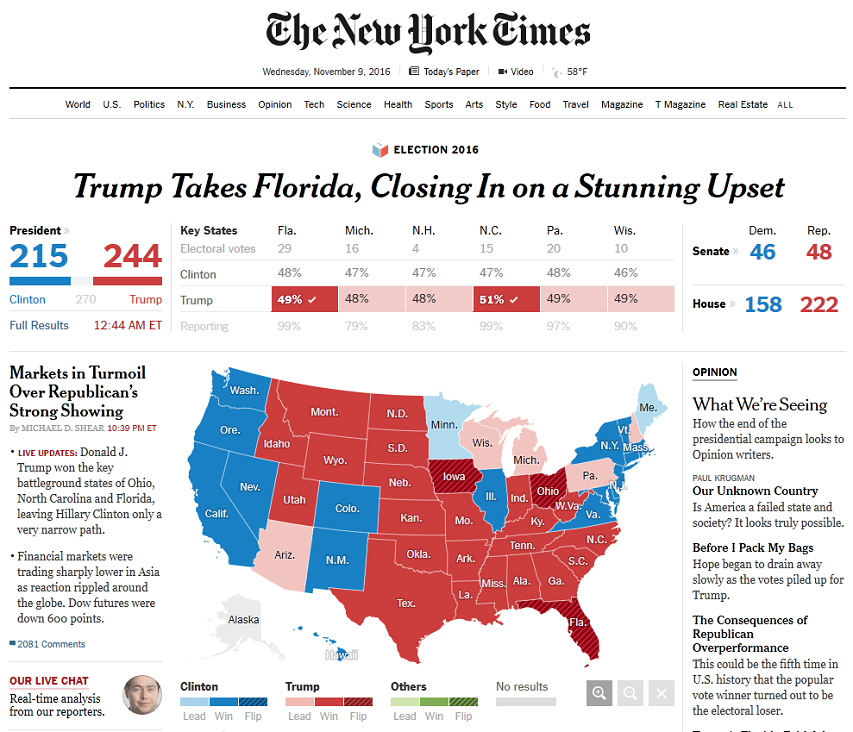
In what I’m sure is totally unrelated news, but the Citizenship and Immigration Canada home page took approximately five minutes to load, due to heavier-than-anticipated traffic.
And like most of you, I’ll find out the “final” results tomorrow morning…
November 5, 2016
Media madness
In Vanity Fair, Ken Stern peers into the murky depths of the right-wing media bubble:
Virtually every day during the past year, I’ve digested a daily dose of Breitbart, the alt-right Web site that many journalists, including myself, have described as “Trump Pravda.” A typical day on Breitbart includes any number of articles extolling the rise of Donald Trump, including the massive size of his rallies and (on and off) his fast-rising poll numbers. There are also several pieces attacking the “mainstream media,” usually CNN, The New York Times or The Washington Post. Recently, there have been a slew of pieces from the Clinton WikiLeaks cache, which are part of a larger set of articles showcasing the couple’s venality, arrogance, and sexual peccadillos. The reporting, such as it is, is generally factually accurate, but mean-spirited and fantastically one-sided. If Breitbart were your primary news source, you would receive a view of the election that would be largely distorted and wholly unrecognizable to swaths of the American public.
When I checked the news the other day, it was more of the same. I counted some 20 articles about the presidential race, each espousing the unequivocal view that one candidate is collapsing due to moral failings, financial improprieties, and complete and utter lack of judgment and ethics. Notably, I was not reading Breitbart. Instead, I was reading The Washington Post, delivered to my doorstep, and the attacks were squarely waged not against the Clintons but rather against Trump.
In the Front Section, there was an incredible array of Trump-phobia, ranging from attacks on his business acuity to his ethics (“How Trump got a personal tax break by defaulting on loans”), to his personal knowledge (“Trump’s map of black America needs an update”), to stupid opinions about Trump (“Nader predicts fastest impeachment in history for a President Trump”), to smart opinions about Trump (“A contemptible candidate — and the party to blame for it”).
If you think this is limited to the National News portion of the paper, you would be mistaken. The Metro section, which typically reports on the Washington, D.C. area, was headlined by a news article describing the dysfunction at the Trump campaign in Virginia and a column arguing that Trump watching should be rated R for children. The top article in the Style section sported a massive feature on the Trump meltdown, supplemented by a column attacking Steve Bannon, the C.E.O. of the Trump campaign and the former head honcho at Breitbart. The sports section featured a column attacking Trump and defending, of all things, locker-room culture. Only the Health section lacked a Trump hook. (Trump, as you may recall, temporarily banned WaPo reporters from his campaign events.)
Rather remarkably, there was virtually no mention of Clinton or any other candidate running for president on this particular day. And so I repeated this little thought experiment again last week and the results were largely the same. The Post should not be blamed for criticizing a candidate who has demonstrated xenophobic, racist, and sexually predatory behavior. But even at the end of perhaps the worst stretch of weeks for a candidate in modern American electoral history, perhaps 45 percent of the electorate, some 55 million voters or so, still will vote for Trump. And some of them may wonder if the Post put their fat thumbs on the electoral scales.
October 22, 2016
Polls, voting trends, and turnouts
Jay Currie looks at the US election polling:
Polls tend to work by adjusting their samples to reflect demographics and an estimate of a given demographic’s propensity to actually vote. On a toy model basis, you can think of it as a layer cake with each layer representing an age cohort. So, for example, if you look at younger voters 18-29 you might find that 90% of them support Hilly and 10% Trump. If there are 100 of these voters in your sample of 500 a simple projection would suggest 90 votes for Hilly, 10 for Trump. The problem is that it is difficult to know how many of those younger voters will actually go out and vote. As a rule of thumb the older you are the more likely you are to vote so now you have to estimate voting propensity.
There are two ways to get a sense of voting propensity: ask the people in your sample or look at the behaviour of people the same age but in the last couple of elections.
And now the landscape begins to shift. In 2008, nearly 50% of voters aged 18-29 voted. In 2012, 40% voted. In both elections, the youth vote was heavily pro-Obama. If you were designing a poll at this point, what sort of weighting would make sense for youth voters? Making that call will change the landscape your poll will reflect. If you want your poll to tilt Hilly you can believe that the prospect of the first woman President of the United States will be as motivating as Obama was and assign a voting propensity of 40-50%; alternatively, if you don’t see many signs of Hillary catching fire among younger voters, you can set the propensity number at 30% and create a tie or a slight Trump lead.
(The results of this are even more dramatic if you look at the black vote and turnout. In 2008 black turnout was 69.1%, 2012, 67.4% with Obama taking well over 90%. Will the nice white lady achieve anything like these numbers?)
One the other side of the ledger, the turnouts of the less educated have been low for the last two elections. 52% in 2008 and a little less than 50 in 2012. There is room for improvement. Now, as any educated person will tell you, often at length, Trump draws a lot of support in the less educated cohorts. But that support is easily discounted because these people (the deplorables and their ilk) barely show up to vote.
Build your model on the basis that lower education people’s participation in 2016 will be similar to 2008 and 20012 and you will produce a result in line with the 538.com consensus view. But if you think that the tens of thousands people who show up for Trump’s rallies might just show up to vote, you will have a model tending towards the LA Times view of things.
October 17, 2016
Hillary Clinton tells us to expect a major US recession shortly after January 20, 2017
Fortunately, as Tim Worstall explains, politicians can rarely be believed — especially when it comes to economics:
Hillary Clinton Vows To Slam The Economy Into Recession Immediately Upon Election
This probably isn’t quite what Hillary Clinton intended to say but it is what she did say at a fundraiser on Friday night. That immediately upon election she would slam the US economy into a recession. For what she has said is that she’s not going to add a penny to the national debt. Which, in an economy running a $500 billion and change budget deficit means tax rises and or spending cuts of $500 billion and change immediately she takes the oath. And that’s a large enough and fierce enough change, before she does anything else, to bring back a recession.
[…]
Now, what she meant is something more like this. That she has some spending plans, which she does. And she is also proposing some tax rises. And that her tax rises will balance her spending plans and thus the mixture of plans will not increase the national debt. Which is possibly even true although I don’t believe a word of it myself. For her taxation plans are based upon static analyses when we really must use dynamic ones to measure tax changes. This is normally thought of as something that the right prefers. For if we measure the effects of tax cuts using the dynamic method then there will be some (please note, some, not enough for the cuts to pay for themselves) Laffer Effects meaning that the revenue loss is smaller than that under a static analysis. But this is also true about tax rises. Behaviour really does change when incentives change. Thus tax rises gain less revenue in real life than what a straight line or static analysis predicts.
That is, as I say, probably what she means. But that’s not actually what she said. She said she’ll not add a penny to the national debt. Which means that immediately on taking office she’s got to either raise taxes by $500 billion and change or reduce spending by that amount. Because the budget deficit is that $500 Big Ones and change at present and the deficit is the amount being added to the national debt each year. The problem with this being that that’s also some 3.5% or so of GDP and an immediate fiscal tightening of that amount would put the US economy back into recession.
September 12, 2016
The impossible choice facing American voters in November
Tamara Keel wraps it up nicely:
Democrats seem baffled that their candidate isn’t galloping away with this thing.
So, my Democrat friends, you know how you’re all “Jesus, how could the Republicans pick someone so incredibly loathsome? Are they stupid?” Pretty much that right back at you.
Just like the Republican primaries managed to select the only candidate who could possibly get beaten by the Lizard Queen from Zeta Reticuli, your unDemocratic Superdelegate Logrolling Festival managed to turn up the one candidate in your party who might lose to Cheeto Jesus.
Both major parties are, ironically, in a place where the best thing that could happen to their electoral chances is for the headliner on their ticket to suffer a sudden heart attack.
August 27, 2016
Scott Adams finds a silver lining to the 2016 presidential race
I didn’t think it was possible, but Scott Adams points out two unexpectedly positive things that have come to pass despite the two leading candidates for the office of President of the United States being two of the most obnoxious and polarizing human beings ever to enter the race:
Hillary Clinton has already broken the ultimate glass ceiling. I see no discussion – in private or in public – about the role of her gender. Clinton did that for you and your daughters. She took gender off the table for the most important job in the land. It doesn’t matter who gets elected now. Clinton already made the gender sale. In 2016, nearly all American citizens believe a woman can, and will, be president. Because of Hillary Clinton. That’s a big deal.
I know that some of you think Clinton “cheated” because she used the advantage of her husband’s presidency to seek her own destiny. But keep in mind that ALL successful people exploit their unique advantages. Clinton just did it better. She isn’t here by accident.
Meanwhile, Donald Trump turned the GOP into a pro-LGBTQ organization. No one saw that coming. And I think it is sticking. That’s a big deal.
So, while we were watching the two most odious personalities on the planet hurl lies and insults at each other, those two odious personalities were bringing civilization toward the light. And succeeding.
Don’t lose that.
August 16, 2016
Would Trump pull the US out of NATO?
Tom Kratman regretfully says no:
The last several months have seen repeated claims and variants on claims that presidential candidate Donald Trump wants to, and intends to, pull the United States out of NATO. Hillary Clinton made the claim on 28 March of this year, repeating a version of it on 8 May on Face The Nation.
Sad to say, Trump hasn’t said we need to pull out; would that he had. Instead, he’s made far weaker calls to “reconsider” our role in NATO, and to restructure or reform NATO to deal with modern threats, like terrorism, rather than Cold War threats, like the former Soviet Union and Warsaw Pact. These were couched in terms generally reasonable and factual; to paraphrase, NATO other than the US doesn’t pay its fair share.
I’m not so concerned with what politicians may say – and Trump’s become one now – who are vying for political office. See, for example, Hillary’s lies about what Trump actually said, cited above. I’m far more concerned with what they should do following election. In this particular case, though what Hillary has claimed of Trump is a lie, it’s a lie he should follow through on.
NATO has rarely pulled its weight in the past, nor is it pulling its weight in the present. Of twenty-eight NATO countries, only five meet their defense spending goal of two percent of GDP. Even that is begging the question, though; because none of them, not one, come near to our level of spending. Britain, for example, with a GDP of 2.679 trillion, spends about fifty-two billion, or just over two percent. France’s defense budget runs under two percent. Germany, Europe’s largest economy, disgracefully, spends a mere thirty-seven billion, or just over one percent. Some smaller NATO countries, the Netherlands, for example, spend about what Germany does.
We, conversely, spend about three times what Germany does, and even more than that if one tallies in a number of indirect expenditures, like the VA, on which we spend more than twice Germany’s entire defense budget.
Frankly, all of NATO is on a kind of moral defense welfare and has been pretty much since inception.
[…]
But the Truman Doctrine! The Truman Doctrine!
I know a lot of people must have missed it, but the Truman Doctrine wasn’t designed to contain Russia. Neither should one be taken in by flighty rhetoric presented to congress. The Truman Doctrine arose in the context of containing communism. That was done. Communism is no longer an international threat (and if we can keep the Hildebeast out of the White House we may be able to keep it from becoming a domestic threat, too).
But we need European troops!
Some of them have been, indeed, excellent. I am thinking especially of the UK’s, Canada’s, Australia’s, and Denmark’s. I am not thinking of Germany’s, the reports on whom, such as I have seen, are almost uniformly wretched, and I am not thinking of France’s, the reports on which are mixed. However, in accord with their defense budgets, those troop slices were objectively small, and they generally did not come with logistic self-sufficiency. In other words, in huge part, we had to provide the transportation and other support to keep them in the field in Afghanistan and Iraq, and that, especially in Afghanistan, where our own logistic capability was badly strained.
That was bad enough, but there is something much worse. There has grown up over the decades since the Second World War a regime of treaties, advancing what is often called “International Humanitarian Law” – IHL – and purporting to subordinate the law of war to it. Some of those claims are so preposterous as to be unbelievable, except that many, many of the world’s elites do believe in them and do force us to subordinate our own laws to them. A discussion of IHL is beyond the scope of this column. Note, however, two aspects of it that have arisen, the International Criminal Court, created by what is called “the Rome Statute,” and the Protocols Additional to Geneva Convention IV. The former subverts national sovereignty by placing it subordinate to unelected, partisan, largely left wing, jurists. The latter were specifically designed and pushed forward by the former Soviet Union to undermine the west.
We accept neither of these and, in fact, have a conditional declaration of war in place, the American Servicemembers Protection Act, should anyone try to grab our troops for trial before the ICC. Unfortunately, our “allies,” for the most part, have signed onto these obscenities. What that means is that we are constrained from acting with the full rigor of the law of armed conflict by the presence of allies, for whom, should we act in accordance with the law of war but against IHL, makes them complicit in what are, by their own domestic laws, war crimes. This constraint is intolerable, a rotten, stinking albatross tied around our necks. And this is what makes the presence of allied NATO troops not worth the bother, even when those troops are superb.
August 13, 2016
If Trump actually wanted to lose, what would he be doing differently?
I think the jury is still out over whether Donald Trump really wants to win the presidency. Back when he entered the race, several people pointed out just how close he had been to the Clintons for decades, and floated the idea that his role wasn’t to win but to make it possible for Hillary to win (by crippling or eliminating anyone on the GOP bench who could beat her in the general election). Since he won the Republican nomination, he has consistently made unforced errors that allowed the media to concentrate their fire on him, especially when something came up that might have hurt Clinton. Maybe Scott Adams will explain how this is actually Trump’s version of the “rope a dope” strategy, but right now it looks like Trump is doing everything he can to lose the election.
At Never Yet Melted, David Zincavage says that Trump’s supporters have been played as suckers:
Donald Trump isn’t a conservative. Donald Trump is not a down-home American like you. Donald Trump is a conniving, cynical New Yorker. He’s 70 years old, fabulously wealthy, already famous and already living a completely sybaritic life-style. For him, moving from one of his luxury residences to the White House and having to be president would be like moving down-market in housing and getting a full-time job. It would be a real bummer.
He is not into personal sacrifice. Donald Trump cares about political ideas the way I care about Olympic soccer matches. Donald Trump has no real personal political ideas or preferred policy agenda at all. He’s just a businessman, a total pragmatist.
Donald Trump is not your buddy and he is no kind of patriot. Trump likes money, tail, and Trump, period.
So we’re watching him campaign. He carelessly contradicts himself. He routinely takes one position and then the opposite one. He constantly offends rival candidates and significant potential voting blocs. He does exactly as he pleases, casually taking time away from campaigning, often spending no money, doing no advertising and no fund-raising. He behaves like a crazy person, defying convention, political correctness, and rather frequently ordinary good manners and civility as well. He says something embarrassing or outrageous several times a week.
One is obliged to conclude that either Donald Trump is crazy and the most incompetent candidate for office in human history, or he is motivated by something other than winning.
Since we know that Trump is a close friend of the Clintons, on the whole, I like best the theory that contends that Trump has really just been running, all along, in order to kill Republican chances in what ought to have been a landslide Republican year and to make possible the impossible: Hillary’s election.
He’s having lots of fun. He’s soaking up the limelight and laughing at all the dopes supporting him, while mischievously dropping another turd in the electoral punchbowl every now and then and watching the commentariat have fits over what they think is a gaffe.
Update: After I had this post queued up for Saturday morning, I noticed this tweet from Megan McArdle:
If the Clintons *had* cooked up a scheme w/Trump to get the nomination & dump the election, how would that look different from what we got?
— (((Megan McArdle))) (@asymmetricinfo) August 11, 2016
July 28, 2016
Scott Adams: Hillary is “selling past the close”
Noted Clinton supporter* Scott Adams thinks Hillary is making a major persuasion mistake in her campaign:
… that brings us to a concept called “Selling past the close.” That’s a persuasion mistake. Clinton has already sold the country on the idea that a woman can be president. Sales experts will tell you that once the sale is made, you need to stop selling, because you have no chance of making things better, but you might give the buyer a reason to change her mind.
Obama understood how to avoid selling past the close. At some point during Obama’s first presidential election campaign the country mentally agreed that an African-American could be their next president. So Obama accepted the sale and talked about other stuff. If he had dwelled on race, and his place in history, he would have risked making things worse. So he stayed quiet on race (mostly) and won. Twice.
Clinton is taking a different approach. As Michelle Obama said, we now take for granted that a woman can be president. That sale is made. But Clinton keeps selling. And that’s an enormous persuasion mistake.
I watched singer Alicia Keys perform her song Superwoman at the convention and experienced a sinking feeling. I’m fairly certain my testosterone levels dropped as I watched, and that’s not even a little bit of an exaggeration. Science says men’s testosterone levels rise when they experience victory, and drop when they experience the opposite. I watched Keys tell the world that women are the answer to our problems. True or not, men were probably not feeling successful and victorious during her act.
Let me say this again, so you know I’m not kidding. Based on what I know about the human body, and the way our thoughts regulate our hormones, the Democratic National Convention is probably lowering testosterone levels all over the country. Literally, not figuratively. And since testosterone is a feel-good chemical for men, I think the Democratic convention is making men feel less happy. They might not know why they feel less happy, but they will start to associate the low feeling with whatever they are looking at when it happens, i.e. Clinton.
* He endorses Clinton for his personal safety. He says neither candidate actually aligns with his views. He also says he doesn’t vote (but he lives in California where Clinton will likely have a huge surplus of votes anyway).


