Quotulatiousness

May 3, 2022

Is all of social media just a “giant domestic surveillance operation”?

Filed under: Business, Media, Technology, USA — Tags: , , , , , , , , — Nicholas @ 05:00

Severian posted this last week, but I’m only just getting caught up now:

I was wrong about Musk buying Twitter. Lot of that going around — the Z Man got a whole podcast on “avoiding error” from his misread of the situation. It’s well worth a listen. I, too, had a “hot take” on Musk’s offer — not that it was particularly hot, as most folks on this side were saying it, but I too thought it was a stunt. After all, Musk, like Bezos and all the other “new commerce” billionaires, don’t exist without massive government support. I figured his “offer” was stoyak — he’s got something in the works in the Imperial Capital and needed to play hardball with somebody.

But I was also working off my longstanding assumption that Twitter, Faceborg, and all the rest are essentially CIA / NSA fronts. When I first heard about Facebook, my first thought was “Wait, don’t we already have Friendster? What does this bring to the table?” My second thought was the first one I’d had about Friendster: “That’s clever, I guess, but how on earth is this going to make money? Even if they saturate it with ads, to the point where it’s unusable — which will happen in about two weeks — they can’t monetize your personal data any farther. People are pretty set in their habits — once the algorithm figures out you’re the kind of guy who likes anime and New Wave music, any further data is useless.”

Being a much more naive, trusting sort back then, I figured it was just stupidity. You know, Pets.com level stupidity. The VC boys were trying to get another dotcom bubble inflated, because if the first one proved anything, it’s that people are dumb and will keep falling for the same obvious scam over and over. I could hear them in the board rooms: “This time, instead of sticking ‘cyber’ in front of everything, we’ll call it ‘Web 2.0.’ Cha-ching!”

Obviously that didn’t happen. So I went with the common explanation that was floating around in those days, that “social media” sites made their money by selling your data to advertisers. But that doesn’t pass the smell test either. For one thing, as I said above, your habits don’t change very much. For another, as anyone who has any experience with them knows, those algorithms really suck. The other day, for instance, I was listening to some old music one of the streaming music sites. And I mean really old. Nothing I’d played the whole morning had been composed after the 17th century, but the service’s algorithm was convinced that what I’d really like to listen to next was some rapper.

Indeed, the whole point of the ads on Pandora, Spotify, whatever seems to be: To annoy you to the point where you pay for their premium service. Pandora, for instance, either really really really believes I want a Surface Pro 8 and some Taco Bell, or they’re just playing those ads every two songs to annoy me into buying the premium service (which is every ad that isn’t Surface Pro or Taco Bell). Which is just bizarre, because I haven’t had Taco Bell since college — which was 30 years ago, and I paid cash — and this essay right here is the first time I have ever even typed the words “Surface Pro 8”, much less looked at the product.

I really wouldn’t be surprised that the “algorithm” is reading itself. Hey, this guy sure has seen a lot of ads for Taco Bell and Surface Pro! He must really want some!

But the algorithm for companies whose entire business model is e-commerce is no better. Amazon seems to have gone to a “push” model — they must be selling their suppliers on the idea that they can push you stuff, which is why they always pimp the same four or five items in the “Amazon’s Choice” recommendations, no matter what you’re searching for. And these again are laughably wrong — the only things I get off Amazon are used history and philosophy books, and stuff for my dog. Based on this, they have concluded that what I’m really looking for are chick lit and beach gear.

Given all that, I came to the conclusion that “social media” (and Amazon too, probably) really only have one customer, who really does have a use for your data, and that customer’s initials are CIA. It’s a giant domestic surveillance operation.

And why wouldn’t it be? The Regime has had a legitimacy problem for a long time, and a “feedback loop” problem for longer than that. Even if we assume no ulterior motives whatsoever — fat chance, but let’s stipulate — the fact remains that public opinion polling, however you want to define it, has a similar problem as psychological studies. Since the vast majority of study participants are college undergrads, what you get is WEIRD — that’s Western, educated, industrialized, rich and democratic, and also in a very narrow age range. Psych studies that purport to be universal are, at their very best, snapshots inside the head of the BCG.

If you haven’t encountered the Basic College Girl, he provided a thumbnail sketch here.

November 5, 2021

The New York Times identifies the next big threat to humanity – “Muskism”

Filed under: Books, Business, Media, Space, USA — Tags: , , , , , , — Nicholas @ 03:00

In Thursday’s NP Platformed newsletter, Colby Cosh outlines the “evidence” amassed in a recent New York Times essay blaming Elon Musk for, well, everything:

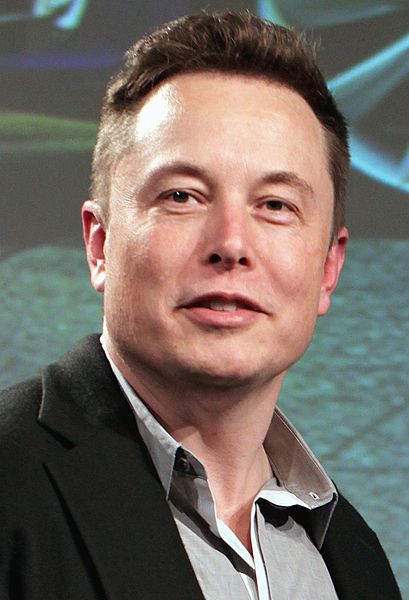
Elon Musk at the 2015 Tesla Motors annual meeting.
Photo by Steve Jurvetson via Wikimedia Commons.

Lepore commences by describing Bill Gates’s 66th birthday party, for which a bunch of rich people — including Amazon’s Jeff Bezos — were helicoptered to a private beach from a nearby yacht. Neither Elon Musk, thought to be the world’s richest person, or Mark Zuckerberg, founder of newly rebranded Facebook, were present at the party. Zuckerberg was busy illuminating plans for his “metaverse”, which Lepore describes as “a virtual reality,” wherein you wear “a headset and gear that closes out the actual world.”

Here’s where Lepore goes from this: “The metaverse is at once an illustration of and a distraction from a broader and more troubling turn in the history of capitalism. The world’s techno-billionaires are forging a new kind of capitalism: Muskism.”

In literally the next sentence, Lepore admits that the subject of her essay, Elon Musk, immediately and publicly made fun of the Facebook “metaverse” plans. We are on the third paragraph of the essay, and Lepore has already: a) blamed Elon Musk for an A-hole billionaire party he didn’t attend, because he was busy with his engineering and manufacturing projects; and b) applied the new coinage “Muskism” to a virtual reality project that actual Musk loudly criticized. Somehow this essay has severed its own hydrocephalic head twice over, within 500 words.

It gets worse from there as Lepore attempts to complete her mission of denouncing Muskism, which she describes as an “extreme extraterrestrial capitalism.” She quickly has to admit that Bill Gates, who is mostly spending a computing fortune on global philanthropy these days when he’s not lifting off from yachts in choppers, doesn’t have one single freaking thing to do with absolutely any of this. NP Platformed was an editor back in the day, so we notice that the intro of Lepore’s essay is at this point not only detached from its body, but has been left to rot several miles away. Gates-Musk-Bezos-Zuckerberg: they’re all tentacles of the same menacing Muskist octopus here, as in so much newspaper and magazine commentary, and abuse flung in their general direction will suffice to condemn all.

Lepore’s accusation against Musk turns out to be … that he likes some classic science fiction but doesn’t always concur with the politics of its authors. Musk has called himself a “utopian anarchist of the kind best described by Iain Banks,” but Banks was “an avowed socialist.” Gasp! Banks (1954-2013), the Scottish science fiction author best known for the Culture series, was a particular kind of U.K. “libertarian socialist” who believed strongly in spacefaring as a step toward post-scarcity life for sentient beings. His politics are easily misunderstood by Americans, who don’t have this particular kind of weirdo, and the interstellar “Culture” he envisioned was never intended to be admired unironically. In other words, that part of Lepore’s essay is as mangled and obtuse as the rest.

September 2, 2021

Charles Stross predicts that Elon Musk will become a multi-trillionaire

Filed under: Business, Economics, Government, Space, Technology, USA — Tags: , , , , — Nicholas @ 03:00

Charles Stross isn’t exactly a fan of Musk’s, but he outlines why he thinks Musk is on a potentially multi-trillion dollar path:

Elon Musk at the 2015 Tesla Motors annual meeting.
Photo by Steve Jurvetson via Wikimedia Commons.

So, I’m going to talk about Elon Musk again, everybody’s least favourite eccentric billionaire asshole and poster child for the Thomas Edison effect — get out in front of a bunch of faceless, hard-working engineers and wave that orchestra conductor’s baton, while providing direction. Because I think he may be on course to become a multi-trillionaire — and it has nothing to do with cryptocurrency, NFTs, or colonizing Mars.

This we know: Musk has goals (some of them risible, some of them much more pragmatic), and within the limits of his world-view — I’m pretty sure he grew up reading the same right-wing near-future American SF yarns as me — he’s fairly predictable. Reportedly he sat down some time around 2000 and made a list of the challenges facing humanity within his anticipated lifetime: roll out solar power, get cars off gasoline, colonize Mars, it’s all there. Emperor of Mars is merely his most-publicized, most outrageous end goal. Everything then feeds into achieving the means to get there. But there are lots of sunk costs to pay for: getting to Mars ain’t cheap, and he can’t count on a government paying his bills (well, not every time). So each step needs to cover its costs.

What will pay for Starship, the mammoth actually-getting-ready-to-fly vehicle that was originally called the “Mars Colony Transporter”?

Starship is gargantuan. Fully fuelled on the pad it will weigh 5000 tons. In fully reusable mode it can put 100-150 tons of cargo into orbit — significantly more than a Saturn V or an Energiya, previously the largest launchers ever built. In expendable mode it can lift 250 tons, more than half the mass of the ISS, which was assembled over 20 years from a seemingly endless series of launches of 10-20 ton modules.

Seemingly even crazier, the Starship system is designed for one hour flight turnaround times, comparable to a refueling stop for a long-haul airliner. The mechazilla tower designed to catch descending stages in the last moments of flight and re-stack them on the pad is quite without precedent in the space sector, and yet they’re prototyping the thing. Why would you even do that? Well, it makes no sense if you’re still thinking of this in traditional space launch terms, so let’s stop doing that. Instead it seems to me that SpaceX are trying to achieve something unprecedented with Starship. If it works …

There are no commercial payloads that require a launcher in the 100 ton class, and precious few science missions. Currently the only clear-cut mission is Starship HLS, which NASA are drooling for — a derivative of Starship optimized for transporting cargo and crew to the Moon. (It loses the aerodynamic fins and the heat shield, because it’s not coming back to Earth: it gets other modifications to turn it into a Moon truck with a payload in the 100-200 ton range, which is what you need if you’re serious about running a Moon base on the scale of McMurdo station.)

Musk has trailed using early Starship flights to lift Starlink clusters — upgrading from the 60 satellites a Falcon 9 can deliver to something over 200 in one shot. But that’s a very limited market

As they say, read the whole thing.

July 25, 2021

The Line editors clearly loved crafting their “Dicks in space!” headline

Filed under: Business, Space, Technology, USA — Tags: , , , , , , — Nicholas @ 05:00

As a fellow space nerd, I welcome the editors of The Line to our number:

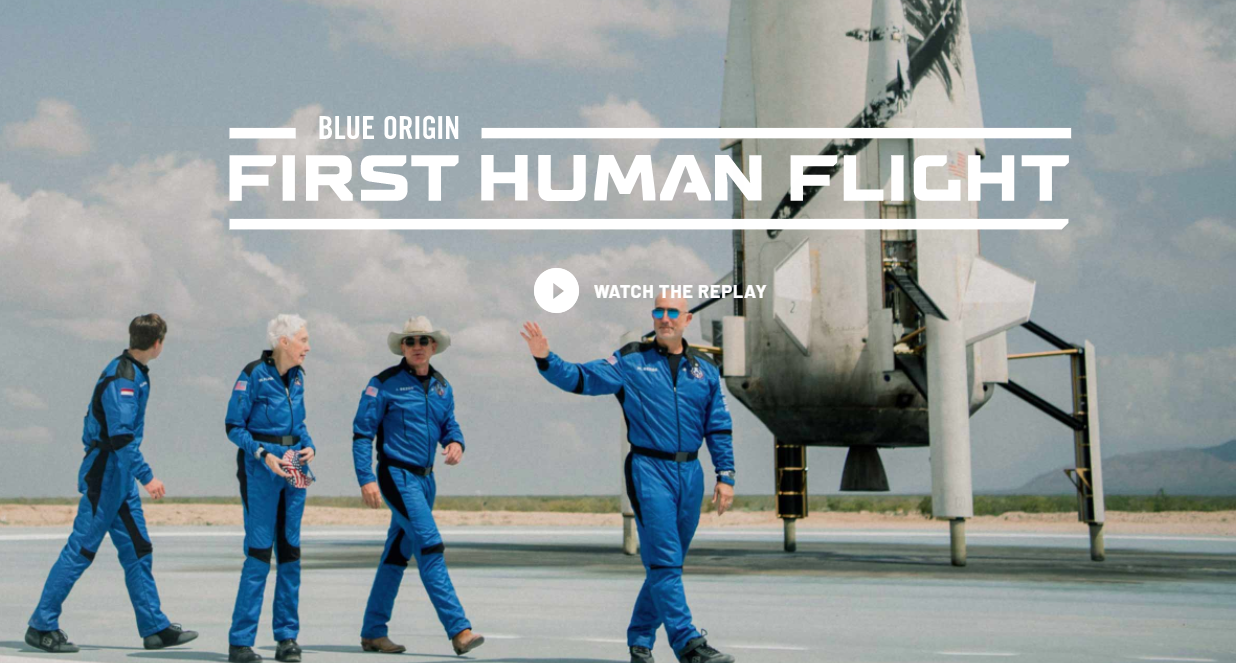
You’ve probably noticed by now that your Line editors are space enthusiasts. It’s been an interesting few weeks on that front. Sir Richard Branson flew out of the atmosphere, into free-fall (not zero-G, you scientific illiterates!), on a Virgin Galactic space plane. That said, he didn’t get high enough to cross the Kármán line, which, in the absence of any real international agreement on where the Earth ends and space begins, is as close as we come to a functional definition of the edge of space. (It’s an altitude of 100 km, for those wondering.) Jeff Bezos, of Amazon wealth and fame, did cross that line this week, along with three passengers, including Wally Funk, which was cool, if you’re into that sort of thing. (We are.) Bezos was riding a Blue Origin New Shepard rocket; Blue Origin is a company he founded and funded with his own gigantic wealth.

Look, let’s face facts — your Line editors are into space. We just are. But yeah, we agree that space policy is important enough and complicated enough to warrant debate. Reasonable people can have different views on this stuff. And we also agree that there are important debates to have about the accumulated wealth of billionaires, and the distorting effects that wealth can have on politics and society.

But unlike a bunch of ya’ll, we don’t get confused about a debate over income inequality and a debate over space travel. You can despise Bezos, Amazon and everything he’s done there, and still recognize that what he is doing on the space front is important. Everyone rolling their eyes at Bezos matching space flight capabilities that the Soviets and Americans achieved literally 60 years ago is allowing their desire to rack up some sweet Twitter likes with a snarky dunk blind themselves to the fact that Bezos (and Elon Musk’s SpaceX, which is way ahead of Blue Origin) aren’t just recreating earlier capabilities, they are massively improving on them.

So yeah, Blue Origin can now do what the Soviets and U.S. could do 60 years ago, but they’re doing it more safely, more efficiently and much, much more sustainably than national space agencies did. Reusability isn’t a frill, it’s a massive game-changer. And as much fun as it is to snort when these private-sector companies recreate an existing capability, do you really think they’re going to stop there?

Branson’s company could be written off as a tourism play for the affluent. Fair enough. Except that making space flight economically viable is the first step to ensuring that capability is both sustainable and more broadly accessible in the long run. Further, Bezos and especially Musk are inventing new and transformative space-flight capabilities. They are materially pushing back against the final frontier in ways that we simply have not before. It won’t matter unless we choose to do anything with these new capabilities, and your guess is as good as ours as to whether or not we will. But we could. That’s huge.

As huge as the gigantic dick-shaped rocket Bezos rode up. Yeah, yeah. We snorted, too. But, like, seriously, folks — making penis jokes about the shape of an object dictated by aerodynamic considerations isn’t quite as witty as you think: the rockets are shaped like penises because they literally have to be in order to work. Having a giggle is fine, but if you actually think you’re making a real point about misogyny and fragile male egos when you get snippy (ahem) about a schlong-shaped rocket, well, we’d love to see what happens when your very emotionally vigorous and feminist vagina-shaped space vehicle hits max Q. So long as we aren’t aboard it or in the landing area for its hurtling debris.

Our main point still stands: don’t let your cynicism and even revulsion at these guys blind you to what they’re doing. Bezos isn’t gonna stop at Yuri Gagarin-vintage accomplishments. Musk sure hasn’t. This’ll matter. It’s time to get serious. They are.

December 1, 2020

QotD: Elon Musk as a real life Delos D. Harriman

Filed under: Books, Business, Quotations, Space, USA — Tags: , , , , , , — Nicholas @ 01:00

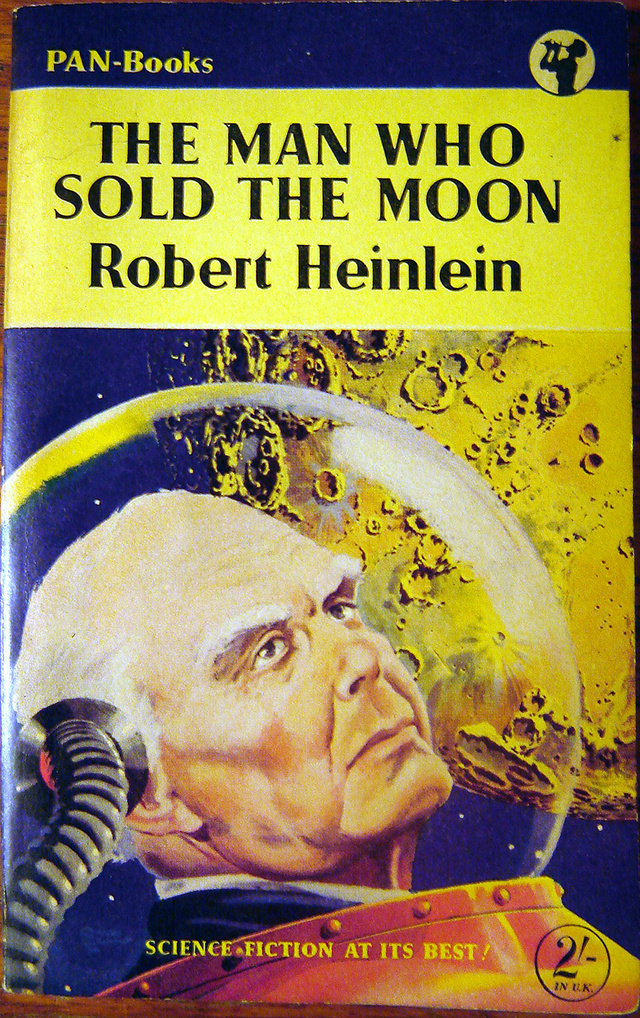
The “key story” [in Robert Heinlein’s “Future History” stories] I just mentioned is called “The Man Who Sold The Moon.” And if you’re one of the people who has been polarized by the promotional legerdemain of Elon Musk — whether you have been antagonized into loathing him, or lured into his explorer-hero cult — you probably need to make a special point of reading that story.

The shock of recognition will, I promise, flip your lid. The story is, inarguably, Musk’s playbook. Its protagonist, the idealistic business tycoon D.D. Harriman, is what Musk sees when he looks in the mirror.

“The Man Who Sold The Moon” is the story of how Harriman makes the first moon landing happen. Engineers and astronauts are present as peripheral characters, but it is a business romance. Harriman is a sophisticated sort of “Mary Sue” — an older chap whose backstory encompasses the youthful interests of the creators of classic pulp science fiction, but who is given a great fortune, built on terrestrial transport and housing, for the purposes of the story.

Our hero has no interest in the money for its own sake: in late life he liquidates to fund a moon rocket, intending to take the first trip himself, because he is convinced the future of humanity depends on extraterrestrial expansion of the human species. (Also, the guy just really loves the moon.)

The actual stuff of the story consists of the financial and promotional chicanery that Harriman uses to leverage his personal investment. Harriman uses sharp dealing with governments, broadcasters, political groups: he plants fake news about diamonds on the moon to blackmail (a disguised version of) the de Beers cartel, and terrorizes companies with the threat of using the moon to advertise for competitors. He is, in short, not afraid to use questionable means to achieve a worthwhile higher end, and does not — Musk haters take note! — recoil from actual fraud.

Heinlein didn’t provide for live broadcasting of his imagined lunar mission, which is almost an afterthought in his Great Man business yarn. TV cameras were, like computers, one of his blind spots. But if he had thought to make Harriman the owner of a fancy-sportscar manufacturing concern, and if he had thought to have Harriman put a car in solar (trans-Martian!) orbit as one of his publicity stunts, that would have been there in “The Man Who Sold The Moon.” Selling the moon is just what Musk is doing. Except the moon is a tad worked-over as a piece of intangible property, so we get Mars instead.

Colby Cosh, “Heinlein’s monster? The literary key to Elon Musk’s sales technique”, National Post, 2018-02-12.

July 3, 2019

QotD: Elon Musk as a modern-day Ferdinand DeLesseps

Filed under: Business, Law, Quotations, USA — Tags: , , , , — Nicholas @ 01:00

I used to love Elon like everyone else. I still think that having four or five billionaires in a space race against each other is finally the world I thought I was going to get growing up reading Heinlein. The Tesla Model S was probably one of the most revolutionary cars of the last 50 years. But he lost me when he committed outright fraud in the Solar City – Tesla deal and since then have only become more skeptical about he and Tesla.

Elon Musk at the 2015 Tesla Motors annual meeting.
Photo by Steve Jurvetson via Wikimedia Commons.

I sort of laugh when folks tell me that really smart successful rich people believe in Tesla. You mean like James Murdoch, on the board of Tesla and who also was lost his entire investment in Theranos? Or like Larry Ellison, an adviser and fan of Elizabeth Holmes who invested $1 billion in Tesla just 6 months ago and has already lost 40% of it? The window on this is probably closing, but over the last 10 years if you wanted to get Silicon Valley investors to throw a lot of money at you, find a traditional bricks and mortar business and devise a story in which you take that industry and convert its economics to that of the networked software world (see: Uber, WeWork, Tesla, and even Theranos in some of its strategic pivots).

Or how about true millennials and Elon Musk? Name a wealthy millennial supporter of Elon Musk and Tesla and I can bet you any amount of money they have not looked at Tesla’s balance sheet or cash flow or the details of its global demand trends. They have not thought about its dealership strategy or manufacturing strategy and the cash flow implications of these. They just like what Elon says. It sounds big and visionary. They buy into Elon’s formulation that he is saving the environment and everyone opposed to him is in a cabal with big oil (ignoring the fact that Elon routinely uses his Gulfstream VI to commute distances less than 60 miles). So saying that rich millenials adore Elon is effectively saying that they want to be associated with the same things Elon says he is for — the environment and space travel et al.

Elon Musk is Ferdinand DeLesseps. He is PT Barnum. He is Elizabeth Holmes. He is the pied piper. He is fabulous at spinning visions and making them sound science-y. But he is not Tony Stark. There is a phenomenon with Elon Musk that everyone thinks he is brilliant until they hear him speak about something about which they have domain knowledge, and then they realize he is full of sh*t. For example, no one who knows anything about transportation or physics or basic engineering has thought his Boring Company and Hyperloop make any sense at all. His ideas would have been great cover stories for Popular Mechanics in the 1970’s, wowing 13-year-old boys like me with pictures of mile-long cargo blimps and flying RV’s. He is like a Marvel movie that spouts science that is just believable-enough sounding that it moves the plot along but does not stand up to any scrutiny.

All of this would be harmless if he was not running a public company. I don’t really care about the rich folks who were duped by Elizabeth Holmes, but hundreds of thousands of small millenial investors who have totally bought into the Elon hype are literally putting their last dollar into Tesla, and sometimes borrowing more. Tesla shorts often laugh at these folks on Twitter, calling them “bagholders,” but it is a tragedy. Unless Tesla finds a sugar daddy sucker, and the odds of that are getting longer, I think it is going to end badly for many of these investors.

As a disclosure, I have been short Tesla via puts for a while now. It you really want to understand Elon, the best book I can recommend is The Path Between The Seas about the building of the Panama Canal. First, it is a great book you should read no matter what. And second, Ferdinand DeLesseps is the best analog I can find for Musk.

Warren Meyer, “People Who Express Opinions Outside of their Domain Seldom Have Really Looked into it Much”, Coyote Blog, 2019-05-28.

January 27, 2019

Some reasons to be bearish on Tesla’s future

Filed under: Business, Media, Technology, USA — Tags: , , , , — Nicholas @ 05:00

At Coyote Blog, Warren Meyer climbs back onto one of his favourite hobby horses:

Yes, I am like an addict on Tesla but I find the company absolutely fascinating. Books and HBS case studies will be written on this saga some day (a couple are being written right now but seem to be headed for Musk hagiography rather than a real accounting ala business classics like Barbarians at the Gate or Bad Blood).

I still stand by my past thoughts here, where I predicted in advance of results that 3Q2018 was probably going to be Tesla’s high water mark, and explained the reasons why. I won’t go into them all. There are more than one. But I do want to give an update on one of them, which is the growth and investment story.

First, I want to explain that I have nothing against electric vehicles. I actually have solar panels on my roof and a deposit down on an EV, though it is months away from being available. What Tesla bulls don’t really understand about the short position on Tesla is that most of us don’t hate on the concept — I respect them for really bootstrapping the mass EV market into existence. If they were valued in the market at five or even ten billion dollars, you would not hear a peep out of me. But they are valued (depending on the day, it is a volatile stock) between $55 to $65 billion.

The difference in valuation is entirely due to the charisma and relentless promotion by the 21st century’s PT Barnum — Elon Musk. I used to get super excited by Musk as well, until two things happened. One, he committed what I consider outright fraud in bailing out friends and family by getting Tesla to buy out SolarCity when SolarCity was days or weeks from falling apart. And two, he started talking about things I know about and I realized he was totally full of sh*t. That is a common reaction from people I read about Musk — “I found him totally spellbinding until he was discussing something I am an expert in, and I then realized he was a fraud.”

Elon Musk spins great technology visions. Like Popular Mechanics magazine covers from the sixties and seventies (e.g. a flying RV! a mile long blimp will change logging!) he spins exciting visions that geeky males in particular resonate with. Long time readers will know I identify as one of this tribe — my most lamented two lost products in the marketplace are Omni Magazine and the Firefly TV series. So I see his appeal, but I have also seen his BS — something I think a lot more people have caught on to after his embarrassing Boring Company tunnel reveal.

May 4, 2018

Tesla’s tipping point?

Filed under: Business, Technology, USA — Tags: , , — Nicholas @ 03:00

Robert Tracinski on the amazingly long run Elon Musk and crew have had in the electric car business without (yet) turning a profit:

Elon Musk may finally be running out of other people’s money. That’s the upshot of a report on how Tesla is burning so much cash it may run out by the end of the year. This is a company that has raised more than $5 billion from its investors so far, and it is still going to need many billions more — if it can get them. What is more interesting is how Tesla got to the point where it is still bleeding cash, just when it was finally supposed to be making good on its extravagant promises.

The company has always been a triumph of PR hype and political messaging over reality. Why invest in Tesla? Why buy a Tesla? Because you’re not just buying a car — you’re participating in a social and technological revolution. You are the leading edge of the new era of electric cars and the obsolescence of the gasoline engine — which will literally save the planet, or so the story goes.

But it’s not just about global warming. You’re also helping Elon Musk revolutionize the entire manufacturing process by building super-automated, hyper-roboticized factories. He’s on the leading edge of the self-driving car revolution, already introducing a feature he calls “Autopilot.” If we don’t manage to save this planet, don’t worry. By boosting Musk, you’re helping him find us another planet to colonize.

In actuality, what has Tesla produced? A very nice car — for $100,000. There are a lot of very nice cars you can buy for $100,000, if you’re the sort of person who thinks this is a reasonable amount of money to spend on a car, as opposed to a house. More to the point, there are a lot of very nice cars you can buy for $50,000. But Tesla has been able to charge an irrationally high premium for sleek design, technological glamour, and what a Tesla-owning friend of mine describes as “happy tree-hugger feelings.”

February 13, 2018

Elon Musk as Heinlein’s Delos D. Harriman – “Selling the moon is just what Musk is doing”

Filed under: Books, Business, Space — Tags: , , , , — Nicholas @ 06:00

I suspect I’d recognize a lot of the books in Colby Cosh‘s collection, as we’re both clearly Robert Heinlein fans. In a column yesterday, he pointed out the strong parallels between Heinlein’s fictional “Man Who Sold the Moon” and his closest counterpart in our timeline, Elon Musk:

Written between 1939 and 1950 for quickie publication in pulp magazines, the Future History is a series of snapshots of what is now an alternate human future — one that features atomic energy, solar system imperialism, and the first steps to deep space, all within a Spenglerian choreography of social progress and occasional resurgent barbarity. It stands with Isaac Asimov’s Foundation trilogy as a monument of golden-age science fiction.

[…]

The result, in the key story of the Future History, is an uncannily accurate description of the design and launch of a Saturn V rocket. (Written before 1950, remember.) But because Heinlein happened not to be interested in electronic computers, all the spacefaring in his books is done with the aid of slide rules or Marchant-style mechanical calculators (which, in non-Heinlein history, had to become obsolete before humans could go to Luna at all). Heinlein sends people to colonize the moon, but nobody there has internet, or is conscious of its absence.

Given that his ideas about computers were from the pre-computer era and even the head of IBM thought there’d be a worldwide demand for a very small number of his company’s devices, that’s not surprising at all. In one of his best novels, a single computer runs almost all of the life support, heat, light, transportation and communication systems on Luna … and is self-aware, but lonely. In later works where computers appear, they tend to be individual personalities or even minor characters, but they’re anything but ubiquitous: powerful, but rare.

I suspect the lack of an internet-equivalent derives both from the nature of his conception of how computing would progress and a form of the Star Trek transporter problem – it solves too many plot issues that could otherwise be usefully woven into stories.

The “key story” I just mentioned is called “The Man Who Sold The Moon.” And if you’re one of the people who has been polarized by the promotional legerdemain of Elon Musk — whether you have been antagonized into loathing him, or lured into his explorer-hero cult — you probably need to make a special point of reading that story.

The shock of recognition will, I promise, flip your lid. The story is, inarguably, Musk’s playbook. Its protagonist, the idealistic business tycoon D.D. Harriman, is what Musk sees when he looks in the mirror.

“The Man Who Sold The Moon” is the story of how Harriman makes the first moon landing happen. Engineers and astronauts are present as peripheral characters, but it is a business romance. Harriman is a sophisticated sort of “Mary Sue” — an older chap whose backstory encompasses the youthful interests of the creators of classic pulp science fiction, but who is given a great fortune, built on terrestrial transport and housing, for the purposes of the story.

The Grand Tour: Legally Tesla

Filed under: Business, Humour, Law, Technology — Tags: , , , , — Nicholas @ 04:00

The Grand Tour
Published on 12 Feb 2018

In a test of the Tesla Model X, Jeremy Clarkson is joined by lawyers in this legally perilous task.

****These observations about the Tesla Model X are made in Clarkson’s personal capacity and should not be regarded as any statement or opinion by any other person or entity about the general safety, road worthiness, mechanical effectiveness, or any other standards of the vehicle about this specific model or any other Tesla vehicle.

January 4, 2018

The Truth About The Tesla Semi-Truck

Filed under: Business, Technology — Tags: , — Nicholas @ 02:00

Real Engineering
Published on 15 Dec 2017

Thank you for your amazing support this year! Help this channel get better by supporting at Patreon:
https://www.patreon.com/realengineering

Website: https://battery.real.engineering/

January 3, 2018

BAHFest London 2017 – Louie Terrill: Why the Kessler Syndrome is key to humanity’s future

Filed under: Humour, Space — Tags: , , , , — Nicholas @ 02:00

BAHFest
Published on Dec 11, 2017

Watch Louie Terrill at BAHFest London 2017 present his theory, “Making sure we’re all in this together: Why the Kessler Syndrome is key to humanity’s future.”

BAHFest is the Festival of Bad Ad Hoc Hypotheses, a celebration of well-researched, logically explained, and clearly wrong scientific theory. Additional information is available at http://bahfest.com/

October 20, 2017

Why the Lights Are Still Off in Puerto Rico

Filed under: Economics, Government, USA — Tags: , , , , — Nicholas @ 06:00

ReasonTV
Published on 19 Oct 2017

The government set the stage for a post-hurricane catastrophe.
—–
Puerto Rico was set up for disaster well before Hurricane Maria hit. Revoked tax breaks, needlessly expensive imports, and crippling debt all led to a shoddy infrastructure that’s still without power on most of the island.

On the latest “Mostly Weekly,” Andrew Heaton explores: how did Puerto Rico get screwed over well before the lights went out, and how do we get them back on?

Mostly Weekly is hosted by Andrew Heaton with headwriter Sarah Rose Siskind.
Script by Sarah Rose Siskind with writing assistance from Andrew Heaton, Brian Sack, and Justin Monticello
Edited by Sarah Rose Siskind and Austin Bragg
Produced by Meredith and Austin Bragg.
Theme Song: Frozen by Surfer Blood.

September 28, 2017

Back to the Moon in 2019?

Filed under: Space, USA — Tags: , , , , — Nicholas @ 04:00

Charles Stross thinks a US circumlunar expedition is on the cards for just two years ahead, and he might well be right:

If Donald Trump is still president, US astronauts will return to circumlunar space around July 16th, 2019 …

That’s the 50th anniversary of the launch of Apollo 11. It’s also 6-12 months on from the projected date of Musk’s translunar tourist trip on a Falcon Heavy.

I expect Falcon Heavy to be delayed a few months, minimum, because no new launch vehicle ever flies on time, especially a crew-rated one, but it’s currently due to fly around December this year for the first time, with a vehicle currently undergoing integration at Cape Canaveral and commercial orders for subsequent flights. It’s rather hard to describe it as vaporware at this point. The same goes for the Dragon 2 crewed capsule; it’s due for a first uncrewed orbital flight test in March 2018, and a crewed orbital test flight later in 2018.

[…]

I’m making this a prediction, however, because the POTUS factor.

July 2019 lies within the term in office of Donald Trump (or Mike Pence, depending whether impeachment/removal has happened first then). Trump is nothing if not an egomaniac, and offering him the opportunity to make a historic phone call to lunar orbit in front of the TV cameras is a guaranteed ego-stroke. Trump is of an age to have young-adult memories of Apollo and I can’t see the idea not appealing to him if he can take credit for it.

So I’m betting that this is how Musk will fund development of his lunar-orbit capability.

(Terms and conditions: prediction invalid in event of nuclear war, global environmental or economic collapse, Trump and Pence both being impeached, or a Dragon 2 capsule exploding in flight, because any of these things might impact the launch schedule.)

Note: Charles is quite a fan of the impeachment scenario, if you hadn’t picked that up from context. The fact that he’s very much not a Trump fan actually makes his prediction that much more striking: he has no interest or desire to see Trump get a propaganda coup to end his term in office.

September 13, 2017

Tesla’s experiment in price discrimination

Filed under: Business, Economics, Technology — Tags: , , , , , — Nicholas @ 05:00

Alex Tabarrok links to a story about Tesla using an over-the-air software update to help Tesla owners in hurricane-threatened areas get more range from their lower-battery capacity cars … but he says this may eventually come back and bite the company:

Tesla knows that some of its customers are willing to pay more for a Tesla than others. But Tesla can’t just ask its customers their willingness to pay and price accordingly. High willing-to-pay customers would simply lie to get a lower price. Thus, Tesla must find some characteristic of buyers that is correlated with high willingness-to-pay and charge more to customers with that characteristic. Airlines, for example, price more for the same seat if you book at the last minute on the theory that last minute buyers are probably business-people with high willingness-to-pay as opposed to vacationers who have more options and a lower willingness-to-pay. Tesla uses a slightly different strategy; it offers two versions of the same good, the low and high mileage versions, and it prices the high-mileage version considerably higher on the theory that buyers willing to pay for more mileage are also more likely to be high willingness-to-pay buyers in general. Thus, the high-mileage group pay a higher price-to-cost margin than the low-mileage group. A familiar example is software companies that offer a discounted or “student” version of the product with fewer features. Since the software firm’s costs are mostly sunk R&D costs, the firm can make money selling a low-price version so long as doing so doesn’t cannibalize its high willingness-to-pay customers–and the firm can avoid cannibalization by carefully choosing to disable the features most valuable to high willingness-to-pay customers.

The kind gesture to Tesla owners in Florida is probably deeply appreciated right now, but…

Unfortunately, I fear that Tesla may have made a marketing faux-pas. When it turns off the extra mileage boost are Tesla customers going to say “thanks for temporarily making my car better!” Or are they going to complain, “why are you making MY car worse than it has to be?”

Human nature being what it is, the smart money is betting on the “Thanks for the temporary upgrade, but what have you done for me lately?” attitude setting in quickly.

« Newer PostsOlder Posts »

Powered by WordPress