Quotulatiousness

July 1, 2024

Fifty ways to leave your leader

Okay, I exaggerate in the headline … Mitch Heimpel only offers a list of eight factors that matter when it’s time for a political party to take their leader out behind the barn, so to speak:

Caucus revolts have gotten more common in Canadian politics of late.

They’ve always been commonplace in Westminster politics. In recent years, they’ve dethroned three prime ministers in the U.K. They’re almost as common as general elections for removing prime ministers in Australia. They’re a sign of a healthy parliamentary system … sort of. Our system runs on confidence. Prime ministers are supposed to be responsive to pressure from the backbench.

Canada has been something of an exception to this, and not always to our national benefit. Though less so lately. We’ve seen sitting governments in revolt (Jason Kenney in Alberta, 2022) We’ve also seen opposition leaders taken out by frustrated caucus (Erin O’Toole federally in 2022, Patrick Brown as Ontario Progressive Conservative leader, 2018.) The Chrétien-Martin feud was more of a civil war than a revolt.

Still, despite the examples above, these events remain relatively rare in Canada, compared to many of our Westminster peers, because of how centralized power has become in leaders’ offices (especially in the PMO). Our normal, as described in Jeffrey Simpson’s The Friendly Dictatorship, is how our system evolved, not how it was meant to be.

Now, since there are signs (see here and here and here) that at least some Liberals are musing about taking a shot at Prime Minister Justin Trudeau, it’s perhaps a good time to set some ground rules for caucus revolts. This is what we’ve learned not just from recent Canadian experience, but also from what our British and Australian cousins have learned over the years.

[…]

If things are going so badly that the caucus wants to revolt, you probably do need to make changes. Showing you’re listening, demonstrating accountability at the senior levels and demonstrating change can take the wind out of a caucus revolt before it gets out of hand.

The above are general rules — exceptions can obviously apply. And as noted at the beginning, Canada doesn’t have much experience with these situations. That’s why Australia and the U.K. are so instructive. But things do seem to be changing in Canada, and certainly, things seem to be changing in the Liberal caucus. The above rules are offered free of charge to mutineers and loyalists alike. Good luck!

May 21, 2024

Idi Amin would have loved MMT

Filed under: Africa, Economics, History — Tags: , , , , , , — Nicholas @ 05:00

Jon Miltimore talks about the economic disaster of Idi Amin’s Uganda after Amin and his predecessor decided to nationalize most big businesses in the country and then to print money to cover the government shortfalls in revenue that resulted:

Ugandan dictator Idi Amin at the United Nations, October 1975.
Detail of a photo by Bernard Gotfryd via Wikimedia Commons.

Idi Amin (1923-2003) was one of the most ruthless and oppressive dictators of the 20th Century.

Many will remember Amin from the 2006 movie The Last King of Scotland, a historical drama that netted Forest Whitaker an Academy Award for Best Actor for his depiction of the Ugandan president.

While Western media often mocked Amin, who ruled Uganda from 1971 to 1979, as a self-aggrandizing buffoon, they tended to overlook the atrocities he inflicted on his people. He murdered an estimated 300,000 Ugandans, many of them in brutal fashion. One such victim is believed to be Amin’s fourth wife, Kay, whose body was found decapitated and dismembered in a car trunk in 1974, shortly after the couple divorced.

While historians and journalists have tended to focus on Amin’s dismal record on human rights, his economic policies are atrocities in their own right and also deserve attention.

A Brief History of Uganda

Uganda, a landlocked country in the eastern part of Central Africa, received its independence from the United Kingdom on Oct. 9, 1962 (though Queen Elizabeth remained the official head of state). The nation’s earliest years were turbulent.

Uganda was ruled by Dr. Apollo Milton Obote — first as prime minister and then as president — until January 1971, when an upstart general who had served in the British Colonial Army, Idi Amin Dada Oumee, seized control and set himself up as a dictator. (The coup was launched before Amin, a lavish spender, could be arrested for misappropriation of army funds.)

Among Amin’s first moves as dictator was to complete the nationalization of businesses that had begun under his predecessor Obote, who had announced an order allowing the state to assume a 60 percent stake in the nation’s top industries and banks. Obote’s announcement, The New York Times reported at the time, had resulted in a surge of capital flight and “brought new investment to a virtual stand still”. But instead of reversing the order, Amin cemented and expanded it, announcing he was taking a 49 percent stake in 11 additional companies.

Amin was just getting started, however. The following year he issued an order expelling some 50,000 Indians with British passports from the country, which had a devastating economic impact on the country.

“‘These Ugandan ‘Asians’ were entrepreneurial, talented and hard-working people, skilled in business, and they formed the backbone of the economy,” Madsen Pirie, President of the UK’s Adam Smith Institute, wrote in an article on Amin’s expulsion order. “However, Idi Amin favoured people from his own ethnic background, and arbitrarily expelled them anyway, giving their property and businesses to his cronies, who promptly ran them into the ground through incompetence and mismanagement.”

Even as he was nationalizing private industry and expelling Ugandan Asians, Amin was busy rapidly expanding the country’s public sector.

The Ugandan economy was soon in shambles. Amin’s financial advisors were naturally frightened to share this news with Amin, but in his book Talk of the Devil: Encounters With Seven Dictators, journalist Riccardo Orizio says one finance minister did just that, informing Amin “the government coffers were empty”.

The response from Amin is telling.

“Why [do] you ministers always come nagging to President Amin?” he said. “You are stupid. If we have no money, the solution is very simple: you should print more money.”

March 4, 2024

Japan’s Meiji Restoration, 1868-1912

Filed under: Government, History, Japan — Tags: , , , , , , , — Nicholas @ 03:00

Lawrence W. Reed outlines the end of Japan’s Shogunate Period and the start of the reign of Emperor Mutsuhito, known as the Meiji Period:

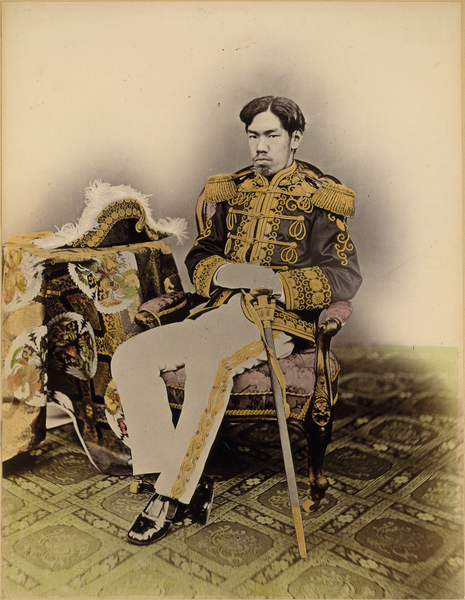
The Imperial Household Agency chose Uchida Kuichi, one of the most renowned photographers in Japan at the time, as the only artist permitted to photograph the Meiji Emperor in 1872 and again in 1873. Up to this point, no emperor had ever been photographed. Uchida established his reputation making portraits of samurai loyal to the ruling Tokugawa shogunate.
Wikimedia Commons.

In the 15 years that followed [American Commodore Matthew] Perry’s venture, the grip of the military dictatorship in Tokyo declined. Civil war erupted. When the smoke cleared in the first few days of January 1868, the shogunate was gone and a coup d’etat ushered in a new era of dramatic change. We call it the Reform Period, or the era of the Meiji Restoration.

That seminal event brought 14-year-old Mutsuhito to the throne, known as Emperor Meiji (a term meaning “enlightened rule”). He reigned for the next 44 years. His tenure proved to be perhaps the most consequential of Japan’s 122 emperors to that time. The country transformed itself from feudal isolation to a freer economy: engaged with the world and more tolerant at home.

In 1867, Japan was a closed country with both feet firmly planted in the past. A half-century later, it was a major world power. This remarkable transition begins with the Meiji Restoration. Let’s look at its reforms that remade the nation.

For centuries, Japan’s emperor possessed little power. His was a largely ceremonial post, with real authority resting in the hands of a shogun or, before that, multiple warlords. The immediate effect of the Meiji Restoration was to put the emperor back on the throne as the nation’s supreme governor.

In April 1868, the new regime issued the “Charter Oath,” outlining the ways Japan’s political and economic life would be reformed. It called for representative assemblies, an end to “evil” practices of the past such as class discrimination and restrictions on choice of employment, and an openness to foreign cultures and technologies.

After mopping up the rebellious remnants of the old shogunate, Emperor Meiji settled into his role as supreme spiritual leader of the Japanese, leaving his ministers to govern the country in his name. One of them, Mori Arinori, played a key role in liberalizing Japan. I regard Arinori as “the Tocqueville of Japan” for his extensive travels and keen observations about America.

The Meiji administration inherited the immediate challenge of a raging price inflation brought on by the previous government’s debasement of coinage. The oval-shaped koban, once almost pure gold, was so debauched that merchants preferred to use old counterfeits of it instead of the newer, debased issues. In 1871, the New Currency Act was passed which introduced the yen as the country’s medium of exchange and tied it firmly to gold. Silver served as subsidiary coinage.

A sounder currency brought stability to the monetary system and helped build the foundation for remarkable economic progress. Other important reforms also boosted growth and confidence in a new Japan. Bureaucratic barriers to commerce were streamlined, and an independent judiciary established. Citizens were granted freedom of movement within the country.

The new openness to the world resulted in Japanese studying abroad and foreigners investing in Japan. British capital, for instance, helped the Japanese build important railway lines between Tokyo and Kyoto and from those cities to major ports in the 1870s. The new environment encouraged the Japanese people themselves to save and invest as well.

For centuries, the warrior class (the samurai) were renowned for their skill, discipline, and courage in battle. They could also be brutal and loyal to powerful, local landowners. Numbering nearly two million by the late 1860s, the samurai represented competing power centers to the Meiji government. To ensure that the country wouldn’t disintegrate into chaos or military rule, the emperor took the extraordinary step of abolishing the samurai by edict. Some were incorporated into the new national army, while others found employment in business and various professions. Carrying a samurai sword was officially banned in 1876.

In 1889, the Meiji Constitution took effect. It created a legislature called the Imperial Diet, consisting of a House of Representatives and a House of Peers (similar to Britain’s House of Lords). Political parties emerged, though the ultimate supremacy of the emperor, at least on paper, was not seriously questioned. This nonetheless was Japan’s first experience with popularly elected representatives. The Constitution lasted until 1947, when American occupation led to a new one devised under the supervision of General Douglas MacArthur.

October 22, 2023

SS Commando Coup in Hungary – WW2 – Week 269 – October 21, 1944

World War Two
Published 21 Oct 2023

The Germans engineer a coup in Hungary to keep the Hungarian army in the war, but the Allies have finally entered Germany in force, taking Aachen in the west. The Soviets liberate Belgrade in the east, and launch new attacks in Baltics, and at the other end of the world come American landings in the Philippines, and the recall of Vinegar Joe Stilwell from China.

00:00 Intro
01:00 Recap
01:21 Raids on the Philippines
04:42 The Invasion of Leyte
06:11 Joe Stilwell is recalled from China
08:12 The Battle of Aachen
12:24 Battle of the Scheldt
14:03 Soviet attacks in the Baltics
16:23 Horthy’s fall- a coup in Hungary
19:45 Germans close in on Slovakia
21:55 Belgrade Liberated
24:47 Summary
25:01 Conclusion
(more…)

August 15, 2023

History must be forced to fit the narrative

Filed under: Books, History, Media, Politics, USA — Tags: , , , , — Nicholas @ 03:00

Chris Bray revisits an older article from the Obama years:

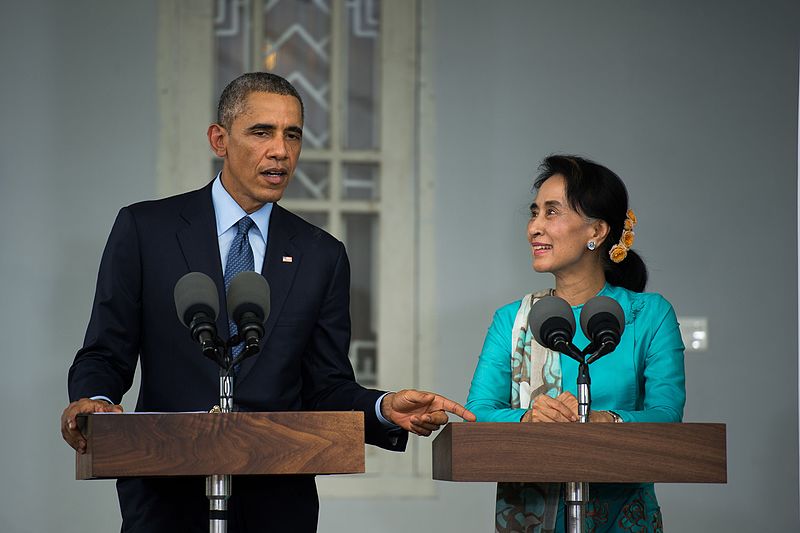
President Barack Obama and Aung San Suu Kyi in 2014.
Photo via Wikimedia Commons

There is no question that authoritarianism is descending on the United States of America, quickly. There is also no question where it’s coming from, as you quickly learn from the current social media musings of the most wonderfully progressive people. Trump must be silenced NOW! Why is the authoritarian being ALLOWED TO SPEAK? Ruth Ben-Ghiat, please call your office.

How have we gotten here?

I’ve mentioned before a looooong essay I wrote, more than ten years ago, about the cottage industry in Barack Obama hagiographies. Obama’s fellatiographers noted, for example, that Obama’s stepfather, Lolo Soetoro, had been ordered back to Indonesia in 1966, and that photos of him from that time show him in the uniform of the Indonesian army. They also mention, with remarkably disingenuous vagueness, that there was maybe some political trouble going on in Indonesia while Obama was there as a child and his stepdad was a soldier.

But what was happening in the mid-1960s in Indonesia is that the Indonesian Communist Party tried to restructure Sukarno’s careful balancing of competing forces in the new country with the kidnapping and killing of a group of right-wing flag officers by leftist soldiers, beheading conservative military power — after which the military responded with the wholesale killing of hundreds of thousands of communists, often with machetes and with a serious commitment to doing the job as grimly as possible: bodies in rivers, heads on pikes, slow killing in front of mass graves. Here’s my last paragraph from that section on the Obama biographies:

    And the lesson? Indonesia was where “Ann was Barry’s teacher in high-minded matters—liberal, humanist values”, Remnick concludes. It’s where she taught him the values of “honesty, hard work, and fulfilling one’s duty to others”, where she lectured him about “a sense of obligation to give something back”, Scott adds. It’s where she “worked to instill ideas about public service in her son”. Because Indonesia in the late sixties was the perfect place and time to learn about liberal humanist values and public service.

Barack Obama was a Democrat who attained the presidency, which means that journalists knew he had to be a sainted figure, and he was the first black president, which means that journalists knew he had to be brilliant and extraordinary. So they assembled the threads of his story — Barack Obama went to Indonesia in 1966 with his stepfather, a soldier, during a long period of extraordinarily brutal political retribution by the Indonesian army — and then, pro forma, wove those threads into the foundation of “liberal, humanistic values”.

If Barack Obama had spent his childhood torturing kittens to death and eating their eyeballs in front of a sobbing crowd of kitten-loving toddlers, the Obama biographies would have said that Barack Obama spent his childhood torturing kittens to death and eating their eyeballs in front of a sobbing crowd of kitten-loving toddlers, a heartwarming experience that taught him the value of democratic pluralism and fundamental human decency. The story was written before anyone began working on it: Barack Obama [experience TBD] and [experience TBD], the formative experiences that made him the kind and wonderful genius he is today.

See also this recent discussion with David Garrow, a historian who has written a new (corrected: published a post-Obama-presidency) biography — and who found, as he researched his subject, that he was often looking at evidence no one had ever pursued before. The hagiographers of the Obama presidency-era weren’t looking for evidence; they already knew the story they meant to write. They came up with some evidence-simulating objects for form’s sake, to assemble their liturgy in the apparent form of biography. Their “Barack Obama” was never Barack Obama.

Their “Donald Trump” is not, now, Donald Trump. There’s a formula; they apply it. There’s a narrative to be written. Donald Trump said he would repeal two federal regulations for every new regulation he implemented — textbook authoritarianism! Donald Trump said that America has fought a bunch of “dumb wars”, and should be much more careful about foreign military involvement — JUST LIKE ADOLF HITLER!!!!!!

It’s beside the point to note that the conclusions never matched the evidence. They were never meant to.

This is crazymaking behavior. Constantly spinning narratives that have nothing to do with anything in the actual, physical world is a recipe for a psychotic break. And we have multiple layers of institutional actors who cosplay “elite” — in media, in academia, in government, and in corporations — who’ve been playing with their shadow puppets for so long that they’ve forgotten they’re shadow puppets. They believe themselves.

That’s how you get to we need a single-party ballot to prevent authoritarianism and we have to arrest the opposition leader to prevent authoritarianism. It’s socially distributed insanity, a real descent into the world of false symbols. And it’s becoming incredibly dangerous.

July 23, 2023

Sayonara Tojo – WW2 – Week 256 – July 22, 1944

World War Two
Published 22 Jul 2023

This week, Adolf Hitler is blown up and Hideki Tojo steps down. In the Pacific, the Americans land on Guam and prepare for hard fighting. In France, the Americans take Saint-Lô and British and German armored forces clash around Caen. In the East, the Red Army enters Latvia, tears a gap in Army Group North, and reaches the gates of Lvov.
(more…)

July 21, 2023

The Führer Adolf Hitler is Dead!?

Filed under: Germany, History, Military, WW2 — Tags: , , , , , — Nicholas @ 04:00

World War Two
Published 20 Jul 2023

Stauffenberg, Olbricht and the plotters launch Operation Valkyrie. The army moves in to seize power, troops surround the government quarter in Berlin, and Joseph Goebbels is arrested. But things start going wrong pretty much immediately and far away in East Prussia the Nazi fightback begins.
(more…)

June 27, 2023

“No one seems to understand what the hell just happened in Russia”

Filed under: Government, Media, Military, Russia — Tags: , , , , , — Nicholas @ 03:00

Discussing anything to do with the Russo-Ukraine war is difficult enough due to the signal-to-noise ratio in the information we get from both sides and (theoretically) disinterested observers. Trying to read the tea leaves in the events over the weekend was just an utter waste of time, despite the potentially earth-shaking possibilities being thrown up. The weekend dispatch from The Line doesn’t pretend to have any deep analysis to offer, which I think is by far the wisest approach:

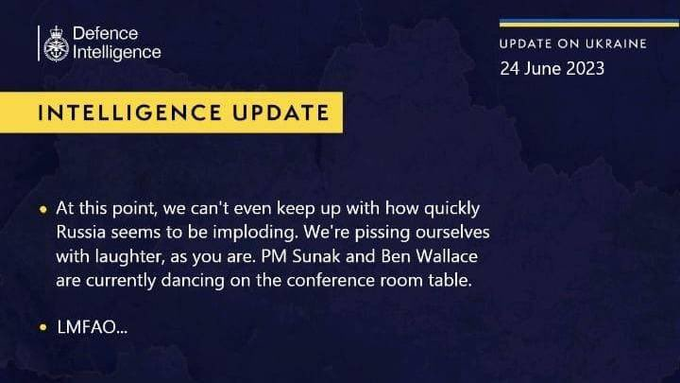
“Sir Humphrey Appleby” tweeted this, saying it was “the intelligence update slide every DI analyst secretly dreams of producing …

As we write this, roughly a day has passed since the sudden end of what briefly looked like a massive event with the potential to reshape global politics for a generation … before it fizzled. The rebellion of Russia’s Wagner mercenary group and its bolt toward Moscow was a stunning story, until it wasn’t. And that itself is a stunning story. Yevgeny Prigozhin, former chef and now Wagner leader, suddenly called off his mutiny, and it just … ended.

Really?

When the mutiny began on Friday, and especially when Wagner seized the southern city of Rostov, home to a major Russian military headquarters overseeing the invasion of Ukraine as well as a million other people, we were surprised, but the more we thought about it, we weren’t particularly shocked. There had been obvious signs of an imminent rupture of some kind in recent months; Line editor Gurney had wondered on Twitter how long it could last before something snapped. That was about three hours before the entire country seemed to snap and Prigozhin marched into Rostov and began moving north.

Events proceeded at a fairly frantic pace after that, with Wagner troops advancing almost all the way to Moscow while Russian security forces fortified the city and tore up roads along the route. It wasn’t clear to us that Wagner had enough men to actually take the city and potentially capture key members of the government. But it wasn’t clear that he didn’t: there are two sides of that equation — the troops Prigozhin had and the troops Putin could count on to oppose Wagner. It was the latter group that captured our interest.

Wagner encountered some resistance along the way, but not much. Most of Russia’s army is deployed in Ukraine, of course, and much of what’s left is now of famously poor quality and morale. But even those military and security forces that were able to block Wagner’s advance didn’t seem that interested in the job. There are reports that some units went over to Prigozhin’s side, but it seems that most of them just did … nothing in particular. And waited to see what happened. For a few hours, we wondered if Prigozhin’s small force would be just large enough in the face of a Russian military that seemed to have no appetite for battle on its own soil.

We can’t pretend to explain the bizarre conclusion to this chaotic day and a half, with an apparent deal brokered by Belarus seeing Wagner’s advance on Moscow called off, a broad amnesty granted to all participants and Prigozhin apparently set to continue to oversee Wagner’s global operations from Belarus in some kind of exile. This is all just wildly unrealistic. Prigozhin cannot be the last person around to realize that he’s put a target on his back and that he’ll soon experience some kind of fatal medical emergency or tragic tumble out of an open window. The moment his mercenaries took Rostov, he had only one path forward: all the way to the Kremlin. What the hell he’s thinking is frankly beyond our ability to guess, and we have fairly vivid imaginations. It’s baffling.

Nor will we try to guess what this will mean for Russia. In a situation like this, your Line editors would normally simply confess that we don’t have the deep knowledge of Russian domestic politics to turn ourselves into credible instant-experts on this. We’d seek out someone with that knowledge. We could interview them, solicit a column from them, or even — as we’ve done in the past — allow someone with deep expertise but who isn’t permitted to speak on the record in public to provide a blurb for one of these dispatches, to run under our shared byline. But in this case, we had to reject all those options, because at least for right now, all the experts seem as baffled as we are. No one seems to understand what the hell just happened in Russia.

We can say with at least reasonable confidence that if you happen to be named Vladimir Putin, it isn’t good. When Prigozhin announced that he was ending his mutiny and began withdrawing his forces from Rostov, the locals cheered them like some kind of conquering heroes. That’s gotta be on Putin’s mind. Also on his mind: the apparent, ahem, reluctance of much of his military and domestic security force to rally to his side during the crisis. This has wounded Putin. Time will tell how badly. Time will also tell how many other people in Russia today have carefully watched recent events, have adjusted their understanding of the facts on the ground there, and are now pondering a variety of intriguing options accordingly.

And the last thing time will tell is what Putin feels he must now do to assert his authority, such as it is. We must recall that whatever Putin’s domestic troubles, he has problems on the battlefield, too. While we haven’t yet seen major breakthroughs by Ukrainian forces, they are not yet fully committed, and their counteroffensive does seem to be making gradual progress in multiple sectors. Events of recent days can only hurt Russia’s combat performance and morale.

We wish we could offer you all a more firm and decisive statement to wrap all this up. But the best we can honestly promise you is that we’ll keep pondering this, trying to figure out what the hell happened, and we’ll certainly be watching this. It’s been a strange war. And we suspect it might get stranger still before it finally ends.

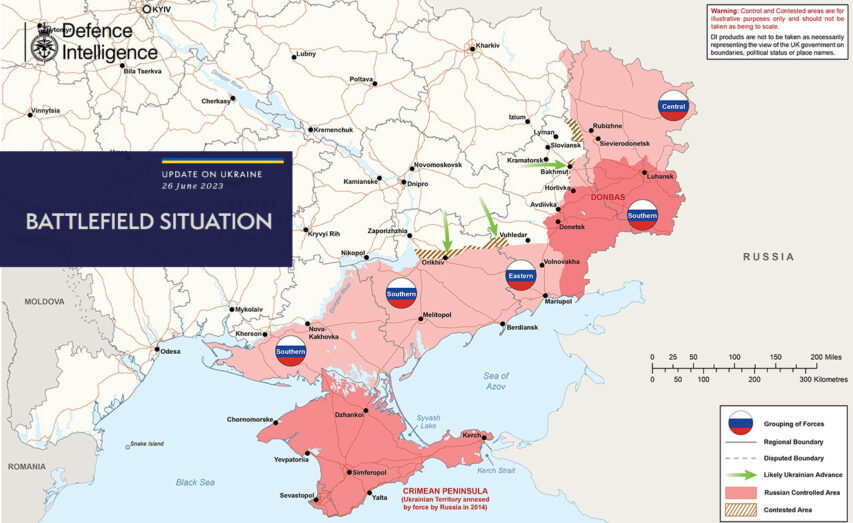
The most recent Defence Intelligence update map from the British Ministry of Defence shows what is thought to be a reasonably accurate representation of the battlefront in eastern Ukraine:

June 21, 2023

“Luttwak tweets with unparalleled Boomer energy, primarily in a write-only mode, at times seemingly oblivious to the waves he causes”

Filed under: Books, Government, Military — Tags: , , , , — Nicholas @ 03:00

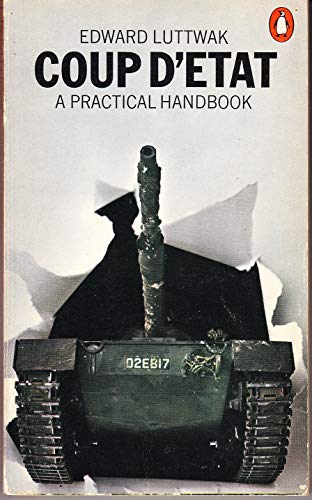
John Psmith reviews the second edition of Edward Luttwak’s Coup d’État: A Practical Handbook. I read the first edition in the mid-70s, when it seemed like coup attempts were an almost weekly news item from any number of exotic tropical locations:

First things first: you need to get the revised, second edition of this book. Why? Because the introduction to the second edition is an excuse for the author to brag about all the bloodstained and bullet-riddled copies of the first edition that have been found among the personal effects of palace security chiefs, spymasters, and air force officers. Perhaps, he gloats, they should have read it more carefully, or perhaps they should have waited for the second edition.

None of this should come as a surprise if you follow Edward Luttwak on Twitter, where his account is characterized by a judicious degree of irascibility and gloating. Yes, I regret to inform you that he’s on Twitter. But unlike some of my other favorite authors who succumbed to the analgesic call of the Great Blue Bird, the medium has not totally destroyed him yet. Luttwak tweets with unparalleled Boomer energy, primarily in a write-only mode, at times seemingly oblivious to the waves he causes. This is good, because it means we get to read his internal monologue, but without the reward loop of social media hacking his amygdala and progressively turning him into a self-parody.

Or perhaps his descent into self-parody was arrested by the fact that he was already a bit of a self-parody. Luttwak came from a Jewish family in communist Romania, spent some time in Palermo where he totally wasn’t involved in the war between the authorities and the mob,1 and provided “consulting services to multinational corporations and government agencies, including various branches of the U.S. government and the U.S. military”, before retiring to the life of gentleman scholar and cattle rancher (and prolific Twitter poaster) in rural Argentina. Along the way he picked up a PhD and wrote a massive pile of books about history, war, diplomacy, and political theory, all while pissing off the authorities in those fields with his epistemic trespassing.

But all of that was still far in the future when he wrote this book about coups. When the non-recommended first edition came out, Luttwak was a tender twenty-six years old, and working tenderly as a consultant for the energy industry in Africa and the Middle East. This raises some questions, questions that Luttwak absolutely refuses to answer, sometimes coyly and sometimes vehemently. Were I concerned about my reputation as a third-world fixer for oil companies, I would simply not write a practical guide to launching coups, but to each his own.

What is a coup? Also known as a putsch, a palace rebellion, or my personal favorite, a pronunciamiento; there are a lot of words for it, many of them in Spanish (you know what they say about Eskimos and their words for snow). The basic definition is a bloodless or almost bloodless extrajudicial transfer of power whereby a group of conspirators is able to turn the machinery of the state against itself, seizing control quickly and cleanly and without triggering a civil war. Note how different this is from other sorts of exceptional transfers of power. In a revolution, all of the institutions in a society are burned down and replaced. A coup is the opposite — only the very top level of the system is swapped out, and the new boss quickly and seamlessly resumes ruling through the machinery of the old regime. Ideally, citizens who aren’t especially politically engaged wouldn’t even notice.

This leads us to a guess as to the most coup-friendly sorts of polities: ideally they should be highly centralized and efficient bureaucratic states, but with very low democratic engagement or popular investment in politics. The first half is important, because without an efficient government machine, there’s nothing for the coup plotters to grab onto. A coup is an action by a tiny group of people who would lose instantly in any fair fight — the only chance they have is to magnify their power by hijacking a system that was already pretty good at controlling the country. It also helps that soldiers, policemen, and citizens in a bureaucratized society are already conditioned to obey impersonal authority, and therefore are more likely to do what the new guy says if he’s careful to use the old, familiar forms. Anarchists love to talk about how anarchy is like a vaccination against foreign occupation, because occupiers generally lack the state capacity to administer newly acquired territories without existing state machinery to co-opt, and that argument is even more true for coups.


    1. Also unclear: which side he was not-involved on.

March 28, 2022

Republic to Empire: Catiline, Cicero, Crassus, Pompey, Caesar the Death Spiral

Filed under: Europe, History — Tags: , , , , , , , , , — Nicholas @ 04:00

Update 6 Feb 2024: Dr. Gabb replaced the original part 7 which discussed the cultural impact of Ancient Greece on the rising Roman Republic.

seangabb
Published 20 Feb 2021

In 120 BC, Rome was a republic with touches of democracy. A century later, it was a divine right military dictatorship. Between January and March 2021, Sean Gabb explored this transformation with his students. Here is one of his lectures. All student contributions have been removed.

Here is the seventh lecture, which discusses the Catiline Conspiracy and the rise and disintegration of the First Triumvirate of Caesar, Pompey and Crassus. There is a digression on Eastern politics and the Parthian Empire.
(more…)

May 19, 2020

The Karenist coup

Filed under: Government, Health, Law, Liberty, USA — Tags: , , , , , , — Nicholas @ 03:00

L. Neil Smith on our current self-inflicted plight:

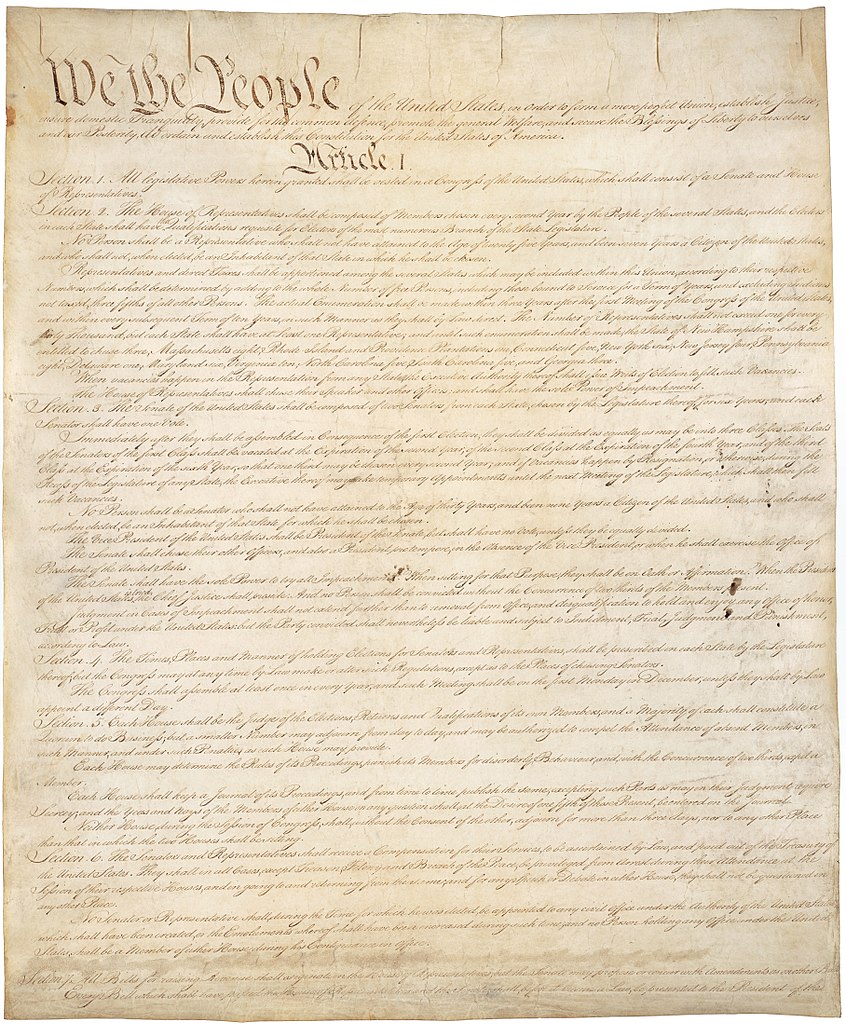
We find ourselves here, in this particular time and this particular place in the history of our republic, because of a 239-year-old oversight made by the Founding Fathers, in that the first ten amendments to the United States Constitution, commonly known as the Bill of Rights (the name itself is a mistake), contain no penalty clause for those — politicians, bureaucrats, policemen — who violate them. I’m not entirely sure it was accidental, but, as a result, they are violated daily, hourly, as a matter of course, and this Corona Virus farce — many others come to mind — is simply the most recent and most preposterous example.

(The name itself is an error because this document is not a mere list of privileges that the government generously lets the people exercise. Quite the opposite, it is a list of things that the government is absolutely forbidden to do It should have been called the “Bill of Limits”. And if the Founders, who had just fought and won a desperate, bloody war against the world’s most brutal and rapacious super-power, hadn’t meant them to be absolute, then why — for all you “living document” idiots out there — would they have even bothered to write them down?)

All over this bruised and battered country, a flock of mean, moronic, petty tyrants have issued illegal orders to those they clearly regard as the peasantry: stay home, avoid your fellow human beings, and above all, shut down the Machinery of Freedom which we know as capitalism. If it’s ever allowed to start up again, it must strictly be on terms that are essentially Marxist in character. No mere individual can ever again scratch his ass without written government approval and permission. In effect, the left has the revolution — as usual, achieved by somebody else — it has wanted for 180 years, since the days of Pierre-Joseph Proudhon.

What’s more, many otherwise decent and intelligent folks are out there begging for their rulers to let them be free again. I find that repulsive and unAmerican. And to those boobies (including Sean Hannity and Joy Behar) blubbering about patriots bring their weapons to demonstrations, listen up: the Founders meant the government to be intimidated by the people, you hapless buffoons.

My bottom line, here, is that, in the short run, we must free ourselves — now — from what we have to call Faucism. Scientific pleaders like the dictatorial doctor must be made painfully aware that when their pronouncements have clear political and economic consequences, their protests of innocence sound a bit too much like “I was just following orders”.

April 10, 2020

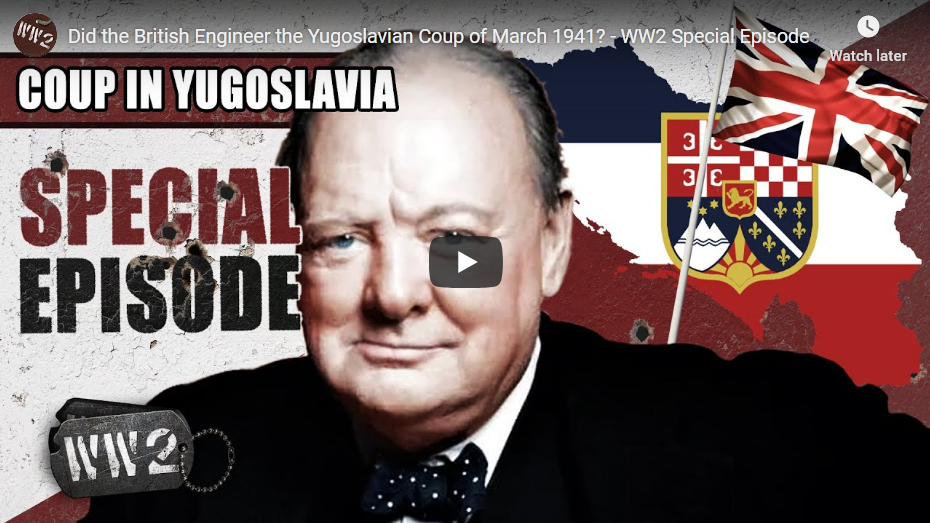
Did the British Engineer the Yugoslavian Coup of March 1941? – WW2 Special Episode

Filed under: Britain, Europe, History, Military, WW2 — Tags: , , , , — Nicholas @ 05:00

World War Two
Published 9 Apr 2020

As Hitler pressured Yugoslavia to join the Axis Powers, Britain tried to gain a Balkan ally. Then Yugoslavia did join then Axis… and then there was an anti-Axis coup in Yugoslavia. But just how much were the British involved in that coup? Let’s find out.

Join us on Patreon: https://www.patreon.com/TimeGhostHistory
Or join The TimeGhost Army directly at: https://timeghost.tv

David Stafford, “SOE and British Involvement in the Belgrade Coup d’Etat of March 1941”. In: Slavic Review 36:3 (1977) 399-419, https://www.cambridge.org/core/servic….

Follow WW2 day by day on Instagram @World_war_two_realtime https://www.instagram.com/world_war_t…
Between 2 Wars: https://www.youtube.com/playlist?list…
Source list: http://bit.ly/WW2sources

Written and Hosted by: Indy Neidell
Produced and Directed by: Spartacus Olsson and Astrid Deinhard
Executive Producers: Bodo Rittenauer, Astrid Deinhard, Indy Neidell, Spartacus Olsson
Creative Producer: Joram Appel
Post-Production Director: Wieke Kapteijns
Research by: Indy Neidell
Edited by: Mikołaj Cackowski
Map animations: Eastory (https://www.youtube.com/c/eastory)

Colorizations by:
Dememorabilia – https://www.instagram.com/dememorabilia/
Adrien Fillon – https://www.instagram.com/adrien.colo…
Norman Stewart – https://oldtimesincolor.blogspot.com/
Julius Jääskeläinen – https://www.facebook.com/JJcolorization/
Daniel Weiss

Sources:
Istorijski arhiv u Pančevu
IWM HU 55505, D 4311, H 10922
FOTO:FORTEPAN / MZSL/Ofner Károly
Narodowe Archiwum Cyfrowe
Portrait of Ronald Ian Campbell, courtesy National Portrait Gallery
Portrait of Frank Nelson, courtesy National Portrait Gallery
Digital Library of Slovenia

Soundtracks from the Epidemic Sound:
Reynard Seidel – “Deflection”
John Hynynen – “Dark Beginning”
Johannes Bornlof – “Deviation In Time”
Philip Ayers – “Trapped in a Maze”
Johannes Bornlof – “The Inspector 4”

Archive by Screenocean/Reuters https://www.screenocean.com.

A TimeGhost chronological documentary produced by OnLion Entertainment GmbH.

August 11, 2018

Post-coup Turkey – every move has served to increase Erdoğan’s hold on power

Filed under: Europe, Middle East — Tags: , , , , — Nicholas @ 05:00

Austin Bay‘s recent essay for Strategika on the post-coup Turkish political situation and its NATO membership:

Ataturk bequeathed Turkey what his greatest biographer, Andrew Mango, called “the structure of a democracy, not of a dictatorship.” He authored an orientation, not an ideology, creating a political, social, and cultural process that he believed would eventually make Turkey capable of perpetual self‐modernization. Ataturk was a political giant and a superb military commander. Eighty years after his death he remains a cult historical and political figure.

President Erdogan is a canny politician and, to be fair, Turkey’s most significant political figure since Ataturk. The green-eyed monster feeds his inner fire; Recep knows he disappears in Kemal’s giant shadow. Not capable of displacing Ataturk the man, he has chosen to replace Ataturk’s state, first under the guise of extending democracy, now behind the façade of maintaining stability. Erdogan also intends to remain in office over twice as long as Ataturk. Turkey 2034 will be an Erdoganist political construct, not Kemalist.

That last paragraph sketches a novelistic interpretation of Erdoğan’s motives. It expands on the answer I gave at Hoover’s October 2017 Military History and Contemporary Conflict symposium after Barry Strauss asked me what I thought drove Erdoğan — the deep drive that might shed light on his long-term vision for Turkey and help us craft policy responses to his challenge.

Novelistic speculations have numerous weaknesses. However, over the decades Erdoğan has supplied plot points and psychologically-indicative dialog. We are able to assess action through time. Early in his career Erdoğan routinely employed Islamist poetry: “Democracy is merely a train that we ride until we reach our destination. Mosques are our military barracks. Minarets are our spears.” That poetry led to his arrest for sedition. After his release he renounced his piously seditious poetry, claiming his fundamentalist views had fundamentally altered. His sudden commitment to Turkish democracy energized his “moderate Islamist” Justice and Development Party’s (AKP) 2002 victory over a tired and corrupted Republican Peoples Party (CHP). In 2003 the AKP became Turkey’s governing party with Erdoğan serving as prime minister.

First he tested Kemal’s structure, then he began to dismantle it. Erdoğan purged the military of suspected political opponents. A cunning narrative camouflaged his operation. He claimed European Union accession rules demanded he strip the military of its political powers and make certain Kemalist military coups entered history’s dustbin. Sometime in 2008, as Erdoğan began pursuing the Ergenekon conspiracy of “secular fundamentalists” and other secret nationalist vigilante organizations, I finally realized whatever explanation du jour Erdoğan offered for his actions, the dismantling scheme always expanded his personal power and influence.

The bizarre July 2016 coup follows the same pattern. The Turkish people defeated the coup. Ironically, Erdoğan remains in office today because Turkish citizens (across Turkey’s complex political and ethnic spectrum) courageously defended their hard-won democracy — a democracy nine challenging decades in the making. In its aftermath, however, Erdogan used emergency powers to purge Gulenist Islamists and his political opponents. He dismantled elements of the democratic system that saved him and his government.

September 15, 2017

Attempted Military Coup in Russia – The Kornilov Affair I THE GREAT WAR Week 164

Filed under: Europe, History, Italy, Military, Russia, WW1 — Tags: , , — Nicholas @ 04:00

Published on 14 Sep 2017

The situation in Russia further escalates as Lavr Kornilov attempts to gain complete power with a military coup. The result is a disaster for him and thousands of armed Bolsheviks in the streets of Petrograd.

September 8, 2017

Attempted Military Coup in Russia – The Kornilov Affair I THE GREAT WAR Week 163

Filed under: Europe, History, Military, Russia, WW1 — Tags: , , , — Nicholas @ 06:00

Published on 7 Sep 2017

The situation in Russia further escalates as Lavr Kornilov attempts to gain complete power with a military coup. The result is a disaster for him and thousands of armed Bolsheviks in the streets of Petrograd.

« Newer Posts — Older Posts »

Powered by WordPress