Quotulatiousness

November 2, 2011

Disagreeing with Pete Townshend

Filed under: Economics, Media — Tags: , , , , — Nicholas @ 09:03

Felix Cohen has an interesting article up at the Guardian‘s “Comment is free” section:

When I was originally sent some quotes from Pete Townshend’s John Peel lecture on Apple — which he refers to as a digital vampire — and music piracy, I was ready to fundamentally disagree with the thrust of his argument, but having taken the time to read it and parse it I’m surprised at how much sense there is. Regrettably, though, he also commits some fairly serious and unforgiveable misunderstandings of Apple and Amazon as companies, the internet and, perhaps least forgivable, the nature of creativity and the auteur as arbiter of what’s acceptable for public consumption.

[. . .]

Because I also believe that the commercial success you and your peers achieved was a brief, Burgess Shale-like period in popular culture, where the dearth of real social recommendation meant that people like John Peel, and now, sadly, Simon Cowell, imposed their tastes on swaths of youth. Peel (Cowell considerably less so) was an amazing, charismatic, much missed man who was able to tap into the zeitgeist and promote acts who wouldn’t have a chance without him. But he had his tastes and dislikes like anyone, and that’s the downfall of auteur theory; you don’t get to see outside of someone else’s perspective.

[. . .]

And, like the creatures in the Burgess Shale, we can look back and say: this brief flowering of bizarre and fantastical cultural expression was only made possible by its environment. This was what popular culture looked like when the only people who could make a real living were the top 0.0001%, while everyone else toiled in garages, college music rooms and village halls, trying everything in their power to break through. And, sadly, it ended up anodyne, populist and, well, The X Factor.

[. . .]

I’m not sorry that the period where you were able to be wined and dined by vast, terrifyingly wasteful record labels because you were paying for all of their A&R failures is over. To return to my prehistoric metaphor, the Cambrian period ended with a mass extinction event, but the period that followed allowed for the establishment of the species we see today. We should hope that creative popular culture follows a similar pattern, and that new artists and musicians will be able to be successful, widely heard, nurtured by crowd-supported services such as PledgeMusic rather than bloated A&R corporations; companies with a more human attitude to what they do and who they are doing it for.
October 24, 2011

Obama organizers seeks poster artists to work for free on jobs campaign

Filed under: Media, Politics, USA — Tags: , , — Nicholas @ 08:59

No, really, the irony meter just pegged:

The Obama campaign has more than $60 million cash on hand. In an economy this bad, you’d think a presidential campaign that flush would be happy to pay good money for a talented designer to create a campaign poster.

But the folks at Obama campaign have taken a page from the Arianna Huffington book of economic exploitation and called on “artists across the country” to create a poster … for free.

And here’s the kicker. It’s a jobs poster.

Yes, the Obama campaign is soliciting unpaid labor to create a poster “illustrating why we support President Obama’s plan to create jobs now, and why we’ll re-elect him to continue fighting for jobs for the next four years.”

H/T to Virginia Postrel (via Google+) for the link.

August 9, 2011

Fish. Barrel. Bang

Filed under: Books, Humour, Media — Tags: , , — Nicholas @ 08:16

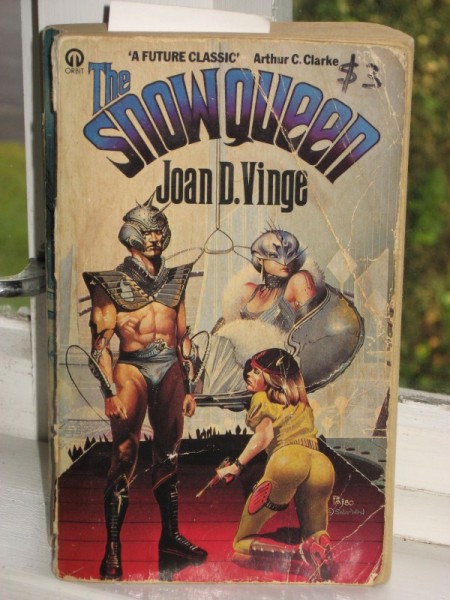
If you’ve never seen these god-awful science fiction book covers, you’ll quickly understand why this website will have a long, long list of candidates for mockery:

Kelly Comments: Considering that later editions have an absolutely gorgeous cover by Michael Whelan, I’m always a bit horrified to see the travesty on my own copy of the book. It looks like a poster for some kind of low-budget 70s bondage. My poor eyes!

H/T to Lois McMaster Bujold, who said “SF covers more dire than my own. Some of these even make me feel better . . .”

May 27, 2011

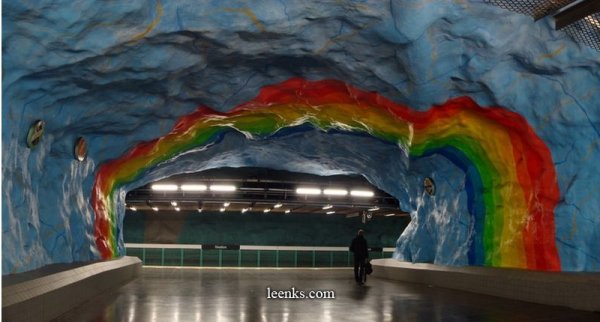
Swedish subway stations or hallucinatory flashbacks to a 1975 shopping mall?

Filed under: Europe, Media, Railways, Randomness — Tags: , , — Nicholas @ 13:10

Andrew Coyne linked to this set of photos of Swedish subway stations saying “Good LØRD. Who was their designer, Willy Wonka?”


I shared the link with Jon, my former virtual landlord, who responded:

Tonight’s nightmares are going to leave a mark.

I can only imagine what the flashbacks must be like for you, though. I suspect that these stations look remarkably like Sherway Gardens did to you and your friend after you guys went drinkin’ at the Steak’n’Burger.

If there is a 1970’s-era Sherway Gardens in Hell, this is what it looks like.

I had a similar reaction to the photos . . . strikingly ugly where they’re not just flat-out disturbing. But what else could we expect from publicly funded artists selected by public transit officials?

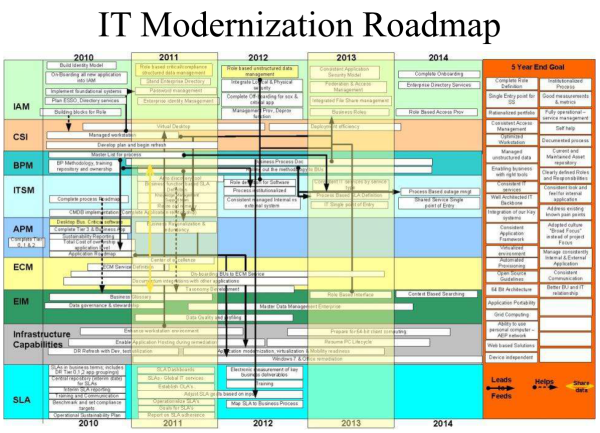
Powerpoint: it’s not presentation software, it’s visual assault software

Filed under: Media, Technology — Tags: , , , — Nicholas @ 11:54

I’ve attended lots of meetings where the Powerpoint slides have been really bad, but I’m happy not to have encountered anything quite as bad as this:

One of this year’s winners in the InFocus Worst Powerpoint Slide Contest.

Our “What Not to Present” contest was epic! Many thanks to all of you kind folks that submitted entries and spread the word about it. Many amazingly horrendous slides were sent in from all around the world. We laughed. We cried. We cringed.

[. . .]

We randomly chose our top 3 winners, but then quickly realized that we had to do more. So we are giving away ANOTHER projector to the slide we thought was the most horrendous. We passed the ugliness around the InFocus offices and to many of our partners pandering for votes — and we have a winner!

Update: While I’m busy poking fun at PowerPoint, here’s the Gettysburg Powerpoint Presentation. H/T to Paul “Inkless” Wells for the link.

April 4, 2011

For a change, this isn’t about an uptight, prudish American mayor

Filed under: France, Randomness — Tags: , — Nicholas @ 08:54

This time, passing all belief, it’s a French mayor having the vapours over the exposed breasts of a patriotic statue:

The good burghers of the French town Neuville-en-Ferrain will no longer be able to enjoy the ample charms of a “patriotic female statue” after the mayor ordered its removal from the town hall on the grounds of excessive chesticles.

Gerard Cordon took exception to the bust of Marianne, the “traditional female embodiment of the French Republic”, the Telegraph explains. He “persuaded” councillors that a €900 replacement based on Laetitia Casta would put an end to unfavourable comments about Marianne’s assets.

A town hall employee explained: “It was making people gossip. Remarks were made, during weddings for example.”

[. . .]

An old boy in Neuville-en-Ferrain expressed his support for Lamacque in a France 3 TV report last week, summarising: “People are stupid. Better nice breasts than none at all.”

September 27, 2010

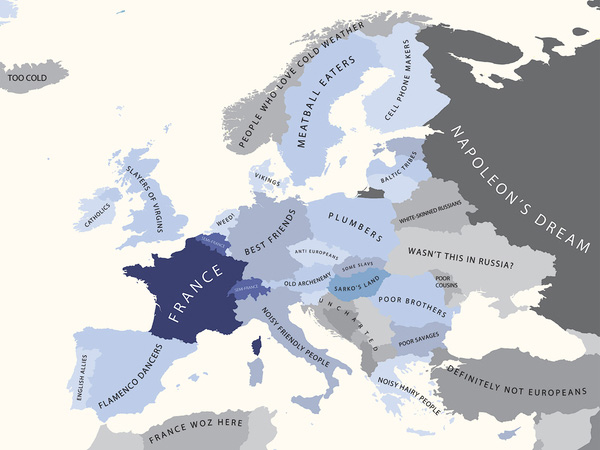
Europe according to . . .

Filed under: Europe, France, Humour — Tags: , — Nicholas @ 14:09

Amusing infographic source including “Europe according to France”:

H/T to Cory Doctorow for the link.

August 27, 2010

Redesigning the American dollar bill?

Filed under: Economics, USA — Tags: , , — Nicholas @ 08:22

Gerard Vanderleun isn’t over-enthused by the notion:

The ObamaBuck-U: A New Bill to Inspire Confident Recovery

I’d advise these sooper-genius designers to design the ObamaBuck with a lot of room for extra zeroes. Gotta plan for the forthcoming Weimarization of the US economy.

What else are these hamstrung colonized minds designing in the way of currency? Here’s there list. You can smell the overheated whiffs of sanctimony just reeking from the stack:

$1 – The first African American president
$5 – The five biggest native American tribes
$10 – The bill of rights, the first 10 amendments to the US Constitution
$20 – 20th Century America
$50 – The 50 States of America
$100 – The first 100 days of President Franklin Roosevelt. During this time he led the congress to pass more important legislations [sic] than most presidents pass in their entire term. This helped fight the economic crises at the time of the great depression. Ever since, every new president has been judged on how well they have done during the first 100 days of their term.

When was the last time these fools took a history course? Third grade? Where are these drool-cup designing dolts based in the US? San Francisco, where else? The town where the homeless defecate freely on the street and where the artists defecate freely in their brains.

If nothing else, the proposed designs would do one useful thing: they’d stop Americans from sneering at the design of Canadian banknotes!

June 17, 2010

“Most culture funding inevitably pays for crap”

Filed under: Cancon, Government, Media — Tags: , , — Nicholas @ 07:52

While providing some deeper explanation for the not-really-in-context sound bite provided by Alberta’s culture minister, Lindsay Blackett, Colby Cosh points out the truth of the matter:

The other knowledge that critics ought to be prepared to display is some familiarity with the material Blackett’s department actually funds. I figure you can’t say it’s not crap unless you’ve at least poked it with a stick. Can the indignant Paul Gross, who received $5.5 million from the Alberta taxpayer for Passchendaele, claim intimate familiarity with In a World Created by a Drunken God or Caution: May Contain Nuts or The Last Rites of Ransom Pride? If not, then why is he shooting off his mouth? It would surely be much more sensible for Gross and for like-minded critics to admit that most culture funding inevitably pays for crap — that the arts world is, in fact, a colossal pyramid of crap, inherently necessary to provide the nurturing and elevating environment from which a few items of permanent value might spring.

But that is something the culturati can never admit. Kirstine Stewart, the general manager of CBC’s English television operations, reacted in the Globe to Blackett’s comments by saying “Nobody can ever question the quality of what we do here in Canada, creatively or otherwise.” Surely this is a much more revealing and intriguing comment than Blackett’s. Does she mean that questioning the quality of Canadian television and film is literally impossible? Or just that criticism is inherently objectionable, a malum in se? And at the risk of appearing to take sides, I must ask: which attitude ultimately seems more healthy and likely to encourage improvement — Blackett’s, or Stewart’s?

Of course, a sensible government wouldn’t be spending any tax money on subsidies for TV and movie production (New Zealand’s most recent study showed a pretty big net loss for their various cultural tax breaks and subsidy programs).

May 4, 2010

The lesson, kids, is don’t ask for colour advice

Filed under: Humour, Randomness, Technology — Tags: , , — Nicholas @ 08:04

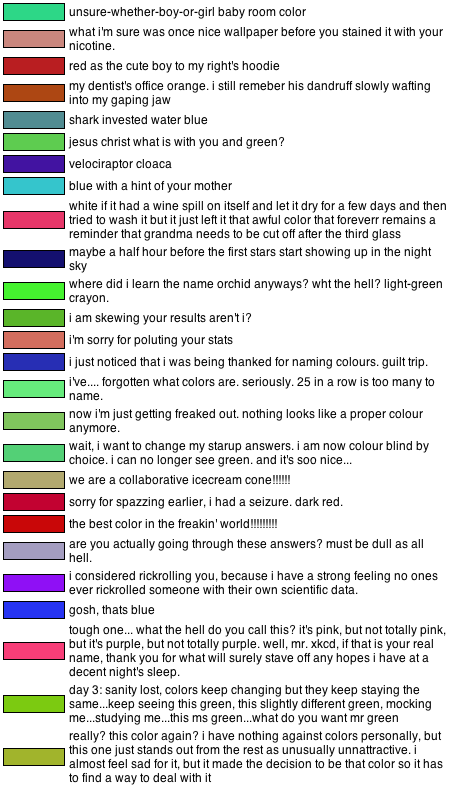
A colour survey gone very wrong:

Thank you so much for all the help on the color survey. Over five million colors were named across 222,500 user sessions. If you never got around to taking it, it’s too late to contribute any data, but if you want you can see how it worked and take it for fun here.

First, a few basic discoveries:

* If you ask people to name colors long enough, they go totally crazy.
* “Puke” and “vomit” are totally real colors.
* Colorblind people are more likely than non-colorblind people to type “fuck this” (or some variant) and quit in frustration.
* Indigo was totally just added to the rainbow so it would have 7 colors and make that “ROY G. BIV” acronym work, just like you always suspected. It should really be ROY GBP, with maybe a C or T thrown in there between G and B depending on how the spectrum was converted to RGB.
* A couple dozen people embedded SQL ‘drop table’ statements in the color names. Nice try, kids.
* Nobody can spell “fuchsia”.

Overall, the results were really cool and a lot of fun to analyze. There are some basic limitations of this survey, which are discussed toward the bottom of this post. But the sheer amount of data here is cool.

And a selection of miscellaneous answers:

May 3, 2010

Virginia cracks down on smut . . . on the state seal

Filed under: Politics, USA — Tags: , , — Nicholas @ 08:57

Some folks just don’t “get” art. Others think they do, but they’re wrong:

Virginia’s attorney general Ken Cuccinelli is hard at work on the important issues of the day — like making sure the Roman goddess depicted on his state’s official seal isn’t exposing herself.

The current seal shows “Virtus, the goddess of virtue, dressed as a warrior,” with her foot resting “on the chest of the figure of tyranny, who is lying on the ground.” She is holding a spear and her left breast is exposed.

Or at least it was exposed. At a recent meeting, Cuccinelli provided pins to his staff with a new seal on which “Virtus’ bosom is covered by an armored breastplate,” the Virginian-Pilot reported. These new pins were not paid for by taxpayer dollars, Cuccinelli’s office insisted.

December 18, 2009

Surprising court decision doesn’t favour the artist

Filed under: Britain, Media — Tags: , — Nicholas @ 08:48

Having just read the brief outline of the case, I was more than a little surprised that the court (correctly, in my opinion) decided that the “art” in question was just glorified vandalism:

Glass act: student fined for smashing gallery window and calling it art
Gallery fails to see funny side after student puts metal pole through window as part of an art project

Does breaking a window count as art? Yes, murmured the 50 or so artniks who recently crowded into a former Edinburgh ambulance garage to view a film of sculptor Kevin Harman doing just that. No, insisted Kate Gray, director of the Collective Gallery in Cockburn Street, whose window it was.

The courts are on Gray’s side. Yesterday Harman, a prize-winning graduate of Edinburgh College of Art, was fined £200 for breaching the peace on 23 November, when he smashed a metal scaffolding pole through one of the gallery’s windows. Fiscal depute Malcolm Stewart described the affair as “a rather bizarre incident” which had left Collective staff “upset.”

I’m actually quite surprised that the court decided this case properly . . . it has seemed for quite some time that an “artist” could declare just about anything to be “art” and get away with it. I’m not against all art, but if in the performance of your artistic work you happen to break a law, I think the police and the courts should not mitigate your treatment just because you’re an “artist”.

November 4, 2009

Transsexual Jesus

Filed under: Britain, Religion — Tags: , , , , , — Nicholas @ 13:53

A play in Glasgow is — all together now — “not intended to incite or offend anyone of any belief system”. In spite of that, some Christians are offended:

About 300 protesters held a candlelit protest outside a Glasgow theatre over the staging of a play which portrays Jesus as a transsexual.

The protest was held outside the Tron Theatre, where Jesus, Queen of Heaven — in which Christ is a transsexual woman — is being staged.

It is part of the Glasgay! arts festival, a celebration of Scotland’s gay, bi-sexual and transsexual culture.

Festival organisers said it had not intended to incite or offend anyone.

Of course, given the parlous state of Christianity in Britain, maybe they really did think that nobody would be offended. Portraying the founder of a different religion in this way might spark a bit more than protest.

October 9, 2009

Awful book covers

Filed under: Books, Media — Tags: , , — Nicholas @ 17:50

John Scalzi has a nominee for the “Worst Book Cover by a Major Publisher” award:

Worst_book_cover_nominee

Seriously, now, DAW, wtf? I know there’s a recession on, but there must be a better class of 12-year-old you can hire to push about the “liquefy” tool in Photoshop. I get that you were aiming for “chintzy, kooky fun” but you landed on “Fourth grade class project on Lulu.com,” and that just isn’t cool, and more to the point, you should know the difference. Were I an author in this particular anthology I would be sad I couldn’t show my friends the book I was in without them asking how much it cost me to publish it. I’m frightened to show it to graphic designers I know because I don’t want to be sued for damages when it causes blood to shoot from their ears. And as a reader, I can say the cover makes a really excellent argument for owning a Kindle.

September 21, 2009

Sir Humphrey is about to be proven correct again

Filed under: Bureaucracy, Politics, USA — Tags: , — Nicholas @ 12:30

The American government is trying to exhort artists to support its goals . . . and doing more than just exhorting:

If you’ve ever wondered–and worried–about where government support of the arts leads, look no further than the full transcript of an August 10 telecon between an official at the National Endowment for the Arts (NEA) and a group of “independent artists from around the country.” The short version: It leads to the use of taxpayer-funded culture as a means of propagandizing for specific, partisan political aims. Which corrupts not just art but artists.

[. . .]

Given that the NEA prides itself on being the single largest funding source for the arts in the country, such arm-twisting by agency officials, however masked in fulsome compliments to creators’ genius, is disturbing on its face. It clearly sets a political agenda for the very people who are likely to be applying for, well, NEA and other government grants. Does anyone think that the organizers were fishing around for projects that might complicate the public option for health care?

Embedded in the discussion is at least one other disturbing point: a nearly lunatic delusion that artists are the vanguard of the proletariat. As Mike Skolnick, the political director for music impresario Russell Simmons, told the participants, the assembled crew “tell our country and our young people sort of what to do and what to be in to; and what’s cool and what’s not cool.” While that command-and-control notion is widely shared by liberals and conservatives alike, it is patently false. Artists and politicians hate to hear this, but the audience does have a mind of its own.

Sir Humphrey Appleby put it best: “Plays attacking the government make the second most boring theatrical evenings ever invented. The most boring are plays praising the government.”

« Newer PostsOlder Posts »

Powered by WordPress