
Project ’44 has a nice introduction to the formation and organization of the joint US-Canadian First Special Service Force during the Second World War. The unit was featured in the 1968 movie The Devil’s Brigade, although many liberties were taken in the film’s portrayal of events:

Sgt. Pat O’Neill (Jeremy Slate) in the messhall scene in The Devil’s Brigade (1968).
In August 1942, a unit unlike any other in Canadian military history was formed. Today it is widely known by its nickname, the “Devil’s Brigade”, but officially it was designated the First Special Service Force (FSSF).
This unique formation was a joint Canadian–American unit born from the unconventional ideas of British scientist Geoffrey Pyke. Pyke envisioned a small, elite force operating deep behind German lines in occupied Norway, spreading disruption and chaos. Although this original concept was judged impractical, the decision was made to create the unit regardless.
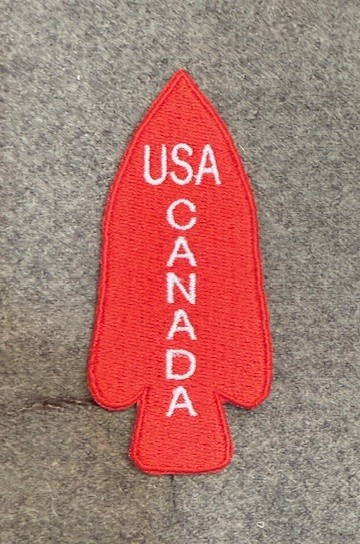
FSSF patch from Project ’44
The combat element of the Force was composed of roughly equal numbers of Canadians and Americans, while the supporting echelon units were entirely American. Most Canadian subaltern officers were recruited almost directly from the Officer Training Centre in Brockville, and the majority of the Other Ranks were drawn from units across Canada. Some personnel were even selected directly from the 1st Canadian Parachute Battalion, much to the frustration of that unit’s chain of command.
The Force was commanded throughout its existence by American Lieutenant Colonel Robert Frederick. The initial Canadian second-in-command, Lieutenant Colonel McQueen, was injured during parachute training and broke his ankle. Because of the limited time available for training, he was returned to his original unit and replaced by Canadian Lieutenant Colonel Williamson.
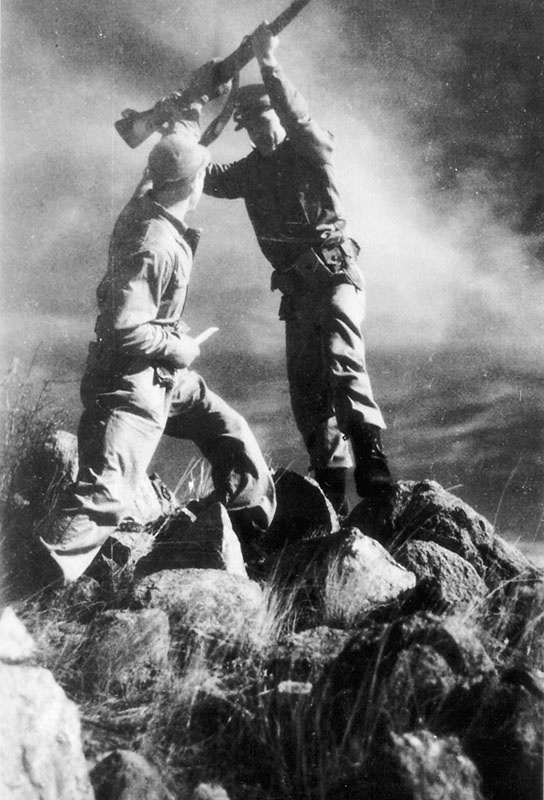
Orval Logan and Stuart Diamond demonstrate hand-to-hand combat
Photo by Paul Moore from Project ’44Williamson served both as second-in-command of the FSSF and as Commanding Officer of the 2nd Canadian Parachute Battalion. This designation served as the administrative cover name for the Canadian component of the Force and was later changed to the 1st Canadian Special Service Battalion. This was not a tactical formation in the field, but rather an administrative structure created to manage Canadian personnel within the joint unit.
As a combined Canadian–American formation, personnel from both nations were distributed evenly throughout the Force. While its overall role and employment resembled that of a brigade, its internal organization followed American regimental doctrine. The Force consisted of three regiments. Whereas a standard American infantry regiment normally contained three battalions and approximately 3,000 soldiers, each regiment within the FSSF comprised only 32 officers and 385 Other Ranks, for a total authorized strength of 412 personnel.



Geoffrey Pyke was an interesting character.
https://warfarehistorynetwork.com/article/geoffrey-pyke-back-room-genius-of-world-war-ii/
Comment by M. Geesing — February 10, 2026 @ 01:52
“Interesting” is a remarkably mild way of describing him!
Comment by Nicholas — February 10, 2026 @ 10:20