
When I first started paying attention to the news in the early 70s, one of the big stories both in the US and in Canada was the plight of the steel industry. It had been an enormously important part of the industrial economy for over a century, but every new story painted the picture blacker. Mergers, plant closings, consolidations, bankruptcies, and layoffs were consistent themes. Yet there is still a significant steel industry in North America. Tim Worstall explains what happened:
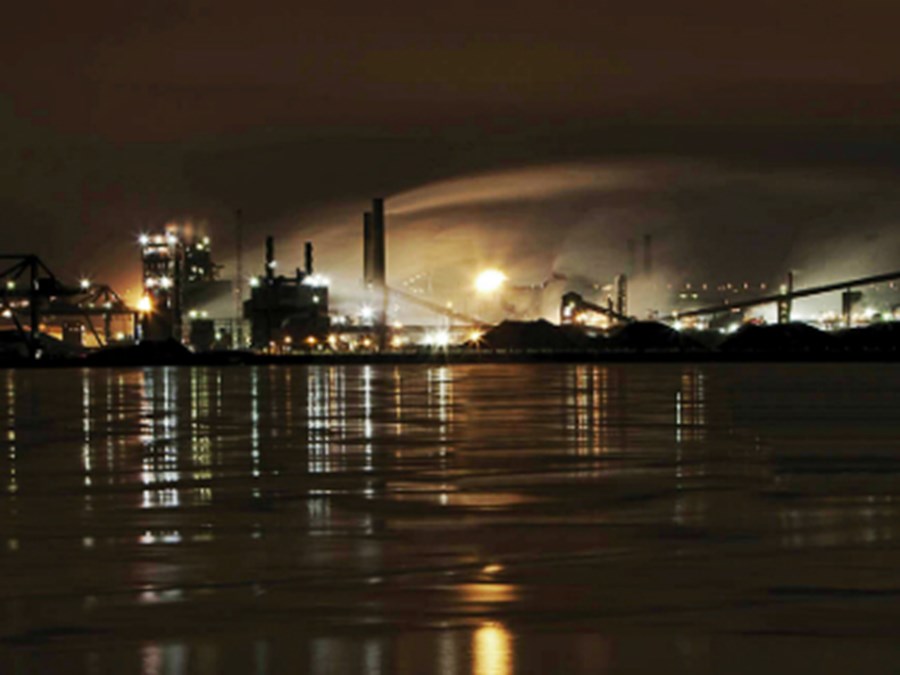
Dofasco’s steel plant on the harbourfront in Hamilton, Ontario
A little digression. To make steel from iron ore you use a blast furnace first. This uses coke (from coal), iron ore and limestone (moderns might use more than just limestone) to produce pig iron. You feed the pig iron into a basic oxygen furnace to make the steel. Yes, we can get much more complicated than that but let’s not.
The US now makes mebbe 20 million tonnes of pig iron a year. Imports are up, a bit, but nowhere near enough to make up the difference. That’s the big change because that’s from the 80 and 90 million tonnes a year of the 1970s. The change is the same whether we measure by domestic production of pig iron or by apparent consumption. Well, the change is the same either way close enough for this to be the big point to make.
What’s actually happened is a change in technology, not a change in trade. Nucor is now 50% or so of US steel output (no, not US Steel, but US steel). Nucor has never used a blast furnace in its corporate life. It collects scrap steel and makes new steel by recycling that. It skips, entirely, the blast and BoF stages. Back in the 1950s Nucor was a couple of scrap yards and a gleam in the corporate eye — now it’s that half the market.
Again, yes, we can get more complex if we wish to. But this is the basic pencil sketch. Yep, we’re more economic in our use of steel these days. Imports of steel are up and so is the importation of things made with steel. But the real change in the steel business over the past 60 to 80 years is the replacement of the steel making business with the steel recycling business. We don’t — and by this I mean the rich countries in general — make all that much steel these days. We recycle an awful lot of steel these days. And that’s what’s really changed.
That’s also what has near entirely screwed over the steel industry of places like Gary, Indiana. For they ran those basic steel making processes, iron ore in, basic steel out. Which isn’t something that has been replaced by imports, it’s something that has been replaced by just not doing it at all.1
Arnade goes on to point out that there are plenty of people still using steel to do things with, make things out of, which is all entirely true. But this idea that the Japanese, or China, killed the traditional US steel industry just isn’t true, not at all. It was Nucor.
All of which makes it just so much fun when it’s Nucor that shouts the loudest about the need for tariffs on steel imports. For Nucor points to the collapse of the traditional industry as its proof. Yet Nucor benefits from those tariffs — they can charge higher domestic prices as a result — even while Nucor is in fact the cause of the traditional collapse.
- “not at all” is rhetorical hyperbole, not a factual statement.


