
I’ve heard many people refer to the Americans with Disabilities Act as the worst piece of legislation in US history, and stories like this one make it easy to agree:

Los Angeles’s streets are in notoriously bad shape. Fewer than two-thirds are considered in a state of good repair, according to the city’s Department of Public Works. Broken sidewalks have spawned years of costly litigation, and Los Angeles pays out millions of dollars each year to drivers whose cars are damaged by potholes.
Many cities would see this situation as a mandate for change. And Los Angeles has indeed made a change: last summer, the city quietly stopped repaving its streets. Not slowed. Not fell behind. Stopped completely.
The Bureau of Street Services (StreetsLA) has not repaved a single street since last June, and the city’s latest budget practically zeros out repaving for next fiscal year. StreetLA crews are still doing some road repairs, fixing potholes and patching problem areas. But the most basic form of urban maintenance — full street resurfacing — has all but disappeared in America’s second-largest city.
Why has Los Angeles stopped repaving its streets? The answer, it turns out, has to do with federal disability rules that, paradoxically, have made fixing roads legally riskier than letting them fall apart. Though well-intentioned, L.A.’s shift shows how such policies can unintentionally worsen urban quality of life.
The clearest explanation of the city’s shift comes from L.A.–based housing and transportation advocate Oren Hadar. Digging through budget documents and engineering classifications, Hadar explained in an essay from late last year that the city didn’t necessarily abandon street work so much as reclassify it out of existence.
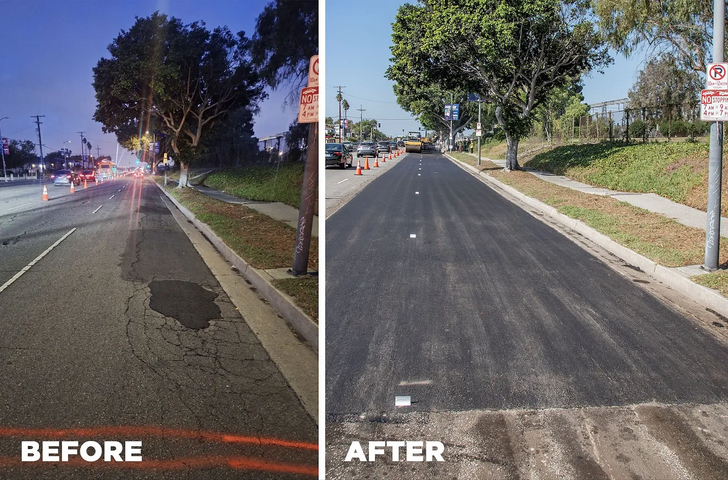
The city seems to have invented a new category of repair specifically designed to avoid triggering costly federal accessibility mandates. Instead of repaving streets, StreetsLA now performs what it calls “large asphalt repairs”. As Hadar explained, these repairs address localized damage — areas larger than a pothole but smaller than full resurfacing. Essentially, the city repaves only part of a street rather than the entire width, as shown below.
A “large asphalt repair” on L.A.’s Century Boulevard. Courtesy: StreetsLA on X
But, as Hadar wrote, “the thing about large asphalt repair is that it’s … not a real thing. It appears to be a term made up by the city some time in the last year.”
Why invent a new classification? The reason lies in federal disability law. Under regulations implementing the Americans with Disabilities Act, when a city alters a street, it must also bring associated pedestrian infrastructure into compliance. That means installing ADA-compliant curb ramps at every intersection along the way.
Repaving is considered an alteration that triggers these requirements. Maintenance activities, such as filling potholes or making minor repairs, are not. The city claims that large asphalt repairs are “pavement maintenance activity” and therefore do not require ADA upgrades.
That distinction carries enormous financial and logistical consequences. Hadar found that each curb ramp costs roughly $50,000, totaling about $200,000 per intersection. With roughly ten intersections per mile, curb ramps alone can add around $2 million per mile to the cost of repaving — a figure that often exceeds the cost of the asphalt itself. Design and construction typically take 9 to 12 months per ramp, and federal rules require the ramps to be completed by the time the street is resurfaced.
Update, 29 January: Welcome, Instapundit readers! Have a look around at some of my other posts you may find of interest. I send out a daily summary of posts here through my Substack – https://substack.com/@nicholasrusson that you can subscribe to if you’d like to be informed of new posts in the future.



I’m not in Los Angeles, but I am in LA county. I’ve seen major intersections overhauled multiple times for ADA compliance. This has involved uprooting and moving traffic signals and even power line poles a matter of three or four feet in order to accommodate new wider wheel chair ramps. The old curb cuts were in line with the sidewalk. The new ones are at a forty five degree angle so that now a wheelchir has to roll down the ramp directly in the path of a right-turning car, and immediately make a turn to get into the crosswalk. They have gone through every housing tract in town and installed curb cuts, and then went back and re-built all of them to include useless little curbs and those bumpy pads as the rules for compliance changed. I’ve seen curb cuts installed in places where the sidewalks end a few feet past the intersection. They are ramps to nowhere. Houses on corners find that the ramps make a clean driveway for an out of control car to smash into the living room. One house nearby had to install concerte pilons in the front yard after the third or fourth time this happened.
There’s a little taco joint not far from our house that has been a frequent stop for us for a long time. New ADA requirements took out more than half of their very limited parking for handicapped,
It seems that the standards for compliance must include blind, deaf, morbidly obese quadriplegics, travelling unaccompanied miles from home in a mouth stick wheelchair. This is graft masquerading as compassion.
JWM
Comment by jwm — January 28, 2026 @ 09:29
[…] DELIVER US FROM GOOD INTENTIONS: An ADA unintended consequence in Los Angeles. […]
Pingback by Instapundit » Blog Archive » DELIVER US FROM GOOD INTENTIONS: An ADA unintended consequence in Los Angeles. — January 29, 2026 @ 03:55
The small town I grew up in did this starting in the 70s due to limited budgets….every winter the roads were reduced to massive rubble fields. They only had the money to patch. Finally got new state program money to redo the streets. The winter tore up the new streets in one year as they were done a new way that was supposed to be more cost effective and ecologically friendly.
Current small city in MD does what LA does and has for 20+ years….probably for the same reason….
Comment by Dan in MD — January 29, 2026 @ 05:38
Here’s the absurd thing. Before the ADA was passed, a wheelchair that could climb stairs had been invented. So, instead of demanding every business, and every street, be modified with ramps for wheelchairs, at an ultimate cost of trillions, it would have been far cheaper to give every person who needed a wheelchair one of them. The idea that the whole world should change to accommodate those few who are different in some way (wheelchair-bound, blind, deaf, etc.) is stupid. Provide the different with what they need to overcome their difference. It will always be cheaper, and it solves the problem everywhere and all at once, because the different bring the solution with them wherever they go.
Comment by yeah — January 29, 2026 @ 10:11