
The artificial intelligence wave continues, despite widespread resistance to AI being inserted into everything. It was bad when your toaster and refrigerator started needing access to the internet, but it’s bound to be so much worse when everything has to have an AI component bolted on to it as well. At The Libertarian Alliance, Neil Lock decries the rising tide of AI slop:
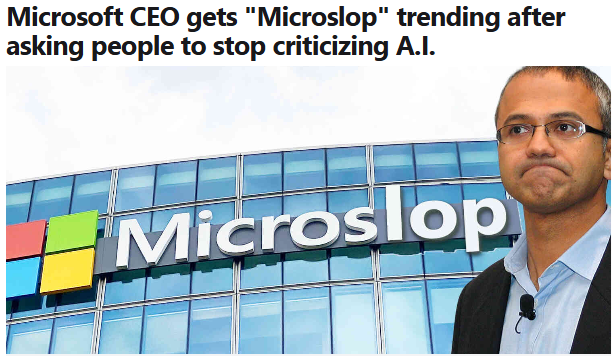
In recent days, there has been an eruption in the tech world. It is unlike anything I have seen in my more than half a century as a software developer, consultant and project manager. Microsoft, its Windows 11 operating system in particular, and artificial intelligence (AI), are in trouble. Big trouble.
The pressures leading to this eruption have been building for a year or so. Right now, the effects are confined mostly to tech blogs and tech people in the USA. But they are spreading. And fast.
Slop
In the last couple of years, AI-generated content has become ubiquitous on the Internet. It may consist of text, images or videos. Some of it is dangerous – for example, erroneous medical information. Most of it is of low to very low quality. And some of it is just bizarre. Such as the infamous “shrimp Jesus” I used as the featured image for this post.
In tech circles, the stuff has become known as “slop”. When you do a Google search, you may see more links to slop than to human-produced material. It looks as if “sloppers” have been using AI to generate large amounts of clickbait, not to mention content that may be misleading or downright dangerous.
In February 2025, Microsoft’s CEO, Satya Nadella, pleaded in an interview for people to stop using the term “slop”. Saying “people are getting too precious about this”. The response could not have been further from what he asked for. The word “slop” went viral.
So much so, that last month Merriam-Webster, the dictionary publishers, declared “slop” to be their “word of the year”. Nadella responded huffily to this, saying: “we need to get beyond the arguments of slop versus sophistication”. The Internet tech community disagreed. And they took their revenge1 by re-naming the phenomenon “Microslop”.
Windows 10 and Windows 11
All tied up with this is Microsoft’s botched transition from Windows 10 to Windows 11.
Windows 11 was launched in October 2021. Due to higher hardware requirements, it would not run on around 60% of the PCs then running Windows 10. Including mine. That was already a time-bomb.
Support for Windows 10 was withdrawn for general customers on October 14th, 2025. Although Extended Security Updates (ESUs) remained available for corporate customers who wanted to keep Windows 10 running.
At no point has Windows 11 been popular with users. It had only about half the take-up Microsoft had expected. And by February 2025, many companies who had “upgraded” their staff’s PCs to Windows 11 had started returning them to Windows 10. It’s estimated that 400 million computers world-wide are still running Windows 10 without any Microsoft software support, simply because the users cannot, or do not wish to, “upgrade” to Windows 11.
Worse, some of Microsoft’s biggest corporate clients, with hundreds of thousands of users each, are switching to Apple Mac. And tech-savvy customers, including gamers and many smaller professional firms, are moving towards platforms like Linux.

If — when — Microsoft tries to force me to switch to a version of Windows with a built-in clanker, then I’ll be forced to switch to Linux. I do have a functional Linux laptop (a 14-year-old HP laptop that could barely boot under Windows by the end, but is now almost peppy running Linux). There’s only one piece of software I still run that doesn’t have a Linux version or competitor but if I accept the reduced functionality of running it in a web browser rather than natively, I could get by.


