Quotulatiousness

December 15, 2025

“America has always been a racist country”

Filed under: History, Media, Politics, USA — Tags: — Nicholas @ 05:00

On the social media site formerly known as Twitter, Devon Eriksen responds to an agent provocateur on the topic of racism:

    Lance Cooper @lmauricecpr
    A white woman called a Somali couple niggers and raised $153k in five days. America has proven again that it is a racist country. They don’t even bother to hide it anymore.

America has always been a racist country in a racist world.

Indigenous Tribals were racist.
Whites were racist.
Blacks were racist.
Orientals were racist.
Arabs were racist.
Jews were racist.
Hispanics were racist.

After being shocked by the excesses of the Third Reich, Whites stopped being racist for a while, and suffered for it.

Everyone else stayed racist, and prospered by it at White people’s expense.

Now White people are sick of it, and they’re becoming racist again, because the only other solution is for everybody else to stop being racist, and there’s no way to make them do that.

So the future is racist. Doesn’t particularly matter if you think that’s good or bad, or if I think that’s good or bad, or if anyone thinks it’s good or bad. It is what’s going to happen.

There was a time when it might have been possible to for everyone to simultaneously stop being racist. But it didn’t happen, because only White people were being told to stop, only White people listened, and only White people stopped.

Everyone else was told that, in the abstract, racism was bad, but they were never called out, lectured, or confronted about their own racism. In fact, that racism was tacitly encouraged, for profit and ego gratification.

Someone even invented rationalizations that only White people even could be racist, because only White people had Power™, which was different from power, because white people somehow had Power™ even if they had no power, and everyone else had no Power™ even if they were billionaires or the King of Sumatra.

So Power™ was just another word for Whiteness.

Around the time when some people started openly calling for the elimination of Whiteness from the nation, the globe, and the human race, White people’s common sense finally started winning out over our desire to be nice and and cooperative and have everyone like us.

We realized it was impossible for everyone else to like us.

Because they didn’t hate us for not being nice. Hell, the nicer we got, the more they hated us. No, they hated us for being White. They hated us for not being like them. They hated us for being successful. They hated us for thriving. They hated us for building civilization. And they wanted us to just hand it over to them, despite the clearly evident fact that a great many of them lacked the skills and temperament to even to maintain it, much less to build more.

(Hint: that desire to be nice and cooperative and have people like us is what enabled us to build all that stuff and get rich in the first place.)

So we’re just going to have to settle for liking each other, preferring each other’s company, and not particularly worrying about whether other races like us or not.

Because that’s the only remaining alternative to suicide.

And, yeah, sure, whatever, you can call me delusional or a liar. You can say White people never stopped being racist, or that we just didn’t anti-racist hard enough.

But, even if that were true, so what? The rest of y’all never stopped being racist. And you never did the anti-racist thing at all. Y’all just kept telling us to do it.

Well, no thanks. Juice isn’t worth the squeeze, because there is no juice, and we’re the ones who were getting squeezed.

And yeah, sure, that’ll keep happening for a while, because some White people haven’t figured it out yet.

And yeah, sure, you can continue to lecture me about how racism is evil, as if you weren’t super-racist yourself, every goddamn day.

But I no longer believe that moral lectures about racism from non-Whites are anything but an attempt to make Whites drop loot.

So I’m not listening.

A lot of people are about to learn the meaning of the term “preference cascade”, and it isn’t going to be pretty.

ESR responded:

I am deeply unhappy about Devon’s conclusion here. But I fear he is probably correct.

There is an alternative, which is to be explicitly high-IQist and mostly ignore skin color. But I admit that such an attempt would probably be sabotaged by the same people who insisted that anti-white racism should be government policy everywhere.

Clankers on the bench, again

Filed under: Britain, Law, Media, Politics, Technology — Tags: , , — Nicholas @ 04:00

On Substack, Helen Dale discusses the most recent high profile case of clanker mis-use in the justice system, as Scottish Employment Judge Sandy Kemp clearly leaned far too heavily on ChatGPT or another AI instance to crank out 312 pages of dubious content:

Grok generated this in response to the request for “Robbie the Robot as a judge”

Maybe Judge Kemp only identifies as a judge, because the farrago of nonsense he’s managed to produce in the Peggie matter is, well, a sight to behold.

Industry news/gossip magazine Roll on Friday — otherwise known as the “orange time-suck” among City solicitors — has a handy run-down of the most egregious fake quotations, selective editing, and incorrect citations. It’s a concise one-stop-shop for Peggie errors, although they’ve already had to add to it since it was published yesterday.

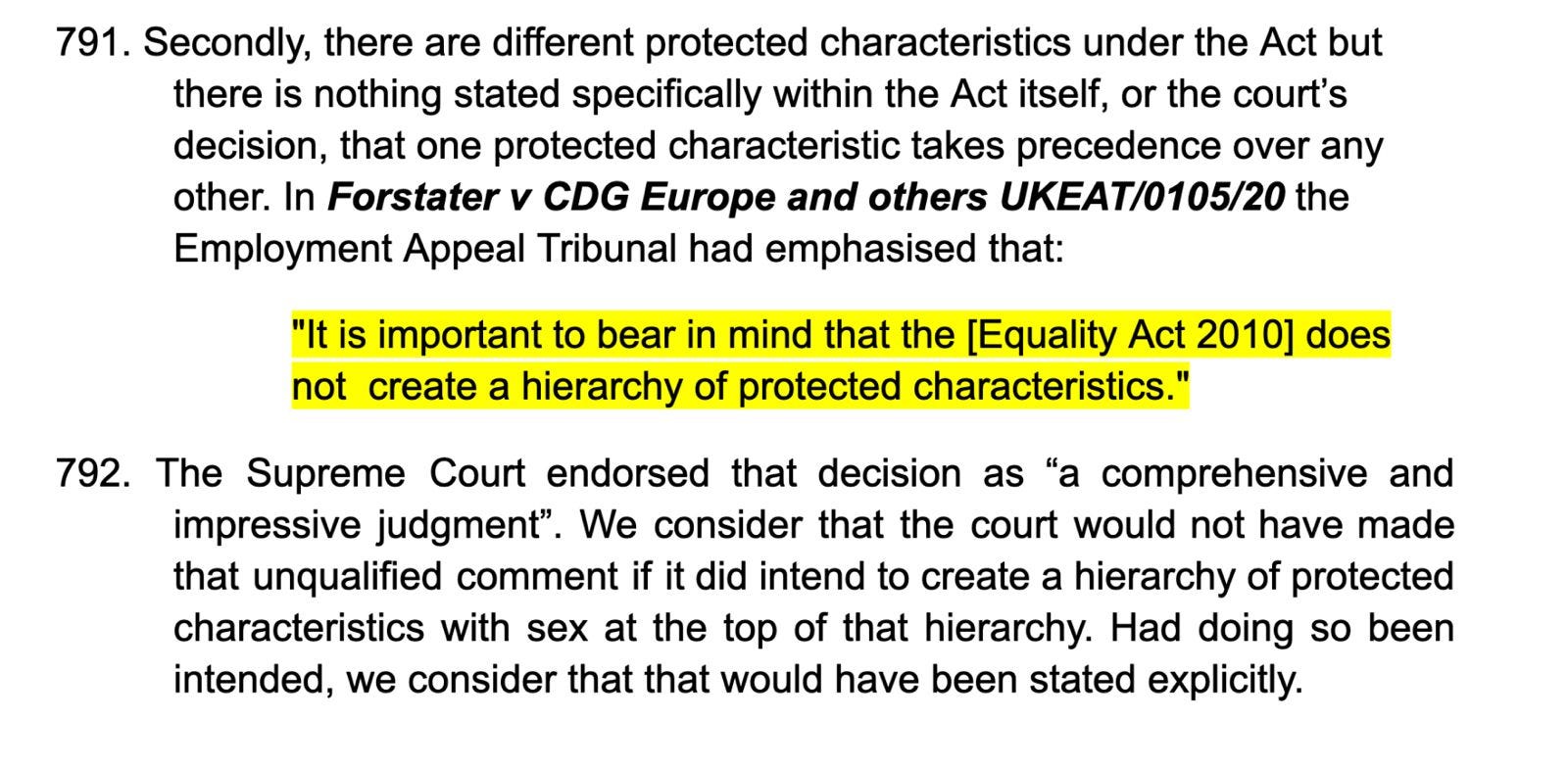
The situation is far more serious than the single — and that was bad enough — fake quotation from Forstater, since corrected by means of what lawyers call “the slip rule”. Notably, the corrected quotation does not support the point Judge Kemp wanted to make, rendering the passage nonsensical.

The slip rule or procedure — something many of us have seen in practice — exists to fix typos, wrong page/paragraph numbers, misspellings. One common error I remember from my pupillage days is fat-fingered judges leaving the “o” out of county in “County Court”, which of course litters the judgment with “Cunty Court”. Yes, everyone laughs and says “typo”, but things like this do have to be fixed.

The Roll on Friday piece notes that the Peggie opinion presents “a summary as if it was a quote from a judgment”, something that “appears to be a recurring issue”. This, as most people know by now, is a hallmark of AI.

I can’t prove that Judge Kemp used ChatGPT or Grok or a bespoke AI made available through the Judicial Office, although my suspicions are strong on this point. As an associate back in the oughts (a special kind of pupil barrister who works for a judge in a superior state or federal court in Australia), I’ve drafted multiple legal judgments. I have a good idea about what goes into them.

I also don’t know if Judge Kemp is on the transactivist side of this particular debate. I do know, however, that the judgment is dreadfully written and full of woolly reasoning, and — as other people have pointed out — all the errors tend in one direction.

I’m now going to set out what I think has happened, with the caveat that I could be wrong — something no-one will know until the appeal is heard and an opinion handed down.

The wrong way to address the credit card debt issue

Filed under: Economics, Government, Politics, USA — Tags: , , , , , — Nicholas @ 03:00

Daniel Mitchell says that US politicians seem to have identified a real problem and they’re proposing solutions. Unfortunately, the biggest proposal not only won’t solve the problem … it’ll make it worse for the most vulnerable credit card debtors:

“Credit Cards” by Sean MacEntee is licensed under CC BY 2.0 .

According to a new report from the New York Federal Reserve, Americans have accumulated over one trillion in credit card debt, an all-time high. It’s a record that would make financial advisor Dave Ramsey lose the remaining hair on his head, but even worse, the share of balances in serious delinquency climbed to a nearly financial-crash level of 7.1%. In other words, Americans are borrowing more and paying back less.

This alarming trend has naturally drawn the attention of politicians eager to offer a quick fix.

Unfortunately, the solution gaining bipartisan traction is a blanket cap on credit card interest rates. Like most political quick fixes, it is an economic prescription guaranteed to harm the very individuals it claims to protect.

The impulse to cap rates is rooted in a fundamental economic misunderstanding. It treats the interest rate as an arbitrary fee levied by greedy banks rather than the essential economic mechanism it is: the price of risk. This misguided philosophy is embodied in the legislation introduced by the populist duo of Senators Josh Hawley (R-MO) and Bernie Sanders (I-VT), which seeks to impose a nationwide cap on Annual Percentage Rates (APRs), sometimes as low as 10%.

Make no mistake: two politicians don’t know better than the marketplace and the law of supply and demand that governs it. The consequences of imposing a price ceiling on credit are not debatable. They are historically certain. Interest rates on credit cards are higher than on mortgages, for instance, because credit cards are unsecured debt. If a borrower defaults, the bank cannot seize collateral to cover the loss. The interest rate must therefore be high enough to reflect the expected default rate across the entire high-risk pool.

It’s wrongheaded. Faced with the possibility of a government-imposed price cap, credit card companies would of course respond as any company would. They will stop extending credit to those who will possibly not pay them back. Studies show that even a cap as high as 18% would put nearly 80% of subprime borrowers at risk of losing access to credit. In other words, the 10% cap proposed by the Hawley–Sanders alliance would have truly devastating effects for credit access, potentially eliminating millions of accounts.

The victims of this policy will not be the wealthy, who already qualify for prime rates; nor will they be the financially literate, who pay their balances in full. The victims will be the economically vulnerable, the working-class single mother needing a short-term buffer, the recent immigrant attempting to build a credit score, or the young person trying to establish his or her financial footing. For these individuals, the Hawley–Sanders policy will deliver not cheap credit, but no credit at all.

How to Eat Like an Ancient Stoic

Filed under: Food, Greece, History — Tags: , , , , , , — Nicholas @ 02:00

Tasting History with Max Miller
Published 8 Jul 2025

Lentil soup with leeks, coriander seeds, and herbs

City/Region: Greece | Rome
Time Period: 3rd Century B.C.E. | 1st Century

The ancient stoics were all about being happy with what you’ve got. If one could learn to take pleasure in eating simple foods like lentil soup and barley bread (usually eaten by the poorest members of society), then they would have more happiness than if they constantly craved luxurious food. Granted, most of these philosophers were wealthy, so they didn’t actually have to live like the very poor.

The ancient Greek stoic philosopher Zeno of Citium was known for carrying around lentil soup in a clay pot, and that was probably just lentils boiled in water. This recipe, adapted from ancient Rome’s Apicius from a few centuries later, is a little fancier, but still rather simple and uses ingredients that would have been available to Zeno. Despite its simplicity, it’s surprisingly delicious with a hint of sweetness, oniony leek, and the cooling effect of the mint.

    Boil the lentils; when skimmed, put in leeks and green cilantro. Pound coriander-seed, pennyroyal, silphium, mint, and rue, moisten with vinegar, add honey, blend with garum, vinegar, and defrutum. Pour over the lentils, add oil, serve.
    — Apicius, de re coquinaria, 1st Century

(more…)

QotD: Free-form Jazz

Filed under: Humour, Media, Quotations — Tags: , , — Nicholas @ 01:00

The music here is “free-form jazz”, which appears to be several heroin addicts chasing a melody glimpsed in a hallucination.

James Lileks, The Bleat, 2005-09-05.

Powered by WordPress