Quotulatiousness

December 3, 2025

Like him or loathe him, Trump’s response to the DC shootings was “spot on”

In The Conservative Woman, Richard North makes the case that US President Donald Trump is the only western political leader who can stop the migration crisis:

Like him or loathe him, question his inconsistencies and his many other flaws, but in my view Donald Trump’s response to the shooting of two members of the West Virginia National Guard in Washington DC by an Afghan migrant was spot on.

There was none of the pussyfooting “my thoughts are with …” etc. Without equivocation, he immediately branded the shooting “an act of evil, an act of hatred and an act of terror”, adding: “It was a crime against our entire nation”.

Shortly thereafter, Secretary of State Marco Rubio posted a tweet declaring: “President Trump’s State Department has paused visa issuance for ALL individuals travelling on Afghan passports. The United States has no higher priority than protecting our nation and our people.”

Attached was an official tweet from the Department of State making it clear that the ban was of immediate effect, with the Department “taking all necessary steps to protect US national security and public safety”.

This added to the ban in June when Trump imposed restrictions on citizens from 12 countries, including Afghanistan, but that ban did not revoke visas previously issued, and holders of Special Immigrant Visas (SIV) were exempt.

Now Trump has gone further. In a Thanksgiving message posted on X, he offered a salutation which, in Trumpian style, didn’t mince words. It started with: “A very Happy Thanksgiving salutation to all of our Great American Citizens and Patriots who have been so nice in allowing our country to be divided, disrupted, carved up, murdered, beaten, mugged, and laughed at, along with certain other foolish countries throughout the world, for being ‘politically correct’, and just plain STUPID, when it comes to immigration …”

That was only the start of a very long and quite extraordinary tweet which, if nothing else, can be criticised for a complete absence of paragraphs and sentences which rivalled in length those in a Dickens novel.

With his opening out of the way, Trump asserted that the official United States foreign population stands at 53million, most of whom, he averred, “are on welfare, from failed nations, or from prisons, mental institutions, gangs, or drug cartels”.

“They and their children,” Trump continued, “are supported through massive payments from patriotic American citizens who, because of their beautiful hearts, do not want to openly complain or cause trouble in any way, shape or form”.

Warming to his theme, he declared: “They put up with what has happened to our country, but it’s eating them alive to do so! A migrant earning $30,000 [£27,000] with a green card will get roughly $50,000 [£38,000] in yearly benefits for their family. The real migrant population is much higher.”

Pressing his point, he stated what none of Starmer’s motley crew will admit.

“This refugee burden is the leading cause of social dysfunction in America, something that did not exist after World War II (failed schools, high crime, urban decay, overcrowded hospitals, housing shortages, and large deficits, etc)”, the Donald wrote.

In a passage which might have got him arrested had he posted in the UK, with refreshing candour, the President gave the example of “hundreds of thousands of refugees from Somalia” who were “completely taking over the once great State of Minnesota”.

Somali gangs, he said, “are roving the streets looking for ‘prey’ as our wonderful people stay locked in their apartments and houses hoping against hope that they will be left alone”.

No matter which country they end up in, Somalis tend to be bad news. There are multiple reports stretching back to 2007 of a plague of criminal gangs among the 32,000 Somalis who have settled in Minnesota.

Recently the Minnesota gangs have been associated with a series of massive welfare fraud schemes, the proceeds of which may have been funnelled to the Somalia-based terror group al-Shabab.

The largest fraud scandal involving Somalis was the “Feeding Our Future” scheme. Prosecutors racked up 56 criminal convictions in what they alleged was a plot to steal $300million (£270million) from a federally funded programme meant to feed children during the covid event.

The Korean War Week 76: Is America Favouring The Communists? – December 2, 1951

Filed under: China, History, Military, USA — Tags: , , , , — Nicholas @ 04:00

The Korean War by Indy Neidell
Published 2 Dec 2025

This week at the Panmunjom Peace Talks the two sides agree on a Demarcation Line for an armistice based on the current battle lines, provided the other items on the agenda have been dealt with within 30 days — or else it is invalid. There is still a huge issue, though concerning rotation and replenishment of force during an armistice, and also the right of inspection. The two sides are very far apart on all that. And 8th Army Commander Jim van Fleet issues orders which are misconstrued in the global press and lead to some embarrassment for Washington.

#KoreanWar #peacetalks #Korea #history #militaryhistory #Ridgway

Chapters
00:00 Intro
01:02 Recap
01:44 Item Three
05:08 Inspections After Armistice?
07:53 Ridgway’s Concerns
09:54 The POW Issue
11:45 Van Fleet’s Instructions
13:51 Summary
14:26 Conclusion
16:36 Call to Action
(more…)

The clankers aren’t going away

Filed under: Media, Technology — Tags: , , , , — Nicholas @ 03:00

In the National Post, Colby Cosh says that we should think of the clankers as they exist right now in the same way we consider verifiably insane people:

The market-liberal economist/pundit Noah Smith has written a fun “stranger in a strange land” essay about his unusual fondness for the emerging species of “generative” artificial-intelligence bots. Smith points out that 100 years of science fiction has prepared us all to have convenient, convincingly intelligent, multilingual automaton life assistants; they are an accepted part of the background of almost all imagined futures, with exceptions like Frank Herbert’s Dune universe (wherein even basic mathematical computing is outlawed on religious principle).

Now these creatures have appeared in our midst overnight, and Smith feels delight, but he acknowledges that the public reaction is mostly dominated by hostility and suspicion. The rule that technological advancements are in general good, even if they have some bad initial effects, seems to apply only in retrospect: we laugh at the Luddites of old, little suspecting that we might just be the same people at a different cusp of progress.

The caveat about “bad initial effects” is extremely important (as is remembering that the Luddites really were personally endangered by progress). Technological leaps creating social fracture and mass violence are a real feature of history going back to the Neolithic Revolution. The printing press set off an orgy of religious wars, aviation created strategic bombing and the carnage of the First World War (along with its 19th-century nationalist and imperialist preludes) couldn’t have happened without railways and the telegraph. Twentieth-century fascism and communism can both be understood as mass-media phenomena, as consequences of asymmetrical human adoption of mass media. I’m sure some of you are keeping one eye on the horrible AI-driven mini-arms-race happening in Ukraine, as the interceptor drones and the attack drones of both sides in the war co-evolve at warp speed, and, like me, you wonder about the implications for the entire political order of the world.

Those news stories are a reminder that Darwin never sleeps, and that you don’t get to take a nap break from history — but also that our species survived these crises and has (so far!) prevailed, escaping the old Malthusian prison to arrive at a period of relative plenty and peace even for the worst-off. In any event, technological leaps are one-way doors: the only way out is through.

Consumer artificial intelligences really are marvels, but you’ve heard me emphasize that they are to be regarded for the moment as insane, and to be trusted only as far as you would trust a genuinely insane human being. We don’t yet know whether, or to what degree, this feature of generative AIs can be corrected.

Full disclosure, while I’ve used Elon Musk’s Grok a few times to generate images to accompany stories here on the blog, I do not use clankers to generate text and I can’t imagine doing so in the immediate future. One of the better signs that we’ll be able to adapt to clankers being omnipresent (as tech bros seem to be all of one mind that they need to add AI to everything they can, accelerating the enshittification of so much technology) was this little anecdote reposted on the social media site formerly known as Twitter:

Update, 4 December: Welcome, Instapundit readers! Please do have a look around at some of my other posts you may find of interest. I send out a daily summary of posts here through my Substackhttps://substack.com/@nicholasrusson that you can subscribe to if you’d like to be informed of new posts in the future.

Battle of Peleliu 1944

Filed under: History, Japan, Military, Pacific, USA, WW2 — Tags: , , , — Nicholas @ 02:00

Real Time History
Published 18 Jul 2025

In September 1944, the US 1st Marine Division is on its way to another amphibious invasion in the Pacific – the tiny island of Peleliu. For almost half the Marines it will be their baptism of fire against veteran Japanese troops with a new defensive doctrine. Some American commanders call for the operation to be cancelled, but it goes ahead. By its end, half the Marines and all the Japanese will be killed or wounded – but was Peleliu worth it?
(more…)

QotD: Origins of the Mediterranean “omni-spear”

Filed under: Europe, History, Military, Weapons — Tags: , , , — Nicholas @ 01:00

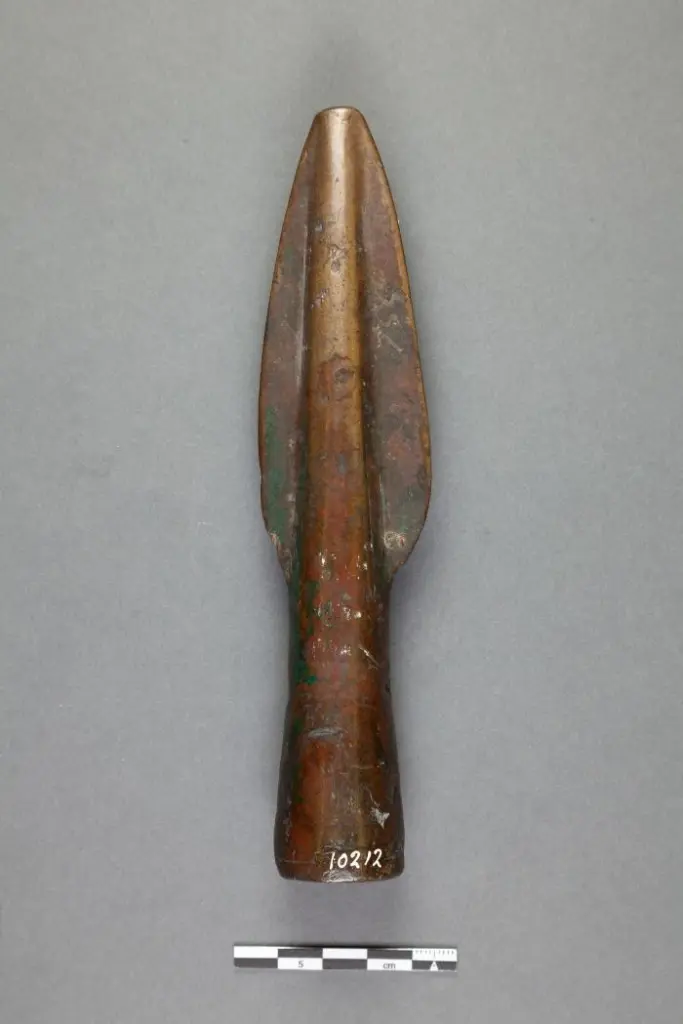
From the Museo Arqueológico Nacional in Madrid, a bronze spearhead (inv. 10212) from Italy, c. 1300-900 BC, identified as Villanovan or proto-Villanovan.

Why are so many early iron spearheads shaped this way? Well, the easy answer to the question is that it is because even earlier bronze spearheads were shaped this way. In every culture I’ve studied with the omni-spear, you can find bronze spearheads with the same basic shape – the strong mid-ridge, leaf-shaped blades and circular socket – proceeding them. There are differences; the bronze spearheads of this type tend to be shorter and as a result somewhat “stubbier” (that is, they’re just as wide, but not as long) compared to the later iron spearheads which borrow their shape. That seems like it is probably a concession to metallurgy and possibly production. On the production side, bronze artifacts were generally cast to shape and depending on the temperature of the cast and type of casting method, that can place upper-limits on the size of the final artifact. Certainly ancient bronze-smiths were capable of managing very large casts with high quality metals – the heaviest recovered naval ram (the Athlit ram, as far as I know) is absolutely massive at 465kg, cast in a single piece.

That said, I suspect the real issue that limits the size of bronze spearheads is the metal itself. Weapons generally tend to push their materials to the outer edges of what they are capable of, because of the demand to keep weight low: the smith is looking to hit the absolute minimum amount of metal which will handle the strains of impact. And the strains of impact here are considerable! Bronze under stress tends to undergo plastic deformation, which is to say that it bends and doesn’t bend back, it isn’t “springy”. As a result bronze weapons – swords, spearheads, arrow-heads, etc. – tend to be quite a bit shorter than later iron weapons, so that they can withstand the rigors of combat without permanently deforming in a way that would render them useless. But iron when put under mild stress deforms elastically, which is to say it is “springy” and when the force of stress is removed it bends back to its original shape (adding carbon to make a high-carbon “spring steel” can improve this quality), so even while iron isn’t any harder than bronze (though steel most certainly is), an iron weapon can take a bigger hit and not end up hopelessly bent. And that is even more true once you begin adding really any amount of carbon to make even very mild steels.

Consequently, you can push an iron sword to be longer for the same weight because you can count on it withstanding a hit, bending a bit to absorb the force and bending back when the force is removed, better than bronze. I suspect the same thing is happening as bronze spearhead designs shift to iron: smiths are realizing they can get a somewhat longer point, with a longer more deadly taper, without an unacceptable increase in weight.

But then why keep the shape? Because a lot of bronze age sword shapes drop or are extensively modified fairly quickly in the shift to iron in places where the omni-spearhead remains the standard shape, albeit somewhat larger than its bronze variant.

Well, the answer, to me, seems to be that its a pretty useful shape, at least in a particular combat environment.

The round socket, of course, is to fit the round haft of the spear. These sockets are, as noted, generally round, which suggests that these spears are almost entirely being used to thrust. You probably could cut with the edges of these blades, but if that was how you expected to use the spear, you’d want a different haft shape so that you could feel the alignment of the edges of the blades. Interestingly, octagonal or rhombic sockets are a minority type that appears in a lot of places (both Gaul and Spain, for instance), but they remain really rare, as opposed to, say, medieval polearms, where non-circular hafts become common over time so that the wielder can feel that edge-alignment.

Extending the socket to make the mid-ridge also makes a lot of sense, as it provides a nice, thick, stout element of the spear to resist the forces of impact, which is going to be a mix of compression and bending. In an ideal, perfect impact, it’d be all compression, but in the real world, your target isn’t standing still and your hit probably isn’t dead-on, so you want some part of the spearhead that can resist that impact and hold its shape, transmitting the force instead into the shaft. The mid-ridge, being nice and thick (and generally not hollow past the socket) accomplishes this neatly.

Meanwhile, those wide, thin blades ensure a wide wound that is going to slice through a lot of the target. You want that too, because the fellow striking with the weapon wants a wound which will disable their opponent as quickly as possible. After all, all of the time between the delivery of a wound and it becoming disabling is, definitionally, a period where you are in range of their counter-attack and they are not disabled and so able to give it. If you ever wondered why a lot of really narrow, quick effective piercing weapons like rapiers were less common on the battlefield, this is a big part of it: those penetrating wounds are really lethal but often not very quickly and in a battlefield (where you may not be able to quickly back off after having delivered a fatal wound) you want a wound that, fatal or not, is going to disable fast.

Wide slicing wounds do that for you, because they cut across blood vessels, muscles and tendons. The former leads to rapid blood-loss, which can be disabling (and of course, fatal, but again, you care about disabling; fatal or not is a problem to consider once you are out of danger), while the later can instantly render limbs useless. It doesn’t matter how much adrenaline or willpower an enemy has, if a blow has sliced the muscles they would use to move their limbs, they cannot physically move those limbs.

The shape of the blades also seems intentional. While we do see neatly “oval” shaped blades, the most common shapes are “teardrop” or “leaf” shapes, which are widest close to the base. That probably helps in preventing over-penetration, because you need to be able to pull the spear back after delivering a strike; you do not want it stuck in the target. Likewise, I think that’s why truly “arrow” shaped spearheads tend to be both early and relatively rare. Instead the base curves back into the socket rather than having barbs, to make it easier to get that spear back out of an opponent after you strike them.

At the same time, spears are by no means immune to weight considerations. Ideally a combatant wants the longest spear they can manage easily in a single hand. That in turn is going to place a hard limit on the weight of the spearhead; every gram in the spearhead shifts the center of balance forward, making the weapon harder to handle. Shifting that center of balance back means adding a gram to the spear butt. Spearheads are pretty much always heavier than spear butts (often several times over), but the basic interaction is there where adding mass to the tip of the spear imposes weight costs which limit length. The trade-off is actually quite clear in medieval spears, where winged and “hewing” spears with larger spear-tips do, in fact, tend to be shorter and may have often been intended for use in two hands.

And because the humans in these systems don’t differ all that much, everyone more or less hits the same set of tradeoffs at basically the same point and so ends up developing spears with very similar weight and length characteristics. This should, I hope, help to dispel any myths that this or that group of ancient agrarian people were super-strong supermen; Greek, Roman, Spanish, Gallic, and Persian spears are all of the same basic length and weight and modern enthusiasts, reenactors and experimental archaeologists can wield those spears just fine. The basic limits of an average warrior haven’t changed all that much.

What you are left with is a spear with a 2-2.5m haft (probably just under 1kg), with spear-tips ranging from 150-450g, mostly clustered in the center of that range around 200g, and spear-butts typically very light, less than 100g and very simple in design (with an exception here for the elaborate Greek saurotar). A simple, no-frills design that would have been very effective on foot or on horseback.1

But as a basic design, the typical omni-spear provides a very effective balance of capabilities: the longest infantry spear that is easy enough to handle with a tip that is suitably deadly against lightly armored or unarmored targets and typically a spear-butt which both encloses the base of the spear (preventing it from delaminating) and provides a point which can be used to both brace the weapon and as an emergency back-up weapon, without adding unacceptable amounts of weight. Note, of course, that I’ve said unarmored or lightly armored: the wide blade on that spearhead is going to cause a strike to have to move aside quite a bit of armor if your opponent is wearing some, greatly limiting the depth of a strike if you have to move the weapon through, say, thick textile armor or mail. But assuming you only expect to strike unarmored targets, or the unarmored portions of armored targets, the shape is very effective.

Bret Devereaux, “Collections: The Mediterranean Iron Omni-Spear”, A Collection of Unmitigated Pedantry,


  1. Though the Greek cavalry spear of the late-Classical and Hellenistic, the xyston – pronounced ksuston, not zystin – is differently structured than this.


Powered by WordPress