
In the National Post, Mark Milke and Tom Flanagan outline one of the major issues dividing Canadians — the state and state-funded propaganda demonizing “settlers” that also lionizes much more recent arrivals as if they’re automatically better than non-Indigenous Canadians:
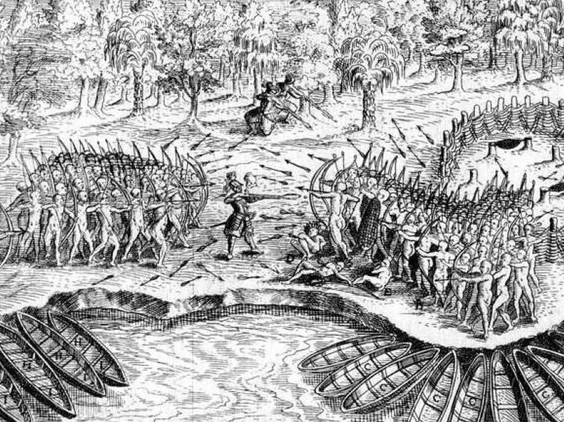
A depiction of Samuel de Champlain’s first encounter with the Iroquois (Mohawks) in 1609, a forest skirmish on future Lake Champlain, including fanciful rowboats, rather than canoes.
Caption from the National Post, image from the National Archives of Canada
If Canadians care to understand why our country is increasingly fractured, one key driver is the notion that non-Indigenous Canadians — “settlers” as they are called — should be grateful to live anywhere in the Americas.
The “settler” label is mostly directed at those of British and European ancestry. But it can apply to anyone whose families arrived from anywhere — Africa, Asia, the Levant, the Pacific — who were not part of the prior waves of migration to the Americas.
According to the most recent scientific knowledge, human settlement in the Americas began about 15,000 to 20,000 years ago. These pioneers of settlement must have arrived from Asia by boat and hopscotched along the Pacific coast because the interior land was glaciated. They migrated as far south as modern-day Chile, but it is unknown how far inland they penetrated and whether they survived to merge with later migratory settlers.
Another wave of migration started around 13,000 years ago when an ice-free corridor opened through Alberta between the two great glaciers covering North America. This made it possible for people from the now submerged land of Beringia to move south through Alaska, Yukon and Alberta across North America.
Later, but at an unknown date, came the movement of the Dene-speaking peoples now living mostly in Alaska and Canada’s North (though the Tsuut’ina got to southern Alberta and the Navajo to the southwestern United States). Their languages still show traces of their relatively recent Siberian origins.
The Inuit migrated from Siberia across the Arctic to Greenland around AD 1000. Another group inhabited the Arctic starting around 2500 BC, but their relationship to the Inuit is uncertain.
In short, the Americas were settled in waves from Asia. Everyone alive today is descended from settlers. The latest “Indigenous” settlers arrived barely ahead of the first European settlers, the Vikings, who settled in Greenland and Newfoundland, and of Christopher Columbus, who started Spanish settlement in the Caribbean.
Singling out Europeans as “settlers” drives land acknowledgments, as well as demands for compensation and reconciliation. It plays on guilt about the actions of actors long since dead, while the concurrent demands for land, decision-making power and financial settlements occur on an open-ended basis. Internationally, the United Nations Declaration on the Rights of Indigenous Peoples (UNDRIP) also assumes the Indigenous vs. settler-colonial divide is valid.
Why does this matter? Because peaceful, relatively prosperous nation-states are not guaranteed to last. In fact, they’re the exception, not the rule. To make actual progress in unifying Canada as opposed to watching it break down and fragment into hundreds of inconsequential principalities (a separate Quebec, a separate Alberta, and multiple First Nations with state-like powers, of which there would be up to 200 in British Columbia alone), it is overdue to dissect these assumptions, and the related belief that Canadians have done little to make up for some of the wrongs done in history.


