In Reason, J.D. Tuccille considers the impact of the US government shutdown on the federal civil service:
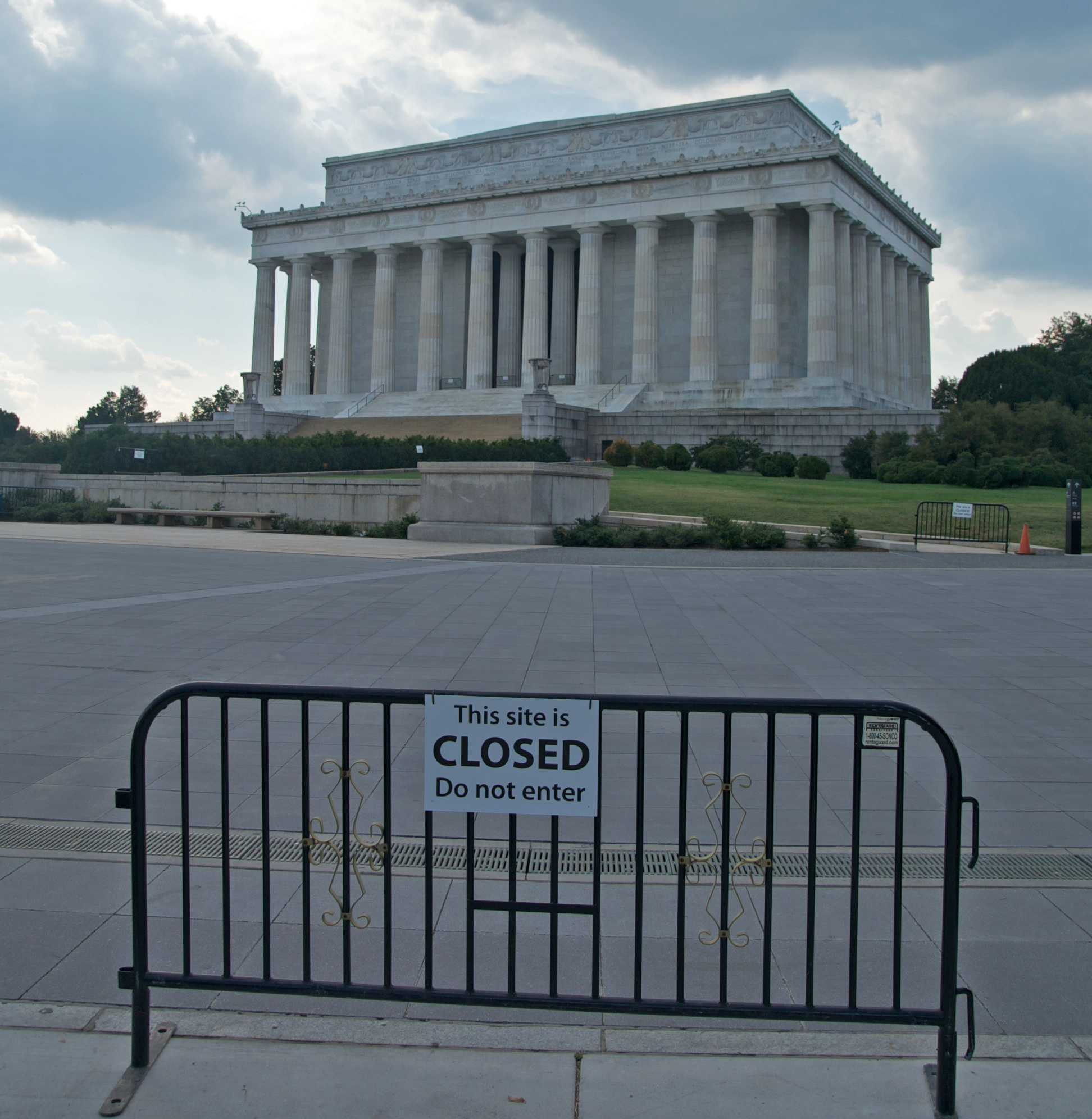
“Lincoln Memorial During Government Shutdown 2013” by Flickr user reivax is licensed under CC BY-SA 2.0 

 .
.
As promised — or threatened, if you wandered over to Reason by accident — the Trump administration has started using the government sort-of-shutdown as an opportunity to engage in mass layoffs of federal employees. In the game of chicken between Republicans and Democrats over just how much the government should overspend and on what, the losers so far appear to be some of the almost 3 million Americans who thought federal employment would be a comfortable way to collect a paycheck.
Setting thousands of former government workers loose to seek jobs elsewhere — preferably not involving money forcibly extracted from taxpayers — is a step in the right direction.
Shutdowns Are (Mostly) Political Theater
As we all should know by now, government shutdowns are largely political theater. National parks and museums are closed to inconvenience the public into believing something big is happening even as taxes keep getting collected and government enforcers continue twisting arms to make sure people comply with laws and rules that never should have been imposed.
The Brookings Institution’s David Wessel pointed out last week, “the Justice Department said 90% of its employees would be exempted from the furlough” and “the Department of Homeland Security said in its 76-page contingency plan that roughly 95% of its nearly 272,000 employees would remain on the job if a shutdown occurred”. Agencies accomplish this by defining “essential” employees who remain on the job in the broadest way possible.
Paychecks may be delayed during the shutdown. But after it ends, “employees who were required to perform excepted work during the lapse will receive retroactive pay” and “employees who were furloughed as the result of the lapse will receive retroactive pay for those furlough periods” according to the Office of Personnel Management. Basically, all federal employees eventually get paid whether they continue to work or are sent home for the duration of the “shutdown”.
An Opportunity To Reduce the Federal Workforce
At least, that’s how it usually works. This time is a little different because the Trump administration came into office promising to downsize the federal government. The Department of Government Efficiency (DOGE) was supposed to accomplish that goal, but the shutdown offers another opportunity. Even before furloughs began, the Office of Management and Budget (OMB) sent out a memo noting:
With respect to those Federal programs whose funding would lapse and which are otherwise unfunded, such programs are no longer statutorily required to be carried out. Therefore, consistent with applicable law, including the requirements of 5 C.F.R. part 351, agencies are directed to use this opportunity to consider Reduction in Force (RIF) notices for all employees in programs, projects, or activities (PPAs) that satisfy all three of the following conditions: (1) discretionary funding lapses on October 1, 2025; (2) another source of funding, such as H.R. 1 (Public Law 119-21) is not currently available; and (3) the PPA is not consistent with the President’s priorities.
The White House is apparently taking this opportunity seriously. “Around 4,200 employees were laid off in total on Friday,” reports Eric Katz of Government Executive. The biggest cuts were at the Department of the Treasury (1,446 employees) and the Department of Health and Human Services (between 1,100 and 1,200 employees). The Department of Education, which President Trump proposes to totally eliminate, also experienced layoffs (466 or nearly 20 percent of its remaining workforce), as did the Environmental Protection Agency, Homeland Security, and Housing and Urban Development.
Everything this administration does seems to involve a bit of chaos, and the latest rounds of reductions in force are no different. While hundreds of employees of the Centers for Disease Control and Prevention (CDC) were included in the layoffs, some were fired by accident and immediately rehired.
Chris Bray notes that — stop me if you’ve heard this before — a district court judge has ruled that the President doesn’t have the power to do, well, pretty much anything to do with the federal workforce (what is it with the executive branch thinking they have powers that haven’t been explicitly approved by the judiciary?):
After a just absolutely bizarre hearing in a Northern California federal court, a judge has forbidden the Trump administration from laying off government employees. The hearing may have been held in the Court of the Red Queen: After Counsel to the Assistant Attorney General Elizabeth Hedges argued that she wasn’t going to get into the legal merits of the Trump administration’s layoffs because the court lacked jurisdiction and the plaintiffs hadn’t met the legal standards for filing a lawsuit, Judge Susan Illston warned that, actual quote, “This hatchet is falling on the heads of employees all across the nation and you’re not even prepared to address whether that’s legal?” Getting laid off is a hatchet attack, so we skip the arguments about ripeness and standing. It’s emotionally dire, a thing that feels very bad. Judges talk like this, now. OH GOD COUNSEL THIS IS LIKE A THING WITH A KNIFE THAT WOUNDS ME. Objection, your honor, inadequate trigger warning. […]
Illston declared the existence of a temporary restraining order from the bench, and I’ve been waiting for her written order to land on PACER. It’s here, and it’s … very … Well, okay: It has a lot of feelings. […]
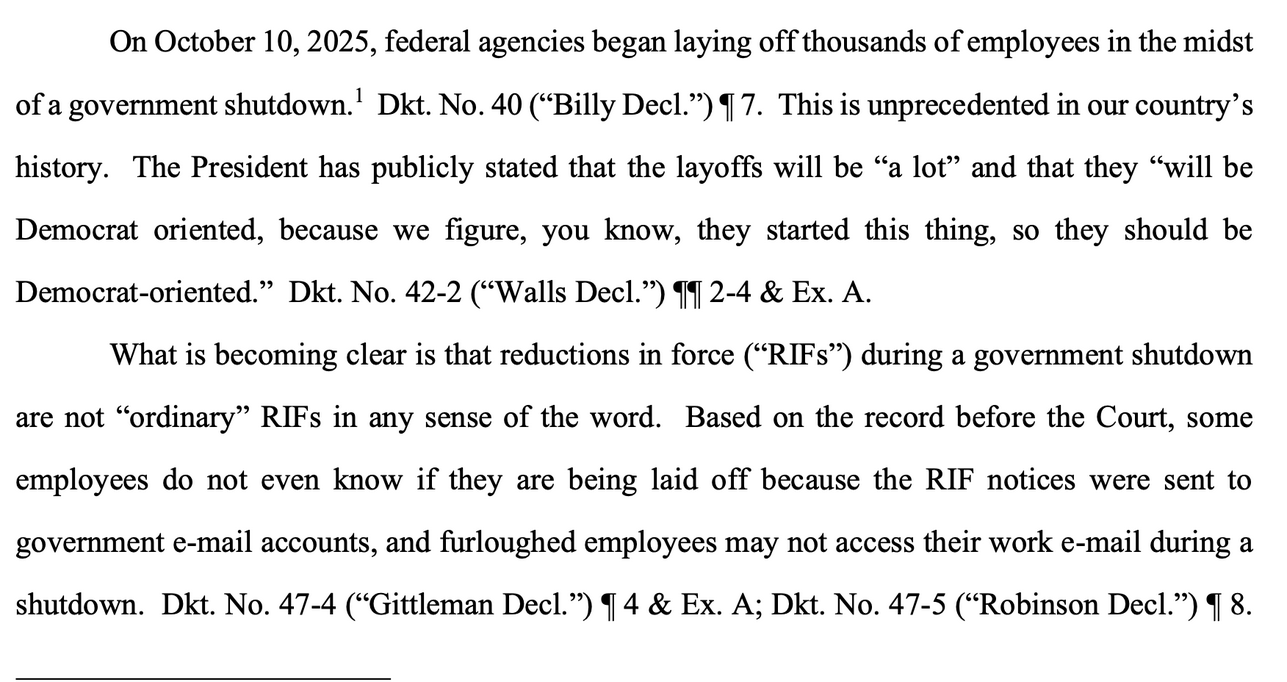
Opening paragraphs, first page:
Note that the first paragraph frames federal RIFs as historically unprecedented, while the second paragraph frames the current federal RIFS as not ordinary: different than the way RIFs are usually conducted. So this is unprecedented, but it has happened before, and the problem with the unprecedented thing is that it’s not being done the way the thing that has never been done before is usually done.
But anyway, a reduction in force of federal personnel during a shutdown is “unprecedented in our country’s history”. Of course, a reduction of force alone is not at all unprecedented, and the Clinton administration reduced the size of the federal bureaucracy by about 400,000 people. Illston doesn’t articulate a reason why reducing the bureaucracy during a shutdown is worse, or a reason why Clinton RIFs were good but Trump RIFs are a violent hatchet attack, but she clearly feels it. Of course, during a shutdown, the agencies being shrunk have no approved funding, so it would seem to make more sense to be careful about personnel costs, but this argument means that I just hurt people with a hatchet.
Above all, note that the argument out of the gate is a normative argument, not a legal argument. This is unprecedented! This is not ordinary! If a judge feels that something is a little off, she can order it stopped.