
On the social media site formerly known as Twitter, Tristin Hopper posted the best explanations I’ve seen for why Canada is in the state it’s in:
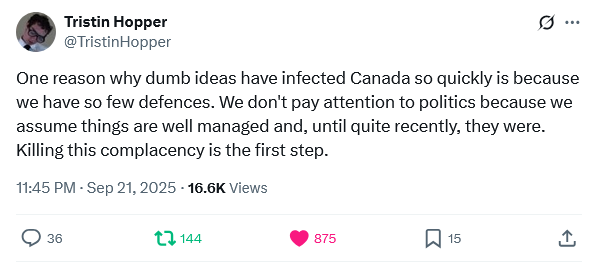
Canadians took it for granted that, no matter which party was in government, the country would continue to be stable, predictable, and competent. That’s clearly wrong today, yet the voters haven’t really accepted the new situation yet. Until they start paying attention, things may not improve.
It’s not just Canada, of course, but Canada is further down the road to ruin and thanks to the governments’ conscious actions, it will probably take longer to recover (and I don’t see a Canadian Javier Milei on the horizon, more’s the pity).
At The Freeman, Will Ogilvie Vega de Seoane discusses a related issue with most forms of representative government:
We are stupid. There, I said it. I feel much better now — like I’ve finally opened up in group therapy. PhDs won’t fix it, nor will subscriptions to all the best outlets. As individuals, we simply do not have the capacity to decide what is best in public life. As voters, we don’t usually care what our representatives are up to, nor do we have the faintest idea what the best policy on agriculture, artificial intelligence, or healthcare should look like — and that’s on a good day. But we do think we know. Deep down we think we are sovereign, that democracy is “all of us”, as though the government were some noble embodiment of “the people” rather than just another collection of organized persons with private agendas.
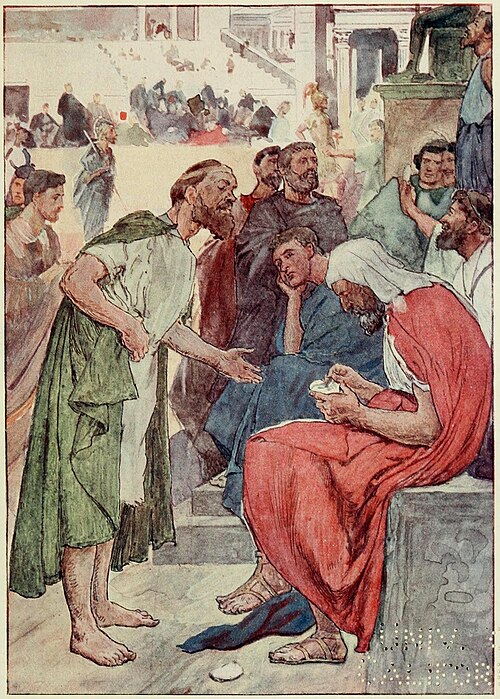
“Aristeides and the citizens” from Plutarch’s lives for boys and girls (1900).
Plutarch tells a story that I have always found marvelous. It’s about Aristeides “the Just”, one of Athens’s heroes in the Persian Wars. The Athenians, weary of kings and tyrants, invented ostracism — a mechanism to expel for ten years any citizen who got too powerful. Each voter would scratch a name onto a shard of pottery, and if more than 6,000 shards had the same name on them, the man was politely asked to take a decade-long sabbatical. Today we’d probably call it “a career break for the common good”.
Anyway, one day a farmer approached Aristeides himself — without realizing who he was — and asked him to write the name “Aristeides” on his shard. Surprised, Aristeides asked if he had ever harmed him. “No,” said the farmer, “nor do I know him by sight. But I am tired of always hearing him called ‘the Just’.” Aristeides, being annoyingly noble, wrote down his own name and handed the shard back. Later, as he left the city in exile, he prayed the opposite prayer of Achilles: that no crisis should come which would force the Athenians to remember him. On LinkedIn, Aristeides might have written: “Currently on a ten-year sabbatical generously sponsored by the people of Athens. Seeking new challenges outside the Attic peninsula #OpenToWork.”
This, in miniature, is how people vote. Not with knowledge, or vision, or even vague coherence — but out of envy, spite, boredom, or some other glorious irrationality. The Athenians had shards; we have hashtags. Instead of ostracism by pottery, we have ostracism by X: one bad joke, one leaked email, and the digital mob sends you packing. Today in Britain, people can even be jailed for their comments on social media. So much for parrhêsia, that old Athenian virtue of speaking frankly to power. We’ve managed to turn it into a crime — and worse, the canceling mob thinks it’s “speaking truth to power” when in fact it is obedience dressed as rebellion.
Modern voters aren’t any better. Some vote because the candidate owns a cute dog. Others because the candidate is endorsed by Taylor Swift. Entire campaigns have been won on promises of free cable, or by a politician smiling the right way on TikTok. In Spain, we even coined a term for it: the Charo. A Charo is usually an old lady with pink hair who parrots whatever our president says. Charos cannot resist the presidential smile. Even when the president contradicts himself, as he normally does, doing the exact opposite of what he promised, they just blush and blink as if to say: “Oh, Pedro, always misbehaving — we love you all the more for it.” They pamper their charming president and dismiss any criticism as fascist slander. Welcome to the Charocracy.
That’s a pitch-perfect description of the typical Liberal voter in Canada. Mark Carney’s Canada is clearly a maple-flavoured Charocracy.


