
Quotulatiousness

September 3, 2025

Dad’s Army caricatures capture life in Britain today

Filed under: Britain, Bureaucracy, Humour, Media, WW2 — Tags: , , — Nicholas @ 05:00

At The Daily Skeptic, Guy de la Bédoyère wonders why everything in modern Britain emulates an episode of the 70s sitcom Dad’s Army:
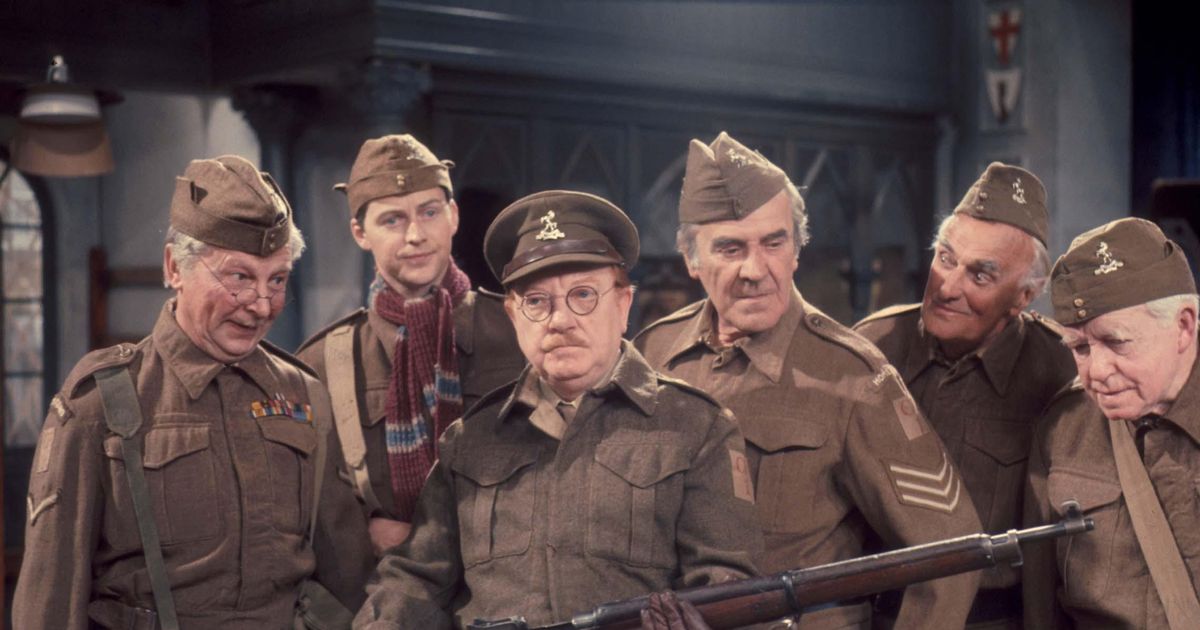
Dad’s Army, a BBC sitcom that ran from 1968 to 1977, starring Arthur Lowe as Captain Mainwaring, John Le Mesurier as Sergeant Wilson, and Clive Dunn as Lance Corporal Jones.

There are plenty of natural laws, but here’s one unique to Britain:

    Every organisation, committee, scenario, initiative and government-backed and corporate project in Britain will inevitably degenerate into a scene from Dad’s Army.

That of course is the celebrated sitcom Dad’s Army, based on the world of Britain’s Home Guard in the Second World War, which ran for nine series in the 1970s. Every character is caricature, and sometimes not even as much as that.

Just think about it. Captain Mainwaring, the prickly bank manager and obsessed with status – the ultimate incompetent management figure, forever frustrated by his own paltry military service in the Great War and now strutting around like a dumpy cockerel as commanding officer of the platoon.

Sgt Wilson, a complacent, dozy and lazy member of the establishment, effortlessly imbued with a sense of privilege and world-weary detachment. Persistently given to undermining Mainwaring.

Lance-Corporal Jones, the panic-stricken jobsworth stifling initiative at every turn and floundering haplessly around to demolish every project with his matchless ability to overcomplicate anything and everything. He has a special skill for wasting inordinate amounts of time with ludicrously impenetrable explanations, usually based on fantasy.

Private Frazer, the miserable doom-laden pessimist and undertaker, forever raining down scorn and stirring up opposition and discontent in the ranks, his own ambitions in the platoon thwarted.

Private Walker, the skiving skimmer who dodged regular military service. Forever on the take but essentially harmless and even with some good characteristics.

Private Godfrey, the embodiment of the well-intentioned but largely hopeless pensioner whose presence relies usually on everyone else. Constantly called away to relieve himself.

Private Pike, the idiotic mummy’s body excused military service. Today he would have a certificate excusing him from any form of employment for anxiety, ADHD and anything else his mother or the system could come up with.

Then there’s the ARP Warden Hodges, whose sole purpose in life is feuding with Mainwaring, finding fault with the platoon’s men and triumphantly announcing their infractions. Hodges is the confrontational and dispute-loving trade union leader to Mainwaring’s shambolic management. His only mission in life is to create conflict and throw his weight about.

To these we can add various other characters, all comic figures (like the vicar and the verger) but essential props that amplify the authenticity.

The reason the sitcom lasted so long is very simple. Every single organisation in Britain is in home to some of or all these personality types, whether it’s the parish council, a local arts society, a corporation or the government.

Almost every problem the Home Guard platoon is confronted with results in bickering, chaos and wasted time, based mostly on posturing, obstinacy, incompetence, obsession with status and a lack of foresight, common sense and lateral thought. If the outcome is a good one, it’s invariably the result of chance.

Sounds familiar? It doesn’t matter what you think about the boats, climate change, the welfare state or the NHS. Every one of Britain’s current problems is being dealt with as if each was an episode of Dad’s Army.

Update, 5 September: Welcome, Instapundit readers! Please do have a look around at some of my other posts you may find of interest. I send out a daily summary of posts here through my Substackhttps://substack.com/@nicholasrusson that you can subscribe to if you’d like to be informed of new posts in the future.
The Korean War Week 63: The Battle of Bloody Ridge – September 2, 1951

Filed under: China, History, Military, USA — Tags: , , , , , , — Nicholas @ 04:00

The Korean War by Indy Neidell
Published 2 Sep 2025

The South Koreans have won their fight northeast of the Punchbowl, but not that far away the Battle of Bloody Ridge is earning its name, with casualties rising into the thousands for both sides.

Chapters
00:41 Recap
01:11 A ROK Success
01:47 Bloody Ridge
06:17 Soviet Reinforcements
07:08 Operation Strangle
11:06 Summary
11:45 Conclusion
13:37 Call to Action
(more…)

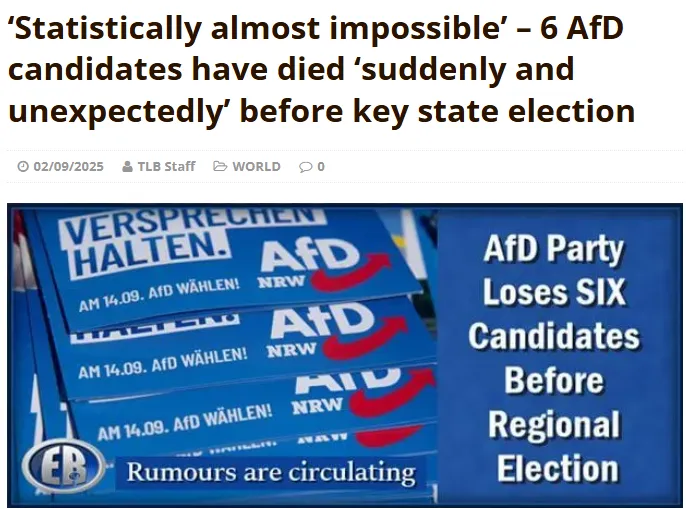
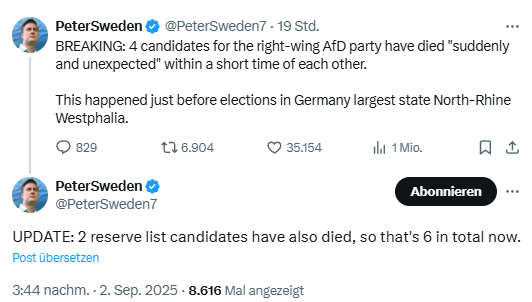
“Once is happenstance. Twice is co-incidence” … but SIX?

Filed under: Germany, Media, Politics — Tags: , , — Nicholas @ 03:00

I depend on eugyppius to keep me up to date on German affairs, and despite the eyebrow-raising total of six AfD candidates dying unexpectedly, he doesn’t think it’s actually “enemy action” as Ian Fleming once wrote in Goldfinger, but it is statistically boggling:

I had plans to write about something else today, and I even have a half-finished post, but the story of the mysteriously dying AfD candidates is everywhere …

… and I feel compelled to address it.

The West German state of Nordrhein-Westfalen (NRW) is slated to hold municipal elections in just under two weeks, on 14 September. Eighteen million Germans scattered across thirty-one districts and 393 municipalities will elect councillors, board members, mayors and district administrators.

It’s important to understand the scale of these elections and the enormous numbers involved: Tens of thousands are presently running for office in NRW. The exact number isn’t certain, but it may be as great as 90,000. Most of these candidates are totally ordinary people. They are not professional politicians and they are not widely known outside their communities.

Four days ago, the German press began reporting on bureaucratic chaos stirred up by a series of unexpected deaths in late stages of the NRW campaign. Each of these deaths happened so late in the game that ballots had to be reprinted and the postal vote repeated. The German economist and social media personality Stefan Homburg picked up the story and called the deaths “statistically almost impossible“. AfD co-chair Alice Weidel retweeted Homburg’s suspicions, ultimately attracting the attention of Elon Musk.

Despite the widespread interest in this story, I really think it’s a nothingburger. We may be looking at an unusual cluster of AfD deaths in the upcoming elections, but we don’t know enough to say for sure how improbable this cluster is. All we can really say is that the deaths themselves are not unexplained and that their coincidence doesn’t look that improbable on its face.

German Occupation FN High Power Pistols

Filed under: Europe, Germany, History, Military, Weapons, WW2 — Tags: , , , , — Nicholas @ 02:00

Forgotten Weapons
Published 28 Apr 2025

When Germany occupied Belgium in the summer of 1940, the took over the FN factory complex and ordered production of the High Power pistol to continue. It was put into German service as the Pistole 640(b), and nearly 325,000 of them were made between 1940 and 1944. The first ones were simply assembled from finished Belgian contact parts, and included all the features like shoulder stock slots and 500m tangent rear sights. As the war continued, however, production was simplified. The stock slots disappeared first, then the tangent sights, then the wooden grips (replaced by bakelite) and eventually even the magazine safety was omitted. Resistance among Belgian factory workers increased as well, with deliberate sabotage in the form of incorrect heat treating, errors in fine tolerance parts, and sometimes even spending lots of time to give a very fine surface finish instead of making more pistols.

These are a particularly popular subject of collecting, and there are a lot of nuances of the production and inspection marks that are worth understanding if you want to take them seriously. I highly recommend Anthony Vanderlinden’s 2-volume book FN Browning Pistols for very good detail on these, as well as other FN handguns: https://amzn.to/42Bc541
(more…)

QotD: The distance between NHS PR and NHS reality

The uncritical national admiration, approaching worship, of the NHS has required the subliminal acceptance of a certain historiography: before the NHS, nothing; after it, everything. Before 1948, the poor received no treatment but were left to fend for themselves when they were sick, and more or less, to die. After 1948, the ever-solicitous state system looked tenderly after the health of the population from cradle to grave.

It wasn’t difficult to promote such historiography by using horror stories from the past, stories which were perfectly plausible because almost any conceivable system will give rise to such stories. If, per impossibile, a new system were to replace the NHS, it would not be difficult to justify it by reference to horror stories, whether or not the new system was better. A war of anecdotes, while always gratifying to the human mind, is not the way to decide important questions such as the superiority or inferiority of a system of health care. Only anecdotes that also illustrate statistical trends or truths are valuable in such a context.

The statistics are not favourable to the NHS, at least if one chooses reasonable standards of comparison, namely other European countries. The results are not disastrous, but they are not good either. The NHS has failed even in its egalitarian goal: the gap between the health of the richest and poorest in society has only grown under its dispensation. And yet the belief in its levelling effect persists.

The propaganda in favour of the NHS has been so successful that it now accords with the sentiments of the population, a triumph that no communist regime achieved despite herculean efforts at indoctrination. The triumph has been achieved without compulsion or violence and ought to be an interesting case for political scientists who study the successful inculcation of political mythology. Of course, the danger of such a study would be that it might induce doubt or cynicism about other political mythologies, and we all need such mythologies to live by.

Theodore Dalrymple, “Worshipping the NHS”, New English Review, 2020-05-07.

Powered by WordPress



