
Quotulatiousness

September 2, 2025

2 September, 1945 marked the formal end to the Second World War

Filed under: History, Japan, Military, USA, WW2 — Tags: , , , — Nicholas @ 04:00

On The Conservative Woman, Henry Getley notes the 80th anniversary of the formal surrender of Japan to the United Nations forces represented by Douglas MacArthur on board the battleship USS Missouri:
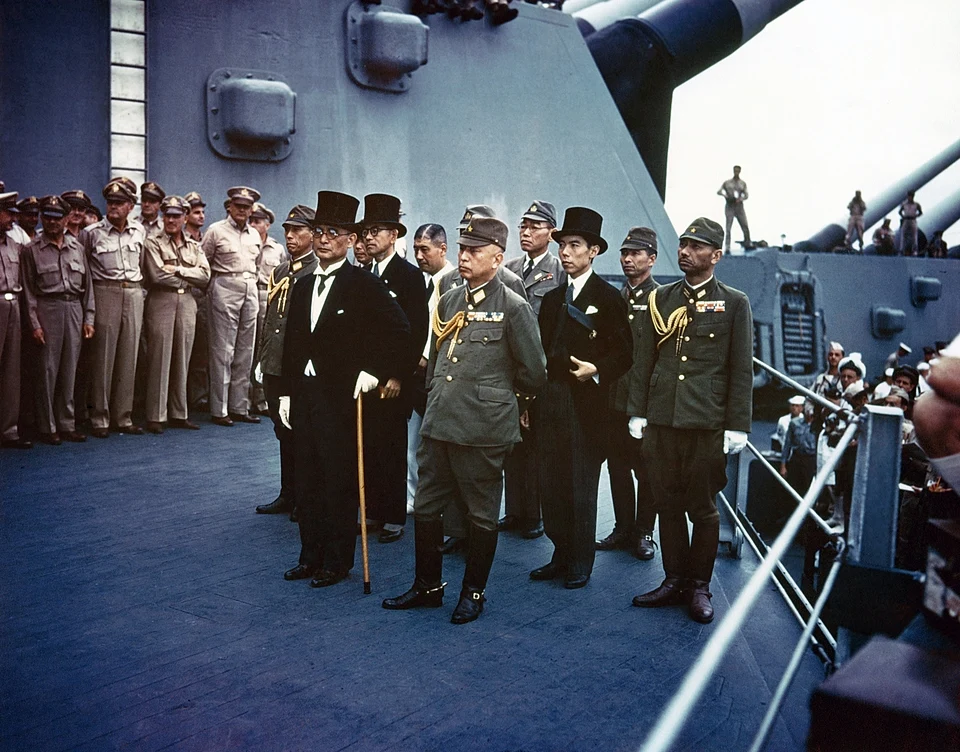
Representatives of the Japanese government on the deck of USS Missouri before signing the surrender documents, 2 September 1945.
Naval Historical Center Photo # USA C-2719 via Wikimedia Commons

ON September 2, 1945 – 80 years ago today – General Douglas MacArthur, Supreme Commander for the Allied Powers, accepted Japan’s formal surrender in a ceremony aboard the US battleship Missouri in Tokyo Bay. Then with the words “These proceedings are closed”, he brought the Second World War to an end.

That final sentence, broadcast worldwide by radio, came five years and 364 days after the global conflict started. Germany invaded Poland on September 1, 1939, but Britain – followed by France – did not declare war on Germany until September 3.

Six years later, on his enforced retirement, MacArthur told the US Congress: “I still remember the refrain of one of the most popular barrack ballads which proclaimed most proudly that ‘old soldiers never die, they just fade away'”.

Now, with the 80th anniversary of the war’s end, Britain’s old soldiers, sailors, marines and airmen have indeed faded away. At the war’s peak, 3.5 million men served in the Army, 1.2 million in the RAF and almost one million in the Royal Navy. Today, fewer than 8,000 veterans of those fighting forces are thought to be left. Most will be 98 or older.

It’s a striking thought for those of us who were brought up in the immediate post-war years. As I recalled in an earlier TCW blog, back in those days almost everyone’s father, uncle or brother had served in the military in some capacity.

The men we kids saw going to work in the offices, shops and factories of Civvy Street were the unsung heroes of the River Plate, Dunkirk, the Battle of Britain, the Battle of the Atlantic, the Arctic Convoys, the Western Desert, Italy, Normandy, Arnhem, the Rhine, Imphal, Kohima, the jungles of Malaya and Burma and many other battles large and small.

Being interested in military history, I was lucky enough to have become friends with several veterans of the Second World War, all sadly no longer with us. They were without exception the finest of men – modest, generous, good-humoured, gentlemanly. All had been at the sharp end in battle, but the last thing any of them would have called himself was a hero. They shared their memories with me reluctantly, anxious not to be thought they were “shooting a line” – that is, exaggerating or boasting. I was honoured and humbled to have known them.

Their passing reminded me that while the war was obviously seared into the very being of those who had experienced it, we of the first post-war generation inherited a lot of what you might call its folk memories and thus it loomed large in our perceptions.
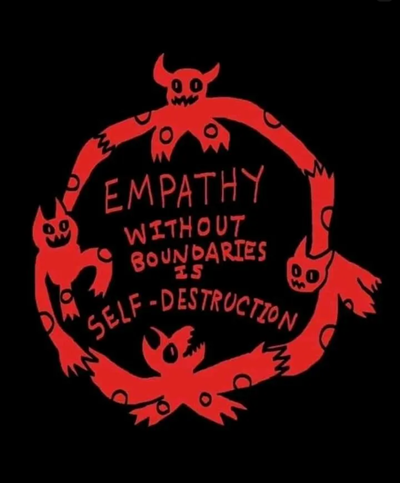

Too much empathy can be more dangerous than too little

Filed under: Cancon, Europe, Health, USA — Tags: , , , , , — Nicholas @ 03:00

Spaceman Spiff explains why boundaries matter, in so many different areas of modern life:

Empathy is a virtue many strive to demonstrate. But few will discuss its downsides. Why it is not universally good or useful. How it can be misdirected.

In some situations it is lethal. It can reflect a suicidal urge we now see in Western nations.

Much empathy in society is in fact sentimentality, which is dangerous. Sentimental ideas about mixing cultures, elevating poor performers through quotas, or tinkering with traditional gender roles have real world effects.

With such an emphasis on empathy, which many think of as niceness, we overlook the need for boundaries to maintain a functioning society.

This is the issue at the heart of much that is damaging us today.

Individual rights

We live in an era that champions individual rights to an almost autistic degree. This is a product of Western liberalism, which now seems to be entering its terminal phase as its effects ultimately destroy what made Western societies strong.

Since an individual’s rights trump everything we cannot easily enforce boundaries our ancestors could take for granted. Try challenging a gay pride parade or transgender material in schools on the grounds of public decency and the least you can expect is to lose your job.

Profound changes have happened just in the last few decades and all in the name of individual rights. The erosion of boundaries on behaviour is one of the most visible aspects of this.

Physical boundaries

The concept of boundaries is almost universal and spans everything from the mundane to the spiritual.

Most countries recognize the right to private property and inherent within this is the notion of boundaries. My car is mine and no one else’s, for example.

This is applied to our homes and gardens. These are ours and defendable from theft. Ultimately this in turn includes a neighbourhood or locale, even a region or state. All these things have visible boundaries that demarcate where they begin and end.

Most famously this applies to national borders, a traditional form of boundary in use for thousands of years. Failing to enforce this barrier is national suicide. The world is not like us and if it comes to us we will look like the world in return. Borders keep the barbarians out.

Everyone instinctively grasps these kinds of boundaries. We close our windows and have locks on our doors because of this understanding.

Using boundaries to exclude others feels natural.

Cultural boundaries

Less explicitly visible are cultural boundaries, often transmitted via tradition and convention. We have spent the last century attacking many of these as old fashioned, with little pause to consider why tradition emerges in the first place.

Marriage between men and women. Complementary gender roles. Sexual mores kept private. The sanctity of childhood, its innocence protected from intrusion.

As we removed constraints in the name of progress we destroyed much of the glue that held our societies together. We are now watching things unravel as people marry less and produce fewer children. We see widespread mental illness and anguish as the few basic certainties of life are destroyed in the name of progress.

People don’t know who or what they are when cultural boundaries are deleted. Women, men, natives, newcomers, the working class. Who are we really without some certainties in life?

How to Make a Poor Man’s Gauge | Paul Sellers

Filed under: Tools, Woodworking — Tags: , — Nicholas @ 02:00

Paul Sellers
Published 25 Apr 2025

Creating solutions does not always mean going out to buy dedicated manufactured tools but thinking about how you can become the solution.

In this short video, I show how you can set up an ingenious way to set out for hinge recessing, mortise and tenon parts, and then a beading tool in a matter of a minute or two only. It’s a trick that’s bailed me out time and time again.

It’s yours just by watching and learning!
(more…)

QotD: “Fixers” and “minders” for foreign visitors

Filed under: Bureaucracy, Cancon, China, Government, Quotations — Tags: , , — Nicholas @ 01:00

Old hands in some foreign places will remember that there are fixers and minders. Fixers are hired by e.g. corporations and news organizations and by embassies to help executives, reporters and senior officials (I was never senior enough ~ I think it was limited to Assistant Deputy Ministers, sometimes directors-general if they were heads of delegation) in strange places. Fixers were interpreters, guides and general helpers, sometimes even bodyguards. Minders did everything fixers did, usually (in my limited experience) better, but they were official; mine was assigned by the Chinese Ministry of Defence and I had no choice about her ~ thankfully she was pleasant and efficient. My minder had a seemingly magical ID card; she was able to move us to the front of almost every line and upgrade air and rail tickets (all at no charge), something that fixers could not do. Of course, she had other duties which included ensuring that I did NOT see or hear what I was not supposed to see or hear. It was just part of dealing with official China.

Ted Campbell, “A new front in Cold War 2.0”, Ted Campbell’s Point of View, 2020-06-26.

Powered by WordPress


