
Chris Schwarz on the frustrations of a (physical) book reader with far too many modern printed books:
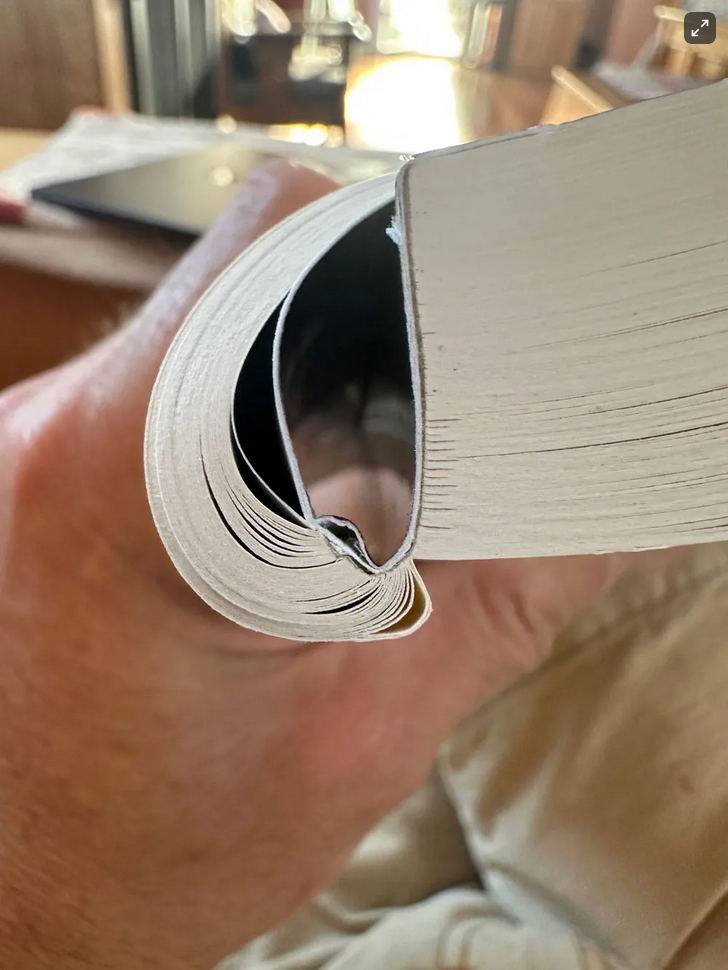
Dammit, Norton!
I don’t read much for pleasure these days. I spend about three hours a day reading manuscripts, draft blog entries, old woodworking texts, academic papers and contracts. When the workday is done, the last thing I want is someone else’s voice chattering in my head.
But I love books and have always been a voracious reader. So I keep a stack of books that I probe and pick at, like a 5-year-old forking through chop suey, looking for something to consume.
This month has been great. I’m in the middle of “The Overstory” by Richard Powers and “A Swim in a Pond in the Rain” by George Saunders. Both books were written with an exquisite pen, and I lose track of time when I’m reading them.
But both books also make me want to burn down the headquarters of Norton and Random House publishing. Because both books are made like dogshit.
Like most books these days, these two are “perfect bound”, which is a misleading name for a crappy technique. Like if we called a “butt joint” the “excellent end-grain joint,” or if we called miters the “super slanty joint”.
What’s perfect binding? Take a stack of individual sheets of paper, like the stack of pages you put in your printer. Slather some glue on one edge and press the goo into the pages. While the glue is still wet, slap the book’s cover to the glue on the spine. Trim the pages, sell the book and make an obscene amount of money.
I don’t know a binding technique that is crappier than perfect binding. Even loose-leaf pages in a Trapper Keeper are better because they can be repaired.
Perfect-bound books are – like a Ryobi drill – a product that has an expiration date. After two or three readings, the pages will start to fall out of the glue. You don’t even have to mistreat the binding for this to happen. The glue gets brittle, then you turn a page like a normal person and the leaves fall like it’s autumn.
Do not fool yourself and think that book publishers are suffering and need to cut corners in the manufacturing department. They aren’t. Book publishing is still one of the most profitable businesses, as far as margin is concerned. It’s not unusual for a publisher to have margins of 30 to 35 percent. (Note: Lost Art Press keeps a margin of about 15 percent – much lower because we pay more in royalties and pay a lot more for manufacturing.)
My paperback copy of “The Overstory” is the 23rd printing of the title since it was released in 2018. Norton is literally printing money at this point with the book. The book’s retail is $18.95. Manufacturing cost (at a plant in the United States): I’d guess is about $3.80.
Norton can do better. But it doesn’t have to. Customers are happy to pay $18.95 for an impermanent book.


