
Ted Gioia contemplates the glorious future of the book:
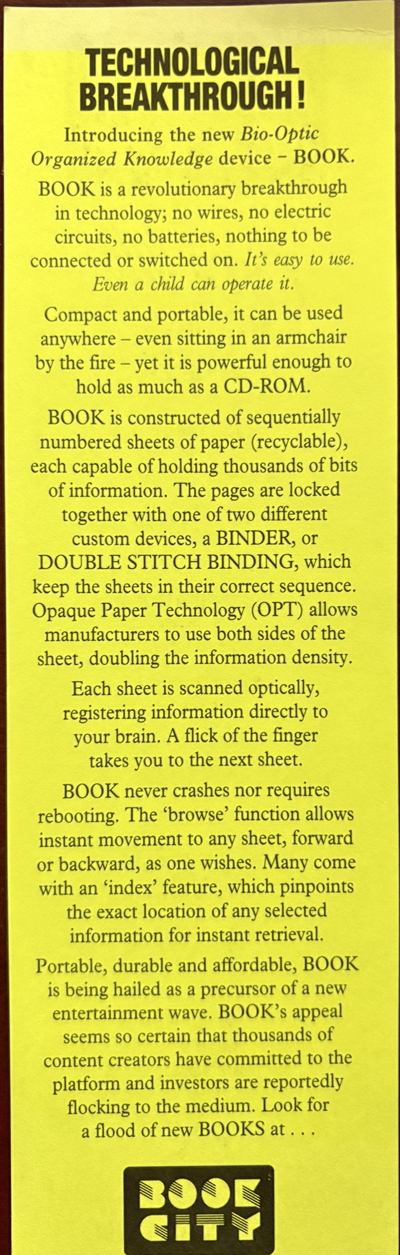
A decades-old bookmark from a Toronto Book City location (probably the store on the Danforth near Chester).
Can you imagine data storage that never needs an upgrade. Even better, there’s no subscription fee. And the system never crashes — there hasn’t been a single minute of down time in recorded history.
And there’s still more:
- There are no terms of service.
- No hidden fees.
- No customer service bots to deal with.
- No annoying follow-up spam emails and texts.
- No privacy intrusions or surveillance of any sort.
- No data incompatibility issues now or in the future.
- No advertising or solicitations of any sort.
The list continues — no cookies, no credit cards, no come-ons, no conditions. None of that.
What a miracle!
I’m talking about my favorite handheld device, and I don’t need a cloud to hold its contents. Just a shelf.
You guessed it — I’m referring to books. They’re the greatest hard storage concept in human history, and nothing else comes close.
The book is the ultimate killer app.
People have been predicting the death of the book for decades. The Internet was going to make them obsolete. But somehow they survived.
The launch of the Kindle in 2007 posed a bigger threat. Even I was convinced — at least for a while. I bought a Kindle and tried it out, plunging with enthusiasm into the world of eBooks and digital storage.
But a month later, I’d returned to physical books. It was a better experience in every way.
It didn’t help when Amazon started deleting books from Kindles. Much to the customers’ surprise, they learned that they didn’t own the book they had bought — they were merely “purchasing a license to the content“.
Access can be terminated. And Amazon is the ultimate terminator.
That’s never happened to any physical book on my shelf. I own thousands of them, and nobody has ever revoked my access. I can also sell or give them to others, and they will retain rights in perpetuity.
You can’t do that with a Kindle. You’re not allowed to sell an eBook. You can’t even donate it to a library. Your license is restricted and non-transferable.
But transferability is how books and literary culture survive. Books are supposed to move without friction across generations and borders and boundaries. Some books have had dozens of owners over hundreds of years — creating a legacy unknown in the world of digital technologies.
Even more insidious, Amazon will update books on your Kindle — changing the text without the reader or author’s permission. That’s happened, for example, to books by Roald Dahl, R.L. Stine, Ian Fleming, and Agatha Christie. If somebody in a position of power decides that an author’s work is problematic, your e-book gets cleansed.


