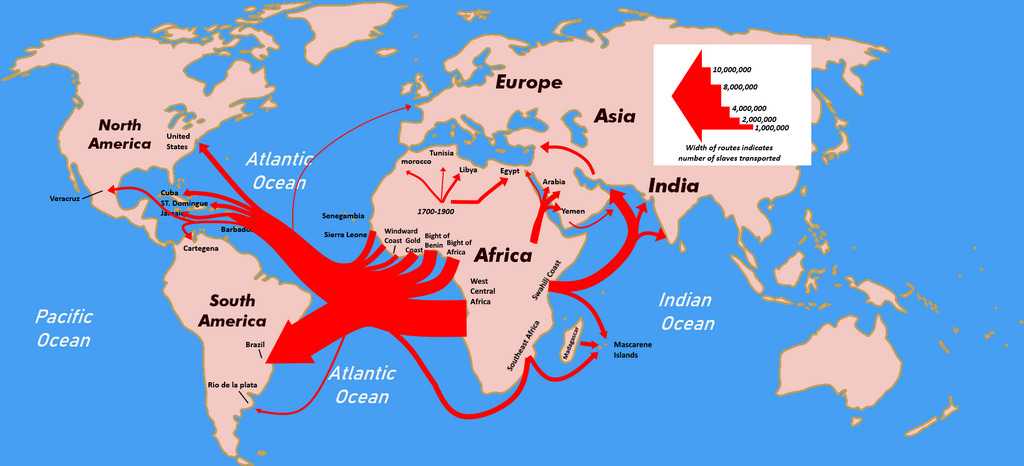
Lorenzo Warby digs deep into the “mountain range of bullshit” over the issue of plunder, as in the claims that the First World got that way by stealing everything they could from what became identified as the Third World:
I am using mainly European examples because it is the genetically (and archaeologically) best mapped continent. But these grim patterns are normal in the history of Homo sapiens. Consider, for example, the Bantu expansion across Africa that mirrors the march of Anatolian farmers across Europe.
The development of farming and animal herding led to the y-chromosome Neolithic bottleneck: a massive harrowing of male lineages that only about 1-in-17 male lineages survived. The development of farming and pastoralism created much higher populations plus plunderable assets. Folk developed much more coherent kin-groups. Teams of male warriors wiped each other out, taking the land, animals and women of the defeated as their spoils.
Plunder was thus endemic in farming and herding societies. The harrowing of male lineages came to an end via the development of chiefdoms and states. That is, the technology of exploitation — keep defeated males alive so they could breed more payers of tribute and taxes — overtook the technology of aggression (kin-groups).
States were both ordering and predatory. This process worked less well among pastoralists, as the need to defend the mobile assets of animal herds generated highly effective warriors who were harder to control or extract surplus from. Pastoralist states tended to be super-chiefdoms rather than full states and the harrowing of pastoralist male lineages continued, just at a lower level.
Africa was the continent of slavery because, being where Homo sapiens evolved, it was full of pathogens, parasites, predators and mega-herbivores that co-evolved with Homo sapiens, so could cope with them.1 This kept population density down. This meant that labour was more valuable than land. There was more potential wealth in grabbing able-bodied people than in grabbing land.
This made slavery endemic in Sub-Saharan Africa long before the Islamic, then the Atlantic, slave trades developed. Sub-Saharan African states were overwhelmingly slave states. Even those that were trade states traded in slaves.
The Atlantic slave trade looks like the most extreme pattern of Europeans plundering others — in this case, Sub-Saharan Africans. It was certainly true that the Atlantic slave trade was horrific and had multiple adverse effects on African society. But those adverse effects were to intensify patterns that already existed. Moreover, the original plundering of people by turning them into slaves was done by … Africans.
The life expectancy of a European who left the African coast was about a year: it was not practical for Europeans to do the original enslaving. They bought the slaves from Africans. This enabled the slave trade carried on by Catholics to conform to the Papal Bull Sublimis Dei (1537) which banned Catholics from enslaving the indigenous inhabitants of the Americas (and, by implication, elsewhere), but did not ban trading in, or owning, slaves.
Wikimedia Commons
Plunder was endemic across human societies: including turning fellow humans into plunder — aka slavery. It was sadly ordinary. It was not a European pattern, it was a Homo sapien pattern. The Islamic slave trade was on the same scale—given it operated for centuries longer — as the Atlantic slave trade, the Saharan passage was every bit as horrific as the Atlantic passage, and the Islamic slave trade had the extra horror of the castration of male slaves. Hence, there is not an ex-slave diaspora in Islam as there is in the Americas.
Just as plunder was endemic, so was poverty. Mass poverty was the norm across farming societies. While there were economic efflorescences across human history, and evidence of periods of sustained growth, the dramatic shifts to mass prosperity since the 1820s — since the application of steam power to railways and steamships — is utterly without precedent. Moreover, it started in precisely one society — Great Britain. None of the other Atlantic littoral societies of Europe showed any sign of such a take-off.
- The megafauna outside Africa — which did not co-evolve with Homo sapiens — almost all died out when Homo sapiens turned up.