
Quotulatiousness

August 21, 2025

Pure quill, 100% genuine Astroturf

Filed under: Media — Tags: , , , , , — Nicholas @ 04:00

You might almost think that Freddie deBoer isn’t a fan of pre-chewed, pre-digested “fandoms”:

brat summer was fake. That’s been my stance for a long while, and I’ve been encouraged recently to learn that I’m not alone in this belief — the belief that the whole Charli XCX “brat” phenomenon of 2024 was AstroTurf, a top-down media phenomenon driven fundamentally by marketing and the clicks-based media’s insatiable need for #content. There was clearly a carefully-coordinated rollout, with key pop culture websites and well-placed influencers shilling brat summer in suspiciously similar terms at the same exact time. And once the actual payola element was out there, once the PR apparatus had gotten the idea into the heads of early-middle-aged music and culture writers, those writers ran with it, in pursuit of the feeling of being out in front of a new craze and wanting to appear to be down with the kids. Someone told them brat was the new thing, they were filled with the FOMO anxiety that dictates their lives, and so they set about acting as though brat really was the new thing, faking it to make it.

This dynamic has been building for years now. The same basic Astroturf pattern was all over the “Barbiecore” moment. The movie itself was certainly popular and deserving of that popularity; it was fundamentally, existentially pretty good and frequently treated as much better than that, but it was still a fun and inventive story that was so much better than a movie based on a series of mass-produced plastic dolls had any right to be. But Barbiecore was fake. The Barbie discourse was fake. The idea that tweens were suddenly enraptured with the whole phenomenon, and particularly its confused brand of inoffensive feminism, was fake. There wasn’t some organic groundswell of pink-clad girl power erupting from the grassroots, but rather an omnipresent corporate campaign designed to manufacture the impression of inevitability. The movie itself was fine, sometimes clever, sometimes clumsy, good enough. But between the Mattel-driven branding blitz, the endless pink product tie-ins, and stunts like Ryan Gosling hamming it up at the Oscars, the film’s cultural footprint was artificially inflated. A popular movie was treated as a broader mass fandom movement that was in turn dressed up as a civilizational turning point, its supposed artistic influence dramatically overstated to serve commercial ends. In the end, Barbiecore didn’t demonstrate the power of art to shape culture so much as the ability of corporations to convince us that commerce is culture.

This is in fact the general condition of what’s now constantly sold as spontaneous collective vibes bubbling up out of TikTok comments and stan culture and the zeitgeist: prepackaged campaigns that combine paid marketing savvy with the cynical manipulation of our poptimism-obsessed cultural commentors, who are terrified of feeling left behind and always ready to buy into any new trend that’s sold as the obsession of the youth. There’s a press release behind every new trendspotting piece, a rollout schedule behind every claim of a new Gen Alpha aesthetic. There are people in glass towers in Manhattan and Los Angeles being paid six figures to decide what your summer will be, and then pretending that you, the amorphous online “fan,” actually decided it. It’s not the grassroots, it’s not organic, it’s not fun in the way subcultures used to be fun. It’s advertising.

Now, I’m a sad middle aged child of the 1990s who believes that selling out is real and bad and that authenticity is a fundamental and essential element of artistic creation and consumption; I believe in those widely-mocked old-school values, and I think my relationship to the art I create and consume is deepened because of that belief. But you don’t have to share my anachronistic artistic ethics to see why the death of organic pop culture appreciation matters. You just have to recognize that all of this ersatz fan enthusiasm creates a hollow kind of cultural participation. If every supposed craze is just a PR initiative with better branding, then what looks like bottom-up fandom is really just a slightly more insidious form of top-down messaging. You’re being asked to play along, to cosplay at authenticity, while the machine harvests your clicks and hashtags. Once again, the digital era’s ballyhooed capacity for citizen participation and “the long tail” has been crushed in favor of top-down control by giant corporations. The promise of the internet was that the gatekeepers would be dethroned, that cultural movements would erupt from the crowd. Instead, we’re living in a Potemkin village of virality where the audience is always the mark and the trick is always the same.

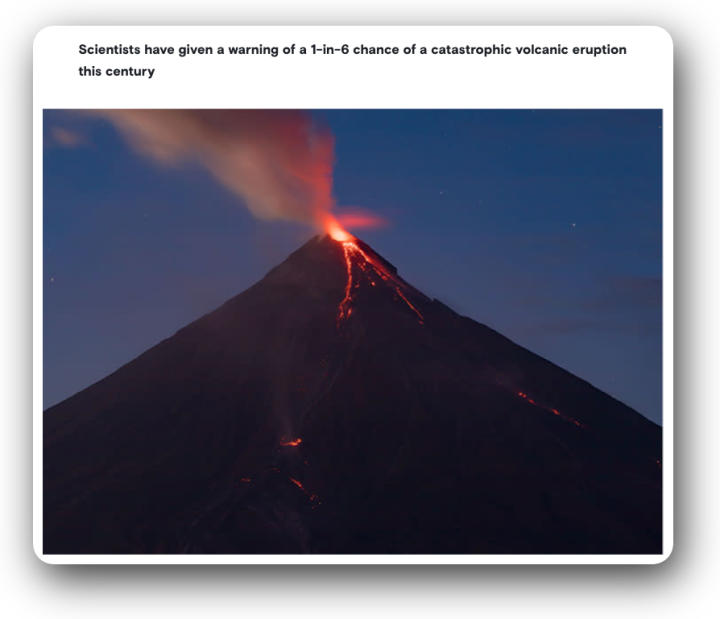
Most of us learned the “pull my finger” gag around grade 2, so why are so many of us still gullible about “scientists warn”?

Filed under: Media, Science, USA — Tags: , , , , — Nicholas @ 03:00

At Watts Up With That?, Willis Eschenbach warns us yet again about believing headlines that say things like “Scientists Warn!”

Only a journalist truly committed to the ancient art of panic-clickbait could squeeze all the world’s existential dread into a headline like, A Giant, Destructive Volcanic Eruption Is Set to Shake the World in the Coming Months, Bringing About the End of Mankind, Scientists Warn. They’ve accompanied it with the following graphic, in case you weren’t adequately terrified.

The dead giveaway? “Scientists Warn“. Whenever you see those two words sandwiched together above the fold, you know you’re about to step into a wonderland of wild extrapolation, qualified maybes, and models run so far into the future they boomerang back with “robots take over” as the y-axis.

They start out as follows:

    A detailed geophysical study published in Nature in by the U.S. Geological Survey (USGS) has refined our understanding of the Yellowstone supervolcano, uncovering new insights into its subsurface magma dynamics. Concurrently, climatological assessments by researchers such as Markus Stoffel (University of Geneva) have renewed discourse around the global systemic risks posed by a potential super-eruption — not only at Yellowstone, but at several other active volcanic complexes worldwide.

There’s an oddity here to start with. They’ve pushed together into one paragraph an actual scientific study of the Yellowstone caldera, and a paywalled puff piece by some random guy trying to frighten people about future eruptions. Unless you’re watching very closely to see which walnut the pea is under, it’s likely to be successful in making you think “Wow, a predicted super-eruption at Yellowstone, and the odds are high in other locations as well“.

Which does sound scary. So keep that thought in mind while we look at the first of the two parts they’ve pushed into one paragraph — the actual Yellowstone scientific study.

It’s the latest USGS study published in Nature under the very boring title “The progression of basaltic–rhyolitic melt storage at Yellowstone Caldera“. It gives us an upgraded, high-res CAT scan of Yellowstone’s magma plumbing. Instead of a giant pool of liquid doom sloshing under Wyoming, the new imaging shows a club sandwich: scattered blobs of partially molten rock, unevenly distributed, with most of the melt sitting in the northeast sector. The scale is impressive — 400–500 cubic kilometers of rhyolitic magma waiting for its cosmic moment. The heat just keeps bubbling up from below, slow and relentless, and with enough time, these melt zones might even hook up into a larger reservoir. But spoiler: no scientist anywhere is claiming that’s on tomorrow’s chore list.

Which brings us to the great, headline-grabbing “16% chance (one in six) of apocalypse by 2100” further down in the popular reports — a number that, if ever printed on a lottery ticket, would bankrupt Las Vegas. From the article:

    Still, climatologist Markus Stoffel and affiliated risk researchers estimate a ~16% probability of a VEI 7 or higher eruption occurring globally before the year 2100.

Except that particular prediction is not referred to by the scientists of the actual Yellowstone study, and has nothing to do with the Yellowstone study.

It comes from a some gentleman yclept Markus Stoffel. And he’s not even talking about Yellowstone. He’s talking about the entire planet. Nothing to do with Yellowstone.

And who is Markus when he’s at home? Is he a member of the team of authors of the Yellowstone study?

Nope.

Well, is he a vulcanologist?

Nope again.

He’s a climate professor at the University of Geneva. He’s published a lot, almost entirely regarding the effects of “climate change” on glaciers, mountain landslides, and mountain lakes.

Six Reasons Operation Market Garden FAILED

Filed under: Britain, Germany, History, Military, USA, Weapons, WW2 — Tags: , , , , — Nicholas @ 02:00

The Tank Museum
Published 3 April 2025

Operation Market Garden failed because the tanks of XXX Corps did not reach the Paras in Arnhem in time. Many historians have argued that the British armoured column “let the side down”. But is this actually true?

We reckon there are six reasons why the operation was a total disaster. It was a poor plan from the get-go, relying on a rate of advance that would outmatch the German invasion of France in 1940. Bad weather prevented the deployment of badly-needed reinforcements, and the terrain Guards Armoured were expected to traverse – a single road with impassable conditions on either side – significantly hampered the efforts of the tank crews.

Poor intelligence also meant that the British column was not prepared for resistance from a retreating and desperate German Army. It was a combination of all these factors that caused Market Garden to unravel completely.

Despite the complications, many acts of valour were carried out by both the airborne and armoured divisions, including the legendary assault across the Waal by the US 82nd Airborne.

So, join us as we explore these six reasons why Operation Market Garden failed and decide for yourself whether XXX Corps could have done anymore.

00:00 | Introduction
02:23 | #1 – A Bad Plan
06:22 | #2 – Poor Intelligence
07:51 | #3 – Difficult Terrain
11:27 | #4 – Determined Resistance
13:45 | #5 – Bad Weather
14:38 | #6 – Loss of Surprise
19:45 | What Went Wrong?
(more…)

QotD: Computer models

Filed under: Economics, Government, Media, Politics, Quotations, Technology — Tags: , , , — Nicholas @ 01:00

Should some sort of post-mortem ever be conducted on the catastrophic failure of all computer models, it will be done with the help of a computer model, that will cost billions in whatever currency to assemble. It will show the need for more computer studies. And therefore, it will be catastrophically wrong.

But note: for 100 dollars or negotiable, I will produce a minority report that will explain everything, infallibly. I will not preview the report in this Idlepost, however, because it might be worth money to me.

Aw, heck. Since I am rich beyond the dreams of avarice, let me just go ahead and blow all the beans. Let me recklessly tell gentle reader why computer models are always mistaken.

It is because their makers decide the result, before they design the model.

This does not mean they are self-interested phanatics, consciously preying on the gullibility of a drooling, ignorant public; although usually it does. For even if, by disposition, they are lofty, objective types, they will need, objectively, a lofty budget to perform a “credible” study. This means they must beg huge sums of money, and this will only be available from a source with an unhealthy interest in the result.

You see, the problem has nothing to do with computers. Even among humans, the phenomenon of “garbage in, garbage out” is well attested. The intention of following the evidence where it leads, is transient. I should think only a saint could sustain it, for longer than he could hold his breath under water.

David Warren, “A note on sternutation”, Essays in Idleness, 2020-06-19.

Powered by WordPress



