
In The Conservative Woman, Dr. Frederick Attenborough discusses the gap between what the Online Safety Act was intended to do and how it’s actually being enforced now that it’s the law of the land:
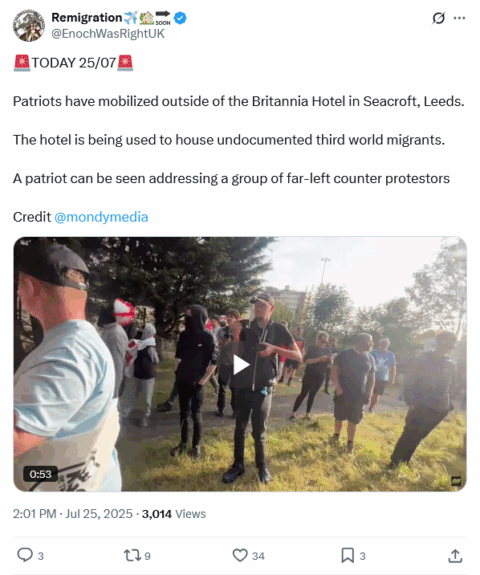
X posts like this may not be visible to uses in the UK under the age verification rules of the Online Safety Act.
At the heart of the regime is a requirement to implement “highly effective” age checks. If a platform cannot establish with high confidence that a user is over 18, it must restrict access to a wide category of “sensitive” content, even when that content is entirely lawful. This has major implications for platforms where news footage and political commentary appear in real time.
Ofcom’s guidance makes clear that simple box-ticking exercises, such as declaring your age or agreeing to terms of service, will no longer suffice. Instead, platforms are expected to use tools such as facial age estimation, ID scans, open banking credentials and digital identity wallets.
The Act also pushes companies to filter harmful material before it appears in users’ feeds. Ofcom’s broader regulatory guidance warns that recommender systems can steer young users toward material they didn’t ask for. In response, platforms may now be expected to reconfigure their algorithms to filter out entire categories of lawful expression before it reaches underage or unverified users.
One platform already moving in this direction is X. Its approach offers a revealing – and potentially sobering – glimpse of where things may be heading. The company uses internal signals, including when an account was created, any prior verification, and behavioural data, to estimate a user’s age. If that process fails to confirm the user is over 18, he or she is automatically placed into a sensitive content filtering mode. As the platform’s Help Center explains: “Until we are able to determine if a user is 18 or over, they may be defaulted into sensitive media settings, and may not be able to access sensitive media”.
This system runs without user opt-in and applies at scale. Depending on how X classifies it, filtered material may include adult humour, graphic imagery, political commentary or footage of violence. Already there are signs that lawful content is quietly being screened out.
One example came on July 25, the day the Act’s age-verification duties took effect, during a protest outside the Britannia Hotel in Seacroft, Leeds, where asylum seekers are being housed. A video showing police officers restraining and arresting a protester was posted on X, but quickly became inaccessible to many UK-based users. Instead, viewers saw the message: “Due to local laws, we are temporarily restricting access to this content until X estimates your age”.
West Yorkshire Police denied any involvement in blocking the footage. X declined to comment, but its AI chatbot, Grok, indicated that the clip had been restricted under the Online Safety Act due to violent content. Though lawful and clearly newsworthy, the footage was likely flagged by automated systems intended to shield children from real-world violence.
In The Critic, Christopher Snowdon explains the breakdown of trust between the British public and their government that the implementation of the Online Safety Act only exacerbates:
People are right to be concerned about this slippery slope and yet it cannot be denied that it is pornography enthusiasts who have been hardest hit by the Online Safety Act in the short term. They must now verify themselves in one of three ways, each less appealing than the last. They can submit their credit card details, they can scan in proof of ID, such as a passport, or they can take a photo of their face and allow AI to judge how old they are. If they want to maximise their chances of being the victim of blackmail and identity theft, they could do all three.
While we might not think twice about submitting our credit card details to Amazon or posting our photos on Instagram, there is an understandable reluctance to hand over private data in order to access dubious websites for the purposes of sordid acts of self-pollution. The government assures us that the data will be kept confidential but it is only two weeks since we learned about a data breach that led to the names of 19,000 Afghans who wanted to flee the Taliban being given to the Taliban and it is less than two months since the names and addresses of 6.5 million Co-op customers were stolen in a cyber-attack. Rightly or wrongly, millions of British plank-spankers and rug-tuggers do not wish to identify themselves to anybody.
The result is a surge in interest in Virtual Private Networks (VPNs) which allow internet users to access websites as if they were in a less censorious country. Half of the top ten free apps in Apple’s app download charts yesterday were for VPNs. Google Trends data show that searches for “VPN” have gone through the roof since Friday. Readers can draw their own conclusions from the fact that these searches have been peaking between midnight and 2am.
Downloading random VPNs comes with risks of its own and opens up a whole new world of illicit online activity from free Premier League football to the Dark Web. But there is a deeper reason to feel uneasy about this unintended, albeit predictable, consequence of paternalistic regulation. By driving another wedge between the state and the individual, it further normalises rule-breaking in a country where casual lawlessness is becoming part of daily life. A law-abiding society cannot long endure if the median citizen thinks that the law is an ass.
The breakdown of trust can be seen most clearly when the ordinary man or woman does not share the moral certainties of the governing class. Among smokers, a collapse in tax morale — the intrinsic motivation to pay taxes — has led to a huge rise in the consumption of illegal tobacco in recent years. Smokers no longer feel any obligation to pay taxes that are designed to impoverish them to a government that vilifies them. Cannabis smokers learn from an early age to be suspicious of a police force that they might otherwise respect. Motorists who are faced with 20mph speed limits that were introduced by people who hate private transport have no scruples about flouting the law.


