
The Korean War by Indy Neidell
Published 29 Jul 2025The Kaesong peace talks drag on, with the main sticking point being the Communist refusal to consider any demarcation line other than the 38th Parallel. UN Commander Matt Ridgway is asking for more force from home, but at least he get some organized force from elsewhere — as various brigades are organized into the 1st Commonwealth Division.
Chapters
00:00 Hook
00:21 Intro
00:56 Recap
01:22 UN Perspective and UN Needs
04:40 US Reserves?
06:31 The Commonwealth Division
09:44 38th Parallel or Nothing
15:03 Summary
15:16 Conclusion
(more…)
July 30, 2025
The Korean War Week 58 – The Empire Strikes Back – July 29, 1951
Comments Off on The Korean War Week 58 – The Empire Strikes Back – July 29, 1951
“The worst thing that can happen to a good cause is, not to be skilfully attacked, but to be ineptly defended”
On Substack, Johann Kurtz provides a great example of Bastiat’s insight (quoted in the title), as debaters ineptly defend the whole notion of masculinity, particularly how boys are victimized for being boys:
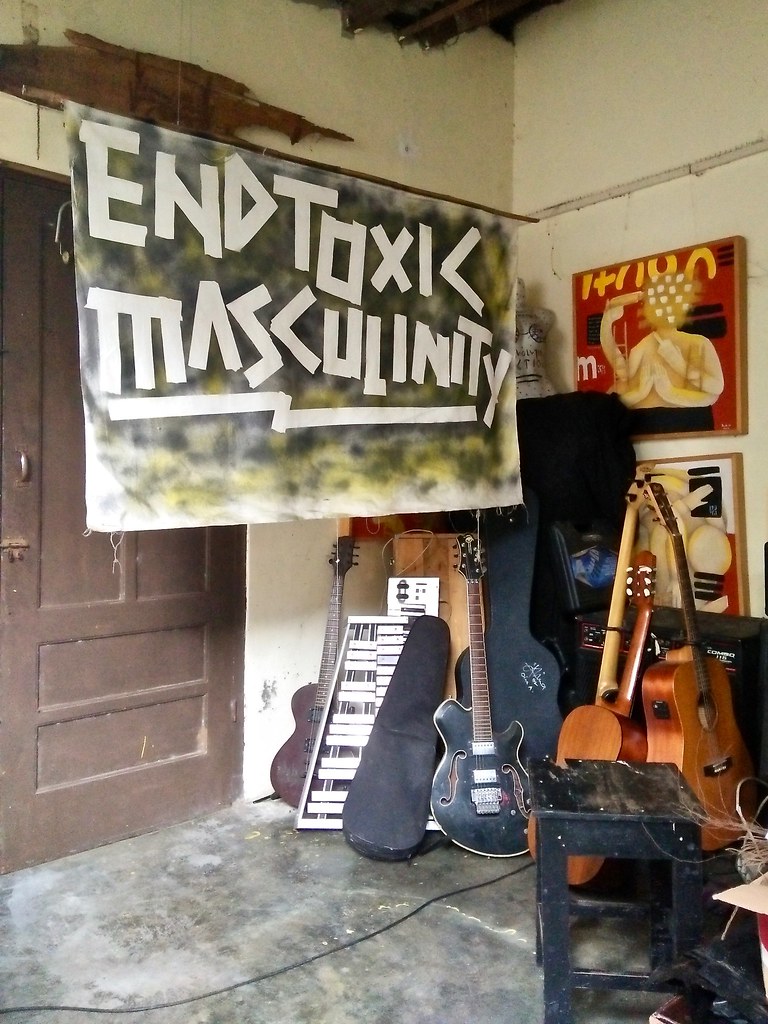
“End Toxic Masculinity” by labnusantara is licensed under CC BY-NC-ND 2.0


We’re failing our boys.
Two-thirds of young men feel that “no one really knows” them. Their real wages have been falling since the 1970s. They’re dropping out of education and the workforce in growing numbers. They die deaths of despair at almost three times the rate of women. Even their physical strength is collapsing.
Terrible solutions are proposed. No matter how much traditional masculinity is undermined, powerful voices continue to insist that the real problem is that it hasn’t been destroyed altogether. “Only then will boys be happy”.
My thesis for this series is that there is a need to defend true masculinity on its own terms, not on the implicit terms of progressives who either don’t understand it or actively hate it.
Take, for example, this debate at the Oxford Union on traditional masculinity. The opening argument of the opposition — who are supposed to be defending traditional masculinity — starts with asserting the need for a “contemporary and inclusive” masculinity which is accessible to anyone “of any race, sexuality, or other identity“.
The best defence that this speaker can mount on this anaemic foundation is an argument that masculinity is useful for activism and community building like the “Movember Foundation”. After this slightly pathetic case she goes back to conceding “being forced to conform to a set of expectations is uncomfortable and even dangerous. We should allow people to access the gender expressions that make them feel like their truest self.”
The next speaker for the defence of traditional masculinity continues the grovelling: “In 2019, you know, we should not be honouring and obeying men — those times have gone.” This talk is a little better — you get the sense that he actually likes men, and notes that it’s overwhelmingly men who die in wars and dangerous jobs — before collapsing back at the end: “We should look at new ways of being a man. I would love to get more men involved in teaching, in nursing — make it ‘cool to care’. I’ve been around Scandinavia talking to stay-at-home dads … These are progressive, beautiful men.”
The final speaker — who, again, is supposed to be defending traditional masculinity — takes the stage and begins: “Some of the most beautiful moments I’ve watched in young men’s lives are when we’re alone in a room — and maybe a brother who’s been struggling with his sexuality comes out in front of a hundred other brothers, and he’s crying, and his other brothers are crying with him“. You can imagine the rest.
None of this has anything to do with traditional masculinity. In this series I will advocate for the cultivation in boys of all of the aspects of masculinity that these “advocates” were afraid to defend: strength, aggression, dominance, stoicism, and risk-taking.
Comments Off on “The worst thing that can happen to a good cause is, not to be skilfully attacked, but to be ineptly defended”
History of Britain VI: Prime Roman Britain
Thersites the Historian
Published 13 Feb 2025Britain became a quietly productive part of the Roman Empire once the Celts of southern Britain were subjugated. This was the period when the Romans built cities, forts, and roads across the southern portion of the island. The good times corresponded with the Classical Optimum. However, after 150 or 200 CE, Britain was beginning to experience a decline in its material well-being.
Comments Off on History of Britain VI: Prime Roman Britain
QotD: Meetings of the Roman Republican Senate
Meetings of the Senate were formal affairs, but unlike modern legislatures the Senate did not stay in session over long periods. Instead, it met in specific venues – they had to be inaugurated – when called by a magistrate with the power to do so.
We may begin with place: the Senate had no single fixed meeting spot, though the curia in the Forum was the most common location, however the place the Senate met had to be religiously prepared via inauguration (the taking of the auspices by the augurs) and by sacrifices in order to make sure the gods approved of the proceedings and its results. Consequently, the Senate always met in a templum in the sense of a consecrated space, but also it tended to meet literally in temples, with meetings in the temples of Jupiter Optimus Maximus, the temple of Fides, the temple of Concord, and so on. Notably, two locations, the temple of Bellona and the temple of Apollo were also used and these sat outside the pomerium, enabling the Senate to meet with magistrates who, because of their active command of an army, could not cross the pomerium; they were also sometimes used to meet with foreign dignitaries the Senate did not wish to let into the city. Later added to this number of sites outside the pomerium was Pompey’s theater, which included a temple of Venus Victrix and a curia as part of the overall complex.
In order to meet, the Senate had to be called or more correctly “driven together” (cogere, often translated adequately as “summoned”, but as Lintott notes, it has an element of compulsion to it) by a magistrate. There were a few standard dates on which this would effectively always happen, particularly the first day of the consular year, but beyond that it was expected that magistrates in Rome could call the Senate at any time to discuss any issue on relatively short notice. There was initially no requirement that Senators live in the city of Rome, but it was clearly assumed. Early on in the second century, we get regulations requiring Senators to stay close to Rome unless they had an official reason to be elsewhere, though Senators might be permitted to leave if they needed to fulfill a vow. In the Late Republic it seems to have been common also for Senators to leave the city during the spring res prolatae, a sort of recess from public business (literally “the deferring of business”), but these informal breaks did not mean the Senate was truly “out of session” and it could still be summoned by a magistrate.
Generally, meetings of the Senate began at dawn, though they could begin later, and they proceeded either until the business was concluded or to dusk. Because of the ritual preparations required, no meeting of the Senate could last more than a day, much like the assemblies, so if the business was not finished, a new meeting would need to be called and the process begun from scratch. While it seems that magistrates generally tried to avoid calling the Senate during festival days, dies nefandi (days unsuited for public business) and meetings of the popular assemblies, there was no requirement to do so and the Senate might be called for any day for most of the Republic, with laws restricting the Senate’s meeting days only coming midway through the first century.
Beyond this, Senators were expected to show up and we hear of threats of fines or other censure for failure to show up, but it also seems like no meeting of the senate was ever very close to the full body and quorums for the Senate were fairly low, 100 or 150. For the Sullan Senate, notionally of 600 members, the highest attendances we know of, as noted by Lintott, are 415, 417 and 392. Of course some significant number of Senators will, at any time, have been active magistrates overseas, or serving as military tribunes, or as senatorial legati, but it seems clear that even beyond this attendance was not universal even if it was in theory supposed to be.
Bret Devereaux, “Collections: How to Roman Republic 101, Part IV: The Senate”, A Collection of Unmitigated Pedantry, 2023-09-22.
Comments Off on QotD: Meetings of the Roman Republican Senate


