
Britain, like Canada, has been moving toward a less free internet experience for ordinary users, the key bit of legislation in the UK being the Online Safety Act, which like Canada’s proposed Online Harms Act, provides tools to the government to clamp down on online activities they deem “unsafe”:
The free and open internet has now ceased to exist in the UK. Since Friday, anyone in Britain logging on to social media will have been presented with a censored, restricted version – a “safe” internet, to borrow the UK government’s language. Vast swathes of even anodyne posts are now blocked for the overwhelming majority of users.
The Online Safety Act was passed by the last Conservative government and backed enthusiastically by Labour. Both parties insisted it is necessary to protect children. Supposedly, its aim is to shield them from pornography, violence, terrorist material and content promoting self-harm. Age-verification checks, we were assured, would ensure that children would not be exposed to inappropriate content, but adults could continue using the internet as they please. Yet as we have seen over the past few days, on many major tech platforms, UK-based adults are being treated as children by default, with supposedly “sensitive” content filtered from everyone’s view.
Predictably, what is deemed “sensitive” and therefore censored goes well beyond pornography and obviously illegal or adult material. Already UK users of X have been blocked from viewing footage of an anti-asylum protest, a tweet calling for single-sex spaces and a video of a speech in parliament on the grooming-gangs scandal. Historical trivia, such as a thread on Richard the Lionheart, and classic artworks like Goya’s Saturn Devouring His Son have been shielded by the tech censors. A thread on X of examples of what has been censored under the Online Safety Act, collated by Benjamin Jones of the Free Speech Union, has itself been partially censored due to the Online Safety Act. Open, political debate online is now a thing of the past.
When the Online Safety Act was first put before parliament, supporters from all parties insisted that fears about its impact on free speech were overblown. “The worst misrepresentation I’ve heard is that the [Online Safety Act] will force tech companies to censor legal social-media posts”, insisted Chris Philp, the then minister for tech and digital economy, now the shadow home secretary, back in 2022. Anyone who warned that this vast new architecture of online speech regulation was obviously going to curtail free speech was presented as a friend of paedophiles, terrorists or the far right. This gaslighting was kept up right until the point the age filters were implemented. “The UK’s online safety regime is here. Will anybody notice?”, asked Politico the day before much of the internet disappeared. The Guardian, on the same day, pondered whether the new rules would be censorious enough.
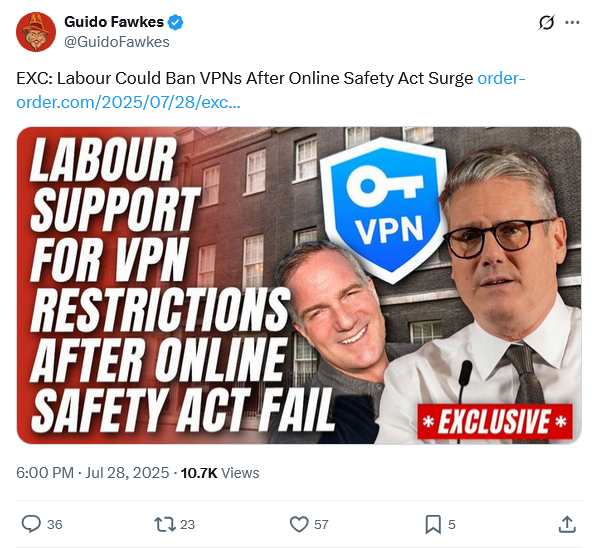
Despite my financial plight, I’d been considering getting a VPN subscription in advance of the Canadian government getting some version of the Online Harms Act onto the books. Clearly many Brits had already gone that route, and the British government reacts with the care and subtlety one would expect:



From the un-paywalled portion of today’s post by Andrew Doyle –
Comment by Nicholas — July 29, 2025 @ 11:39
The US tried that shit back in 1996 with the CDA, Communications Decency Act. It was successfully challenged by Annoy.com and others in the Supreme Court. A later try at dumbing the internet down to Saturday morning kidding cartoon status was COPA, the Children’s Online Protection Act. Totalitarianism “for the children” don’t you know.
http://annoy.com/history/
Comment by Hogeye Bill — July 29, 2025 @ 11:45
Canada’s equivalent hasn’t gotten past Parliament … yet … but we can hope that the bad example being set by Britain will galvanize resistance to this kind of censorship regime being adopted on this side of the pond.
Comment by Nicholas — July 29, 2025 @ 13:38