
In The Line, Mike Colledge considers how Trump has managed to change the political environment that used to be fairly well described by the Overton Window:
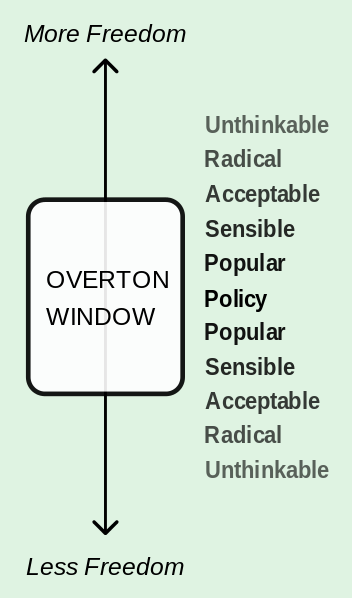
Diagram of the “Overton Window”, based on a concept promoted by Joseph P. Overton (1960–2003), former director of the Mackinac Center for Public Policy. The term “Overton Window” was coined by colleagues of Joe Overton after his death. In the political theory of the Overton Window, new ideas fall into a range of acceptability to the public, at the edges of which an elected official risks being voted out of office.
Illustration by Hydrargyrum via Wikimedia Commons
The Overton Window, named after Joseph Overton of the Mackinac Center for Public Policy, is used to explain how policy ideas gain acceptance and move from idea to policy. The “window”, as Overton saw, could include a wide range of ideas from those with little to no support to those that have matured, gained public traction, and could be supported by the public as legitimate policy options for governments. The “window” was not static. It could — and did — shift, expand, or contract based on social movements, economic pressures, cultural trends, and/or the actions of leaders in the public and private sectors.
Those who wanted to push ideas into the window and gain acceptance and support usually had to spend considerable effort — and sometimes years — promoting and making the case for their cause and moving it into the mainstream. Al Gore’s documentary An Inconvenient Truth and Greta Thunberg’s ongoing efforts to push for action on climate change are examples of leaders using their profile to push and keep climate change action in Overton’s Window.
Lately, though, it feels like the Overton Window has been replaced by the Trump Door. While Overton observed and studied what was happening, Trump is more of an active participant. Overton provided us with an analytical framework; Trump’s door is more of a tactical approach.
And this is a big change. The world moves much faster than it did in the mid-90s when Overton first created his “window”. The democratization of communications and the speed of communications means anyone can comment, report, or share an opinion instantly (and often without considering the consequences). Increased polarization means that leaders looking to act and to reinforce support for their desired policies do not have to wait for a majority to support a given policy before they act. They merely need a vocal plurality of their own supporters to move forward with an idea.
Trump hasn’t so much smashed the window as he has replaced it with a large swinging Western saloon-style door. He has shown no interest in framing and positioning an issue for the public’s consideration in hopes of building support from a majority. He is throwing ideas into and out of the public-consideration saloon as fast as possible. Some ideas he throws in as distractions. Others he throws in as announcements of his intent regardless of the public’s perspective.
To those of you saying in your head “I don’t think Trump thinks this deeply about what he is doing,” you could be correct. But the net impact of his actions is the creation of a Trump Door that, unlike a window, is not transparent and, again unlike Overton’s Window, is not about building public acceptance. It is a tool to achieve his goals as fast as possible. When obstacles require a shift in policy — given there is no need to engage the public — he simply throws another idea into the saloon.


