
The more I read about the state of male-female interactions on the dating scene (such as it is), the more grateful I am that I’m decades out of that killing ground. Male survivors have clearly decided that the risks are far greater than the potential relationship rewards and individually withdrawn in large enough numbers that the “dating scene” is a shadow of what it once was in the pre-swipe-left era. Janice Fiamengo responds to a “men, come back!” plea from Rachel Drucker in the New York Times:
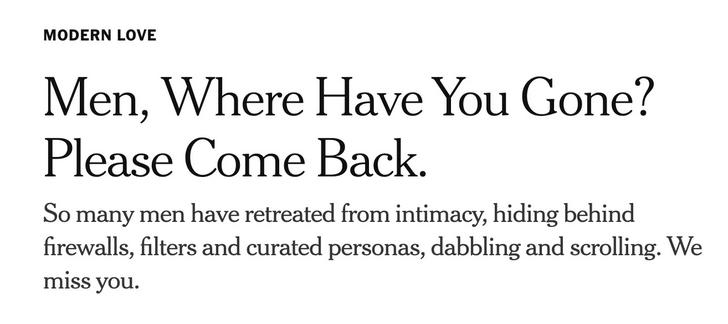
The question of where men have gone, in the title of Rachel Drucker’s New York Times op/ed, is surely disingenuous. Drucker thinks she knows: men have disappeared into social media posting, digital lurking, uncommitted sexting, and porn. Allegedly afraid of emotional intimacy, they are no longer “showing up” for women. Drucker addresses men directly, diagnosing their feelings: “You’ve retreated — not into malice, but into something softer and harder all at once: Avoidance. Exhaustion. Disrepair.”
Well, maybe. Maybe not.
Drucker’s article is part social lament, part personal ad, and like many statements by modern women about men, it is notable for its presumption. Drucker seems to think she can call off the sex war simply by saying she’s had enough. Men were never supposed to stop being available to women. Drucker mourns a lost time when men “asked questions and waited for the answers”, when they “listened — really listened — when a woman spoke”. It doesn’t seem to occur that men have been listening and have heard women’s messages, loud and clear.
Drucker goes so far as to express nostalgia for a time of male sexual pursuit, when having a woman on one’s arm was a way for a man to prove himself and impress other men. “It wasn’t always healthy”, she says in one of her many massive understatements (ignoring the barrage of condemnation leveled against such men) “but it meant that men had to show up and put in some effort”.
Drucker produces no evidence of men’s lack of effort, and it is not clear that her personal anecdotes — all culled, it seems, from her monied Chicago milieu — are representative. I know many men, including young men, who are still willing to pursue romantic relationships with women; many put in a lot of time and thought. But it does ring true that at least some portion of men are far more wary than in previous eras, unwilling to risk the potential hell of divorce or of a false accusation in a culture that believes women and belittles men.
Some men have simply come to the conclusion that modern women aren’t, in general, all that likable — neither marriage material nor viable candidates for motherhood.
As far as female pronouncements about men go, Drucker’s piece is not the worst. It does not hector or accuse (at least, not much), and Drucker expresses some genuine liking for men. But it’s not clear how much that is worth when she is so oblivious to men’s points of view and unaware that at least some of the onus for re-engaging men must fall on women. Drucker’s blind spots and unearned certainty turn her wistful dirge into a tone-deaf commentary on contemporary sexual politics.
The article begins with a restaurant, where Drucker notes the absence of men. There are women together, doing what women do, but almost no coupled men. And in her own life, Drucker notes, there has been retreat. It isn’t just her, she’s sure: it’s a collective act in which men are removing themselves from women’s lives, no longer “trying to connect”.
Drucker is part of the problem, though she doesn’t seem to recognize it. She admits that she “spent over a decade” working for Playboy and more hardcore sites to get men addicted to digital pornography. Part of her job was “to understand exactly what it took to get a man to pay for content he could easily find for free”. She does not seem to regret this work or recognize its damage; on the contrary, she exults that it helped her understand men’s deepest selves.
Her characterization is simplistic and contemptuous: “We knew what worked”, she boasts. “It wasn’t intimacy. It wasn’t mutuality. It was access to stimulation — clean, fast and frictionless. In that world, there’s no need for conversation. No effort. No curiosity. No reciprocity.”
If this is what men fundamentally are to Drucker — sex bots without emotion or desire for reciprocity — why is she so disappointed that they are no longer around?



Yeah…. I’m with you on the killing ground comment. A female acquaintance of ours decried the insincerity of men on dating sites, meaning that they were married, misrepresented themselves, and/or wanted one-night stands, etc. I don’t imagine I’d hit a digital meet-market to find a serious relationship. I’d go the old-fashioned way – know anyone I might find interesting and vice versa?
May I never need to walk that route!
Comment by Wm Plante — July 14, 2025 @ 12:23
It’s old hat to lament the place men occupy in the traditional dating world, but there was a book published several years ago by a lesbian who disguised herself as a man to discover the “real story” about male privilege. She was horrified at the way men were treated by women — to the point that she found herself developing misogynistic feelings after being brutally rejected by multiple women. One reviewer noted with a certain degree of amusement:
Comment by Nicholas — July 14, 2025 @ 12:46