
In Quillette, Ronald Radosh reviews the long-awaited biography of arch-conservative William F. Buckley by his friend Sam Tanenhaus, Buckley: The Life and the Revolution That Changed America:
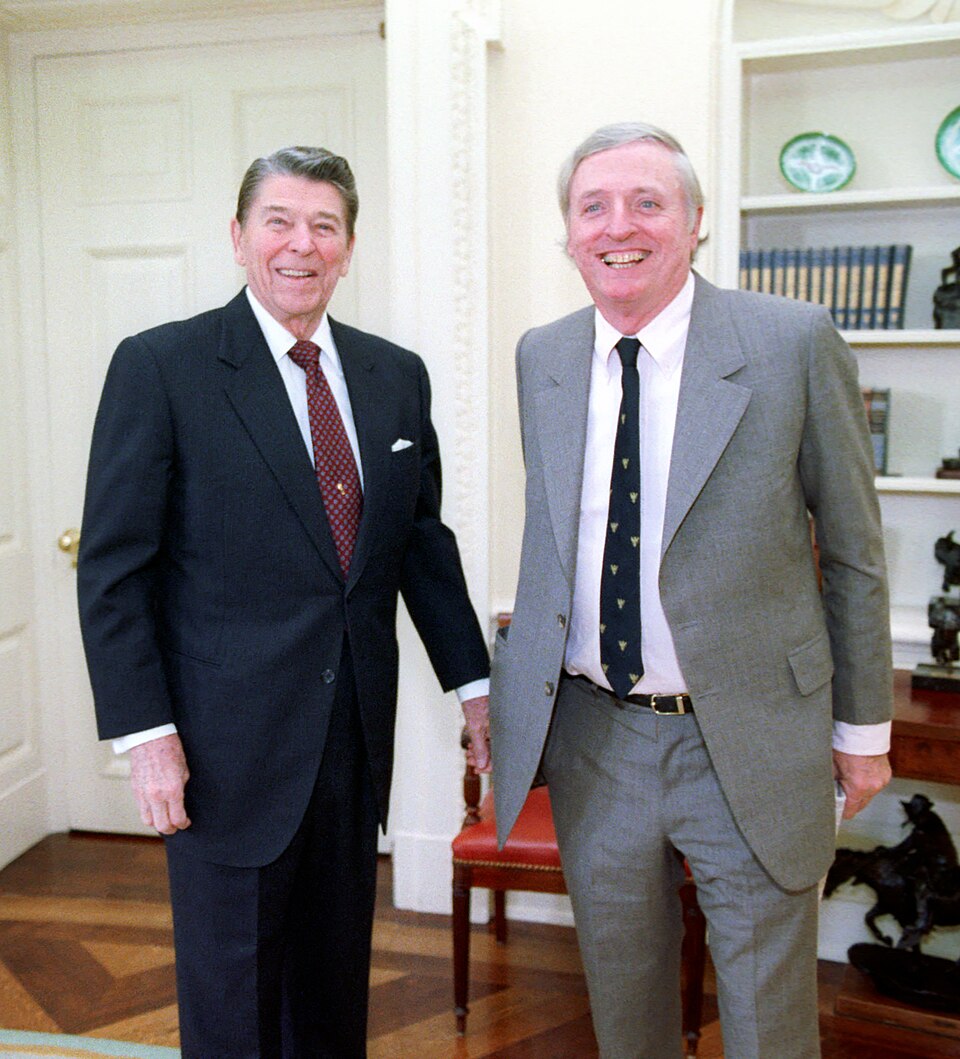
President Reagan meeting with William F. Buckley in the White House, 21 January, 1988.
Photo from the White House Photographic Collection via Wikimedia Commons.
William F. Buckley Jr. was a polymath of unusual erudition. The author of scores of books (including nearly two dozen novels), Buckley was an ardent apostle of conservatism at a moment when American liberalism was ascendant. But he was also an accomplished musician who played the harpsichord, a sailor who entered competitions and spent most summers on the sea, and an avid skier who spent his winters on the slopes of Gstaad after a morning of writing. Most Americans knew him as the host of a weekly television talk show called Firing Line, in which he interviewed and debated a wide range of politicians and intellectuals, most of whom he vehemently but politely disagreed with. (Many of these episodes are now available to view on YouTube.)
Television allowed Buckley to display his not inconsiderable wit and charm. He interviewed prominent socialists like both Norman Thomas and Michael Harrington, but he invited fellow conservatives onto his show as well. He had fellow conservatives on his show too, but he particularly relished debates with ideological opponents like Julian Bond (the young black leader of the Student Nonviolent Coordinating Committee), author Norman Mailer, journalist Christopher Hitchens, Ramparts editor Robert Scheer, and leaders of the Black Panther Party. The only people he would refuse to debate, he told the TV network, were communists lest he lend them legitimacy. Agents of the Soviet Union, he maintained, were not worth engaging with.
Buckley’s other major accomplishment was founding and editing America’s first nationwide conservative magazine. The bi-weekly National Review was the conservative counterpart of the influential liberal publications of the day, including the New Republic, The Nation, The Reporter, and the New Leader. Those liberal magazines all had rather small circulations but they also had the field to themselves until Buckley’s NR came along. Buckley hired a roster of old-style conservatives and ex-communists, including the former Trotskyist James Burnham, the former Communist agent (and accuser of Alger Hiss) Whittaker Chambers, Willi Schlamm, and Frank Meyer. As time went by, he added prominent young conservatives to the magazine’s masthead, many of whom would go on to become political leaders in the new American conservative movement. His prize protégé may have been Gary Wills, who eventually left NR‘s ranks and, much to Buckley’s disappointment, became an influential American liberal. Other NR contributors went on to become important American essayists and authors in their own right, like Joan Didion, George Will, and John Leonard, who edited the New York Times Book Review during the 1970s.
Buckley was the scion of a wealthy Connecticut family with a great estate in Sharon, Connecticut, that his father William F. Buckley Sr. named “Great Elm”. However, Buckley Sr. was also a Texan who identified closely with the American South, and after he made his fortune speculating in oil in Mexico and Venezuela, he purchased a mansion in Camden, South Carolina, for use during the cold Eastern winters. He named it Kamchatka, and the neighbouring residents, Tanenhaus writes, embraced the family “as Southerners who had come home”. Kamchatka had previously been the home of a Confederate general and senator who left office when Lincoln was elected President in 1860, but Camden would play an important role in the civil-rights movement.
By the 1950s through the ’60s, Tanenhaus writes, “the institution of Jim Crow — the legacy of slavery, the Civil War and Reconstruction — was being shaken at its foundations”. In the ’50s, the nation learned about the brutal murder of fourteen-year-old Emmet Till and massive protests by the black population began to appear across the South. The liberal magazines of the day covered the rise of the civil-rights movement and did what they could to mobilise Northerners in support of Southern blacks. In the deep South, activist efforts culminated in the famous Freedom Summer movement for black-voter registration in 1964. Camden, too, became the centre of a massive resistance movement.
Yet all this political and social upheaval never received a word of positive coverage in the pages of National Review. The reason for this was not complicated. Buckley’s family believed that “race was a settled question” and that racial separation was justified “as a matter of law as well as custom”. The Buckley family, of course, hired black help for their Camden mansion, whom they treated with respect and support. But members of the “Negro” race, as blacks were then called, had to know their place. So, Buckley wrote a number of unsigned editorials in February 1956 defending the South’s “deeply rooted folkways and mores”. The South, he argued, “believes that segregation is the answer to a complex situation not fully understandable except to those who live with it”, just as his own parents and siblings did. He vigorously objected to the Supreme Court’s verdict in 1954 outlawing segregated schools in Brown v. Board of Education, and he wrote editorials arguing that the Court’s decision was not an interpretation of the Constitution but rather “a venture in social legislation.”
In Camden, meanwhile, the Buckley family started and financed a newspaper called the News, which was meant to be a vehicle for the white South’s racist population and their “Citizens’ Councils”. Instead of burning crosses and lynching, the Councils preferred to use “legal threats, economic harassment, and public denunciation” in defence of segregation. In one case, a business owned by a black protestor was destroyed and his family harassed by the Council, after the owner tried to register to vote. As the violence in Camden became more extensive and widely reported, Buckley responded with an unsigned NR editorial on 10 January 1957 in which he argued that “the Northern ideologists are responsible for the outbreak of violence”. He did also condemn the “debasing brutality” of the white population’s behaviour, and for years, that remark remained his strongest condemnation of white violence. He continued to ignore the support provided to the Councils by South Carolina authorities.
One of Tanenhaus’s most stunning revelations is that, in 1956, Buckley dispatched an NR contributor to report on the National States’ Rights Conference in Memphis. The man he sent was one Revilo Oliver, whom Tanenhaus correctly describes as “a fanatical racist and anti-Semite”. The following year, NR published Buckley’s most infamous editorial, titled “Why the South Must Prevail”. The white community, he wrote, had a right to defend segregation because “for the time being, it is the advanced race”. The white South, he wrote, “perceives important qualitative differences between its culture and the Negroes’; and intends to assert its own”. And since NR “believes the South’s premises are correct”, the black population could justifiably have its interests thwarted by “undemocratic” but “enlightened” means. That editorial, Tanenhaus rightly notes, “haunts [Buckley’s] legacy, and the conservative movement he led”. Buckley also believed that if suppression of the black vote violated the terms of the Fourteenth Amendment, then that and the Fifteenth Amendment should be considered unconstitutional — “inorganic accretions to the original document, grafted upon it by victors-at-war by force”.


