
The Roman response to Pyrrhus’ initial arrival was hardly panic. Military operations in Etruria for 280, under the consul Tiberius Corucanius, continued for the year, while the other consul, Publius Valerius Laevinius, went south to fight Pyrrhus and shore up Rome’s position in Southern Italy. We don’t have clear numbers for the size of the armies at Heraclea – Plutarch stresses that they were big (Plut. Pyrrh. 16.3) – but I think it is fair to suppose that Lavinius probably has a regular consular army with two legions and attached socii, roughly 20,000 men. It has sometimes been supposed this might have been a double-strength army (so 40,000 men) on the basis of some of our sources (including Plutarch) suggesting somewhat nebulously that it was of great size.
There are a few reasons I think this is unlikely. First, sources enlarging armies to fit the narrative magnitude of battles is a very common thing. But more to the point, Pyrrhus has crossed to Italy with 28,500 men total and – as Plutarch notes – hasn’t had a chance to link any of his allies up to his army. That may mean he hasn’t even reabsorbed his scouting force of 3,000 and he may well have also had to drop troops off to hold settlements, secure supplies and so on. Pyrrhus’ initial reluctance to engage (reported by Plutarch) is inconsistent with him wildly outnumbering the Romans, but his decision to wait for reinforcements within reach of the Romans is also inconsistent with the Romans wildly outnumbering him. So a battle in which Pyrrhus has perhaps 20-25,000 men and the Romans a standard two-legion, two-alae army of 20,000 give or take, seems the most plausible.1
The two forces met along the River Siris at Heraclea on the coastal edge of Lucania, Laevinius having pushed deep into southern Italy to engage Pyrrhus. As usual for these battles, we have descriptions or partial descriptions from a host of sources (in this case, Plutarch, Dionysius of Halicarnassus, Zonaras, Florus) which don’t always agree, leaving the modern historian in a bit of a pickle. Generally, we assume that a lot of the later Roman narratives of a famous defeat are likely to have been tailored to try and minimize the embarrassment, either by implying the battle was closer than it was or that Pyrrhus was a very impressive foe (or both) or other “face-saving” inventions. Worse yet, all of our sources are writing at substantial chronological distance, the Romans not really having started to record their own history until decades later (though there would have been Greek sources for later historians to work with). Generally, Patrick Kent tends to conclude that – somewhat unusually – Plutarch’s moralizing focus renders him more reliable here: Plutarch feels no need to cover for embarrassing Roman defeats or to embellish battle narratives (which he’d rather keep short, generally) because his focus is on the character of Pyrrhus. Broadly speaking, I think that’s right and so I too am going to generally prefer Plutarch’s narratives here.
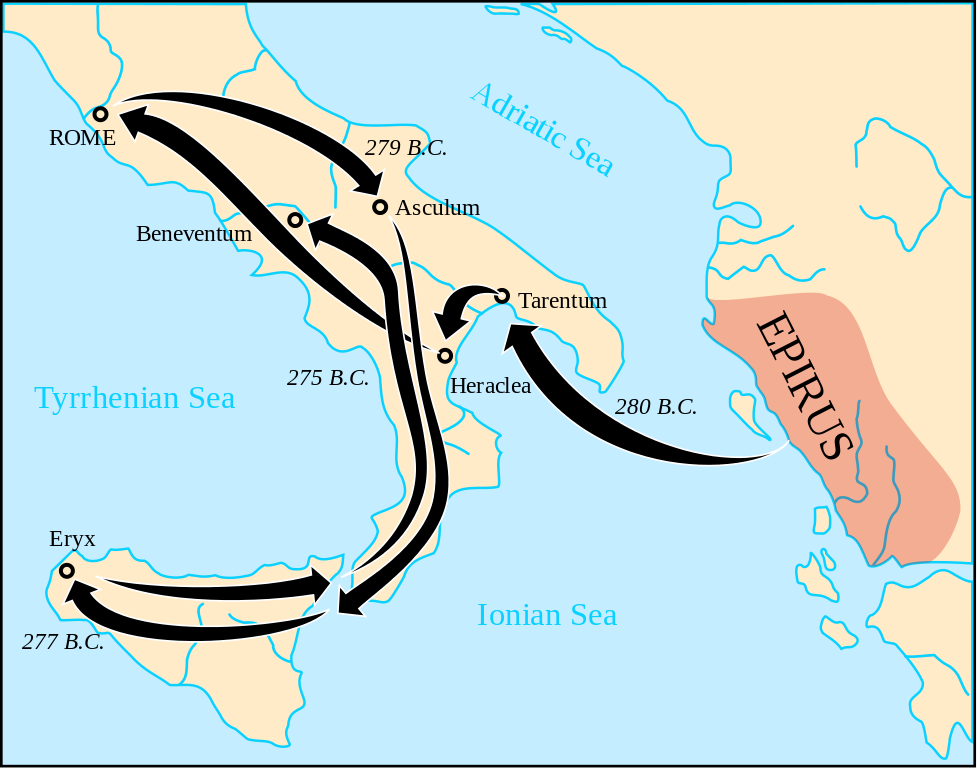
A fairly handy map of Pyrrhus’ campaigns (though some of the detail is lost in the big sweeping arrows). What is notable is, apart from Pyrrhus’ lightning raid into Latium in 280, he is almost invariably fighting in “friendly” territory, either in Lucania (Heraclea), Apulia (Asculum) or Samnium (Beneventum), the lands of his allies. Pyrrhus never fights an actual pitched battle on Roman-controlled territory, which I think speaks to his strategic intent: to carve out a kingdom in Greater Greece, not to conquer the whole of Italy.
Wikimedia Commons.The battle was defined by Pyrrhus’ use of terrain – Pyrrhus thought delay might be wiser (to link up with his allies) but left a blocking force on the river (the Romans being on the other side). The Romans responded by forcing the river – typical Roman aggression – but Plutarch at least thinks it caught Pyrrhus by surprise (he hadn’t fought Romans before) and so it leaves him in a scramble. He charges his cavalry (Plut. Pyrrh. 16.5) to give his main phalanx time to form up for battle resulting in what seems like a cavalry engagement near the river. Pyrrhus nearly gets himself killed in the fighting, but survives and falls back to his main infantry force, which then met the Romans in an infantry clash. The infantry fighting was fierce according to Plutarch and Pyrrhus, still shaken from being almost killed, had to come out and rally his troops. In the end, the Romans are described as hemmed in by Pyrrhus’ infantry and elephants before some of his Greek cavalry – from Thessaly, the best horse-country in Greece – delivers the decisive blow, routing the Roman force.
It is, on the one hand, a good example of the Hellenistic army “kit” using almost all of its tactical elements: an initial – presumably light infantry – screen holding the river, followed by a cavalry screen to enable the phalanx to deploy, then a fierce and even infantry fight, finally decided by what seems to be flanking actions by cavalry and elephants. Plutarch (Pyrrh. 17.4) gives two sets of casualty figures, one from Dionysius and another from Hieronymus; the former says that the Romans lost 15,000 to Pyrrhus’ 13,000 killed, the latter that the Romans lost 7,000 to Pyrrhus’ just a bit less than 4,000 killed. The latter seems almost certainly more accurate. In either case, the Roman losses were heavier, but Pyrrhus’ losses were significant and as Plutarch notes, his losses were among his best troops.
Even in the best case, in victory, Pyrrhus had lost around 15% of his force (~4,000 out of 28,000), a heavy set of losses. Indeed, normally if an army loses 15% of its total number in a battle, we might well assume they lost. Roman losses, as noted, were heavier still, but as we’ve discussed, the Romans have strategic depth (in both geography, political will and military reserves) – Pyrrhus does not. By contrast, Alexander III reportedly wins at Issus (333) with just 150 dead (and another 4,802 wounded or missing; out of c. 37,000) and at Gaugamela (331) with roughly 1,500 losses (out of c. 47,000). The Romans will win at Cynoscephelae (197) with just 700 killed.
This isn’t, I think, a product of Pyrrhus failing at all, but rather a product of the attritional nature of Roman armies: even in defeat they draw blood. Even Hannibal’s great victory at Cannae (216) costs him 5,700 men, according to Polybius (more, according to Livy). But the problem for Pyrrhus is that his relatively fragile Hellenistic army isn’t built to repeatedly take those kinds of hits: Pyrrhus instead really needs big blow-out victories where he takes few losses and destroys or demoralizes his enemy. And the Roman military system does not offer such one-sided battles often.
Nevertheless, Pyrrhus shows that a Hellenistic army, capable handled, could beat a third-century Roman army, albeit not cleanly, and that is well worth noting.
Bret Devereaux, “Collections: Phalanx’s Twilight, Legion’s Triumph, Part IIIb: Pyrrhus”, A Collection of Unmitigated Pedantry, 2024-03-08.
1. I should note, this is Kent’s assessment as well.
July 11, 2025
QotD: Pyrrhus arrives in Magna Graecia to support the Tarantines
Comments Off on QotD: Pyrrhus arrives in Magna Graecia to support the Tarantines
No Comments
No comments yet.
RSS feed for comments on this post.
Sorry, the comment form is closed at this time.


