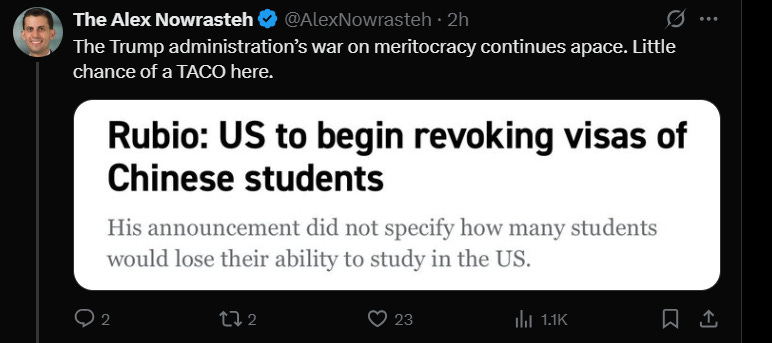
Theophilus Chilton takes on the progressive arguments for bringing in as many “high quality” immigrants as humanly possible from his own professional background:
One of the constants that you can count on in any debate about the value of immigration (of every sort) is the inevitable assertion about the NECESSITY of immigration. Immigrants POWER AMERICA. Without them, NOTHING WOULD HAPPEN! They are ELITE HUMAN CAPITAL without which the White American chuds who did things like build the atom bomb and otherwise created modern technological civilisation would barely be able to keep the lights on in their single-wides. It’s not just that immigrants want a new life or might be useful — they are an absolutely necessity and the ones coming here are the cream of the world’s crop.
As a result, the recent move by Marco Rubio and the State Department to revoke visas from Chinese students in American universities (especially those associated with the CCP or who are in positions to commit especially damaging industrial espionage) will certainly not be well-received by this crowd. For example, witness Alex Nowrasteh, who’s whole schtick is to burble on about “meritocracy” and whine about “affirmative action for White Americans” while filling a useless sinecure at the Cato Institute that he got by being the token immigrant. He is appalled that we’d act in our own national interest rather than in the interests of a bunch of random foreigners.
Immigration man have big sad
Many people who know me on X already know this, but most readers here may not. Before I made a radical life-changing vocational choice a few years ago, I used to be a scientist in Big Pharma. For a little over two decades, I worked in the biotech/biopharma industry, covering a wide range of drug development stages and product types. I’ve developed vaccines (which is why I was skeptical about the Covid vaxx from the very beginning). I’ve developed small molecule drugs. I helped to bring to market several of the pharmaceuticals that millions take regularly and which you see advertised on television. I’ve done everything from bench scale analytical work to protein purification on 5000-liter batches used in support of human clinical trials. I’m proficient in literally dozens of different analytical techniques. Before that, in both undergraduate and graduate school, I specialised in synthetic organic small molecule development across a number of different subspecialties. And I’m good at all of this.
One other thing that I did throughout was work side-by-side with, and later manage, LOTS of visa holders and immigrants, especially from “tech heavy” countries like India and China, the stereotypical “H1-Bers”. As a result, I consider myself to be a pretty good judge of the value which visa holders bring to tech fields.
My judgment is, and has been for decades, that their value is minimal and it certainly does not live up to the hype. Indeed, one of the constants that I observed among most Indian, Chinese, and other visa holders was that they did not really, truly understand the science that was involved with the products being developed and the techniques being used to develop and test them. Most of these folks were the living embodiment of cramming to pass the test. When the test methods and the SOPs being employed were straightforward, these folks were great. They had a robot-like efficiency that comes with repetitively doing the same thing over and over and over again. Unfortunately, for anything requiring innovative or independent thinking, they’d be totally lost. If results from a test deviated from expectations and required some commonsense interpretation? That’s where the wheels came off. I mean, there was little to no capacity to deal with anything that wasn’t completely textbook.
Even basic scientific sense was often missing. At one job, there was an Indian guy who would takes dumps in the bathroom and then walk straight out back to his manufacturing suite in the cell line division without even washing his hands. I know this because I observed it for myself several times. I mean, even if you don’t care about getting fecal coliform bacteria all over door handles and whatnot, at least don’t carry them back into the suite where you’re helping to grow batches of genetically engineered E. coli. I assume he was properly gowned before going in, but still, there’s just that basic lack of sense there.
And then there are the ethics (or lack thereof) displayed by many visa holders (especially Chinese and Middle Eastern). Data manipulation, tweaked results, etc. etc. These tend to occur because both of those groups are under intense social pressure within their own cultures to “get the right results” rather than just dealing with the results you get. The “tiger mom” mentality carries over into the workplace. There is a reason for why these two groups are disproportionately overrepresented on the FDA’s debarment list. Indians can be subject to serious lapses in integrity as well, though theirs tend to revolve more around cutting corners and mistreating underlings, as I illustrated in a thread on X about three years ago where I recounted my time working for an Indian-owned company.
Over the years, my observations have been substantiated and reiterated by any number of people in various tech-heavy industry to whom I’ve related them. Whether it’s pharma or IT or medicine or metallurgy or whatever else, the familiar story is told. It’s really, really difficult to reconcile this mass of lived experience with the theoretical assertions made by people like Nowrasteh that immigrants are this valuable resource that we absolutely need to be or remain competitive in world markets.
In effect, the goal with this type of white-collar mass immigration is to “roboticise” tech fields which can’t be given over to AI or actual robotics just yet. The formula is to import masses of workers who can simply follow a script and save companies money on labour costs. If you think about it, this is really a low IQ, high time preference approach by corporations whereby they sacrifice real innovativeness and future competitiveness for short-term savings. I’d argue that the entry of H1-B and other visa holders in large numbers into American tech industries which accelerated around the late 2000s-early 2010s has actually led to a slowdown in real innovation. We may have tons of new apps for our phones, but fewer truly groundbreaking advances in tech across the board.